
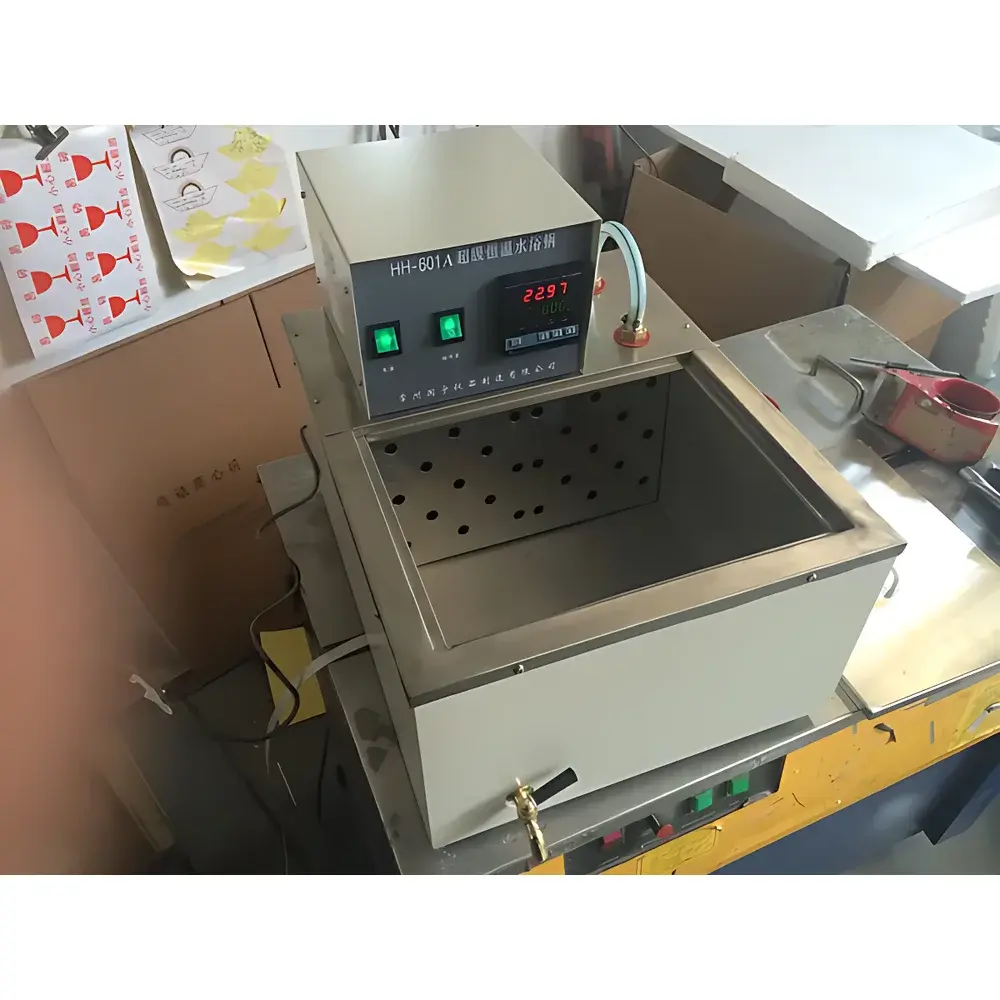
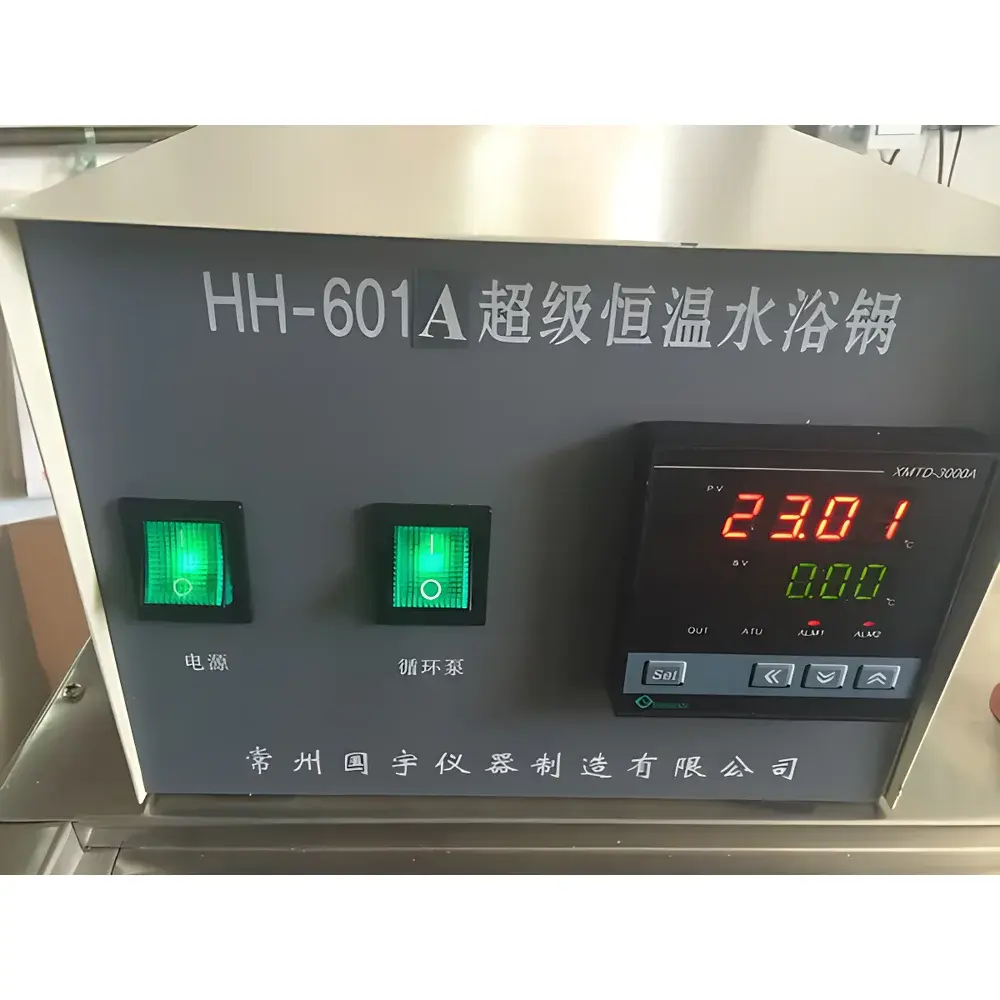
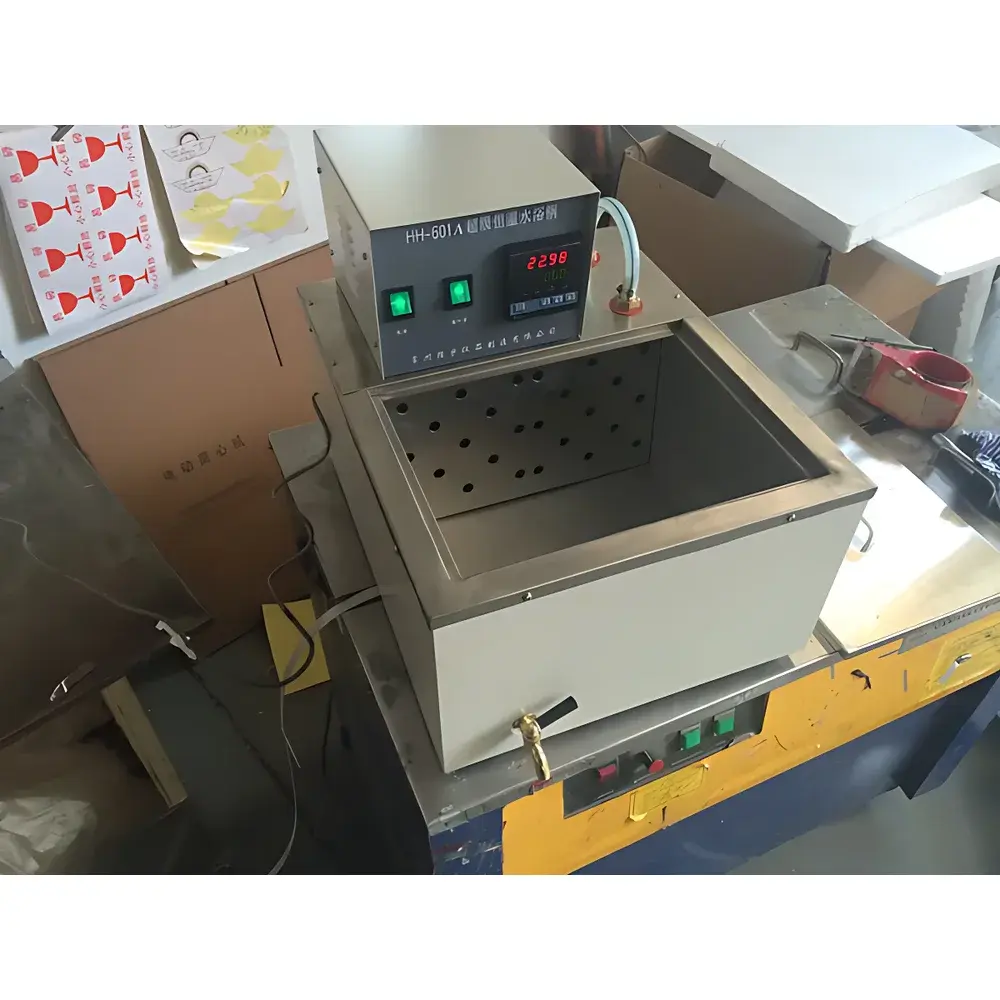
CZGY HH-501A & HH-601A High-Precision Circulating Water Bath
| Brand | CZGY |
|---|---|
| Origin | Jiangsu, China |
| Manufacturer Type | Direct Manufacturer |
| Product Category | Domestic |
| Models | HH-501A, HH-601A |
| Instrument Type | Constant-Temperature Bath |
| Circulation Mode | Internal & External Circulation |
| Temperature Control | Heating-Only |
| Bath Chamber Dimensions | 400 × 300 × 180 mm |
| Temperature Range | Ambient +5°C to 100°C |
| Temperature Stability | ±0.05°C |
| Temperature Resolution | 0.01°C |
| Power Supply | 220 V, 50 Hz |
| Rated Power | 1550 W |
| Timer Range | 0–9999 minutes |
Overview
The CZGY HH-501A and HH-601A are high-precision circulating water baths engineered for stable thermal control in analytical, biochemical, and pharmaceutical laboratory workflows. These units operate on the principle of forced convection via an integrated circulation pump, ensuring uniform temperature distribution throughout the bath chamber—critical for applications demanding minimal thermal gradients (≤ ±0.05°C). Unlike basic immersion heaters, the HH-series employs a microprocessor-based PID temperature controller with programmable setpoint logic, enabling precise ramp-and-hold thermal protocols. The bath chamber—constructed from stainless steel with corrosion-resistant internal finish—supports both internal circulation (for homogeneous bath temperature) and external circulation (for remote temperature control of auxiliary equipment such as viscometers, spectrophotometer cells, or reaction jackets). Designed for continuous operation under GLP-compliant environments, these baths meet fundamental requirements for thermal stability in ASTM E2251 (Standard Specification for Liquid-in-Glass Thermometers) and ISO/IEC 17025-accredited calibration support.
Key Features
- High-stability temperature control: ±0.05°C at setpoints between ambient +5°C and 100°C, verified per IEC 61000-4-30 harmonics-aware thermal logging
- Dual-mode circulation system: Internally recirculates bath fluid for uniformity; externally interfaces via dual 1/4″ BSP ports for integration with external reactors or analytical instrumentation
- Digital PID controller with user-accessible tuning parameters (P, T, E), supporting adaptive response to load changes and minimizing overshoot during setpoint transitions
- 0.01°C temperature resolution with real-time digital display (LED, 4-digit), enabling traceable manual recording for audit-ready lab notebooks
- Programmable timer (0–9999 minutes) with auto-shutdown function—essential for unattended overnight operations in QC labs
- Robust mechanical architecture: 1550 W heating element with overtemperature cut-off, grounded chassis, and IP20-rated enclosure compliant with IEC 61010-1 safety standards
Sample Compatibility & Compliance
These water baths accommodate standard laboratory glassware—including 1 L and 2 L round-bottom flasks, condenser assemblies, and jacketed reaction vessels—within the 400 × 300 × 180 mm working chamber. The stainless-steel tank is compatible with deionized water, glycerol-water mixtures (up to 50% v/v), and low-conductivity aqueous buffers. Not recommended for use with organic solvents (e.g., acetone, ethanol) due to material compatibility constraints and vapor pressure considerations. Units comply with CE marking requirements under the Low Voltage Directive (2014/35/EU) and Electromagnetic Compatibility Directive (2014/30/EU). While not FDA 21 CFR Part 11–certified out-of-the-box, the instrument’s deterministic timer and non-volatile setpoint memory support ALCOA+ data integrity principles when used with controlled procedural documentation.
Software & Data Management
The HH-501A and HH-601A operate as standalone instruments with no embedded software stack or network interface. All operational parameters—including current temperature, setpoint, timer status, and heater duty cycle—are displayed locally and manually recordable. For laboratories requiring electronic data capture, third-party USB or RS232 data loggers (e.g., Omega OM-DAQPRO-5300 series) may be connected via optional analog output modules (0–5 V or 4–20 mA)—available upon request. Firmware does not store historical temperature logs; however, the controller retains last-used setpoint and timer values across power cycles, reducing setup time during repetitive assays. Audit trails must be maintained externally per ISO 17025 Clause 7.7 (Control of Records).
Applications
- Calibration of thermometers and RTDs against NIST-traceable references using fixed-point verification at 25°C, 37°C, and 60°C
- Temperature-controlled enzymatic assays requiring strict thermal consistency over 2–24 hour durations
- Distillation and reflux setups where condenser jacket temperature must remain within ±0.1°C of boiling point
- Stability testing of pharmaceutical formulations per ICH Q1A(R2) guidelines (e.g., 40°C/75% RH accelerated conditions simulated via bath-coupled humidity chambers)
- Pre-heating and equilibration of HPLC mobile phases and sample vials prior to injection
- Supporting rheological measurements by maintaining constant bath temperature for rotational viscometer spindles or capillary rheometers
FAQ
Is external circulation mandatory for achieving ±0.05°C stability?
No. Internal circulation alone achieves the specified stability under static load conditions. External circulation is required only when transferring thermal energy to secondary systems.
Can the unit maintain temperature during power interruptions?
It lacks battery backup or uninterruptible power supply (UPS) integration. Upon power loss, thermal decay follows Newton’s law of cooling; recovery time depends on bath mass and ambient conditions.
What maintenance is required to sustain long-term accuracy?
Monthly cleaning of the stainless-steel tank with 10% acetic acid solution to prevent scale buildup; annual verification of sensor calibration using a certified reference thermometer (e.g., Fluke 1523)
Does the instrument support remote monitoring via Ethernet or Wi-Fi?
No. It is a local-control-only device. Integration into building management systems requires add-on industrial I/O modules and custom SCADA configuration.
Is the timer function validated for GMP-regulated processes?
The timer meets basic functional requirements but lacks electronic signature, event logging, or deviation reporting—features required for full GMP compliance per Annex 11. Manual logbook entries remain the validated method.



