
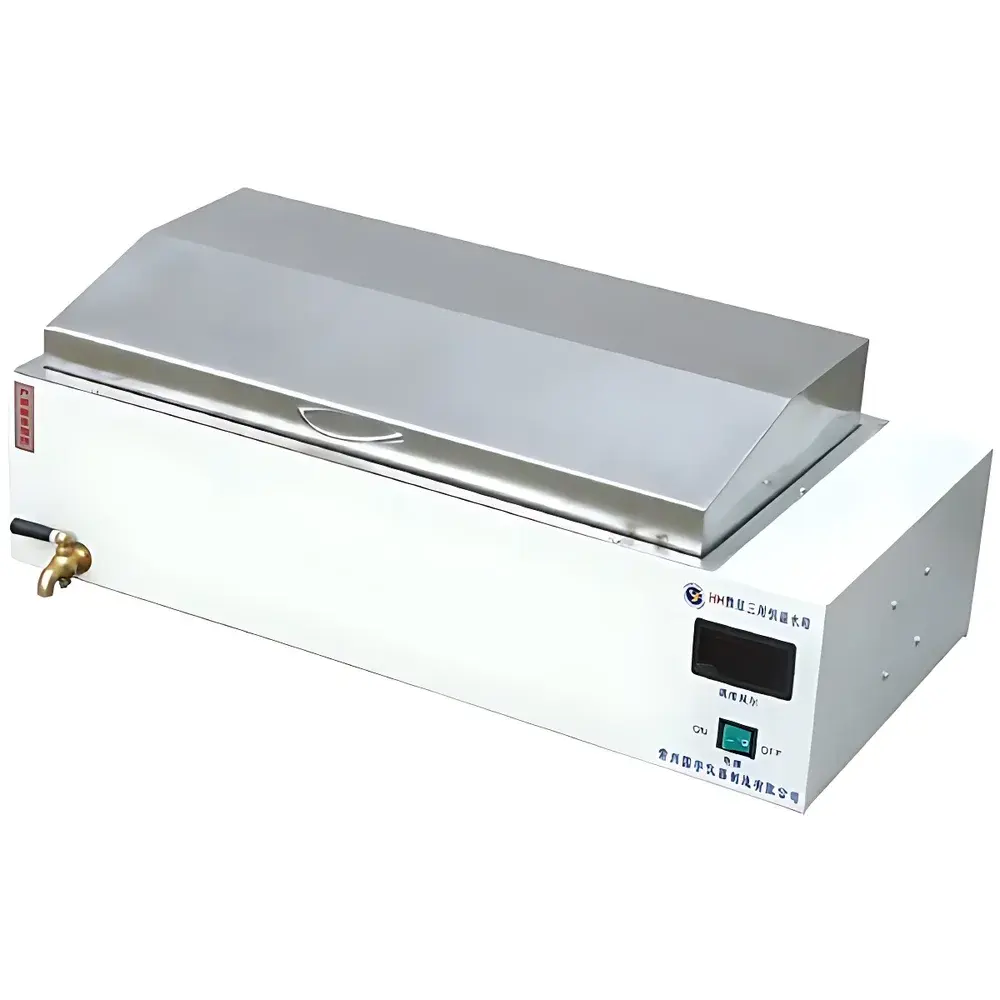
CZGY HH-W420 Digital Display Triple-Use Water Bath
| Brand | CZGY |
|---|---|
| Model | HH-W420 |
| Type | Constant-Temperature Water Bath |
| Application | Distillation, Drying, Concentration, and Temperature-Controlled Immersion of Chemicals or Biological Samples |
| Voltage | 220 V ±10%, 50 Hz |
| Power | 1000 W |
| Tank Dimensions (L×W×H) | 420 × 180 × 150 mm |
| Number of Wells | 2 × Ø120 mm |
| Temperature Range | Ambient to 100 °C |
| Control Accuracy | ±0.5 °C (typical, at steady state) |
| Heating Element | Immersed Stainless Steel Sheathed Resistance Heater |
| Construction | Inner tank — 304 stainless steel welded body |
| Display | LED digital temperature readout with PID-based thermostatic controller |
| Circulation | Non-circulating (static bath) |
| Origin | Jiangsu, China |
| Manufacturer | CZGY Instrument Co., Ltd. |
Overview
The CZGY HH-W420 Digital Display Triple-Use Water Bath is a benchtop, static-temperature immersion system engineered for precise thermal control in routine laboratory workflows involving distillation, solvent evaporation, sample concentration, enzymatic incubation, and temperature-stabilized chemical or biological wet processing. Unlike circulating baths, the HH-W420 relies on conduction- and convection-driven thermal equilibrium within a sealed, insulated stainless steel reservoir—making it ideal for applications where mechanical agitation or forced fluid movement is unnecessary or undesirable. Its operational range spans from ambient temperature up to 100 °C, calibrated and maintained via a microprocessor-based PID controller with LED digital display, ensuring repeatable setpoint accuracy within ±0.5 °C under stabilized conditions. Designed for compatibility with standard laboratory glassware—including round-bottom flasks, beakers, and test tubes—the unit features two identical 120 mm-diameter wells, each fitted with removable stainless steel covers to minimize evaporation and improve thermal uniformity across the bath surface.
Key Features
- Two independent 120 mm-diameter immersion wells with precision-machined stainless steel covers for vapor retention and thermal consistency
- 304 stainless steel inner tank—fully welded, corrosion-resistant, and easy to clean; compliant with ISO 8573-1 cleanliness standards for non-sterile lab environments
- Robust outer enclosure fabricated from cold-rolled steel with electrostatic epoxy powder coating—resistant to chipping, abrasion, and common lab solvents
- 1000 W immersed heating element positioned centrally in the water volume for rapid thermal response and low thermal gradient (<1.2 °C across well bottom at 80 °C)
- Digital PID temperature controller with real-time LED display, manual setpoint adjustment, and over-temperature cut-off protection (auto-shutdown at >105 °C)
- No external pump or circulation loop—eliminates maintenance points associated with tubing, seals, or impeller wear
- Integrated grounding terminal and three-pin grounded power cord—meets IEC 61010-1:2010 safety requirements for laboratory electrical equipment
Sample Compatibility & Compliance
The HH-W420 supports a broad range of sample containers including borosilicate glassware (e.g., Pyrex®), polypropylene centrifuge tubes, and stainless steel vessels rated for continuous immersion at ≤100 °C. It is routinely deployed in QC laboratories performing ASTM E29–22-compliant thermal conditioning of polymer samples prior to tensile testing, USP auxiliary warming steps for non-sterile compounding, and ISO 5725-2:2019 reference material stabilization protocols. While not certified for GLP/GMP production environments, its design aligns with Annex 11 (EU GMP) principles for documented temperature control when used with external data loggers. The absence of recirculation avoids cross-contamination risks—critical for multi-user academic labs handling sensitive biochemical reagents or cell culture media pre-warming.
Software & Data Management
The HH-W420 operates as a standalone analog-digital hybrid instrument without embedded software or network connectivity. Temperature setpoints and real-time readings are managed exclusively via front-panel controls and the integrated LED display. For regulatory traceability, users may integrate optional third-party USB or RS-485 data loggers (e.g., Omega OM-DAQPRO-5300) to record time-stamped temperature profiles compliant with FDA 21 CFR Part 11 requirements—provided audit trails, electronic signatures, and secure storage protocols are implemented at the host system level. The unit itself retains no internal memory or firmware update capability.
Applications
- Controlled-temperature digestion of environmental water samples prior to heavy metal analysis (EPA Method 200.8)
- Pre-heating of agarose gels and electrophoresis buffers in molecular biology workflows
- Accelerated stability testing of pharmaceutical excipients per ICH Q1A(R2) guidelines (40 °C/75% RH support stage)
- Softening of paraffin-embedded tissue blocks in histopathology preparation
- Thermal equilibration of viscosity standards before rotational rheometry calibration (ASTM D445)
- Low-risk warming of enzyme solutions, antibodies, or fetal bovine serum without denaturation risk from shear stress
FAQ
Is the HH-W420 suitable for oil bath applications?
Yes—its 100 °C upper limit and stainless steel construction allow safe use with silicone oils and mineral oils having flash points above 120 °C. However, oil viscosity increases heat transfer resistance; extended operation above 80 °C requires monitoring for localized overheating.
Can this unit maintain temperature uniformity across both wells simultaneously?
Within ±0.8 °C under static load (no active stirring), verified per ASTM E1112–20 methodology using NIST-traceable PT100 probes placed at geometric centers of each well.
Does the HH-W420 comply with CE or UL certification requirements?
It meets the essential safety and EMC requirements of IEC 61010-1:2010 and is supplied with CE-marked components; however, full CE self-declaration applies only to end-user-configured installations meeting local national deviations.
What is the recommended maximum fill level?
Water or bath fluid must fully submerge the heating element (minimum depth: 65 mm) but remain ≥20 mm below the top rim to prevent boil-over during prolonged operation at 95–100 °C.
Is calibration documentation provided with shipment?
A factory calibration certificate (traceable to CNAS-accredited standards) is available upon request at order placement; field recalibration is performed using external Class A PT100 sensors and digital thermometers per ISO/IEC 17025 guidelines.



