
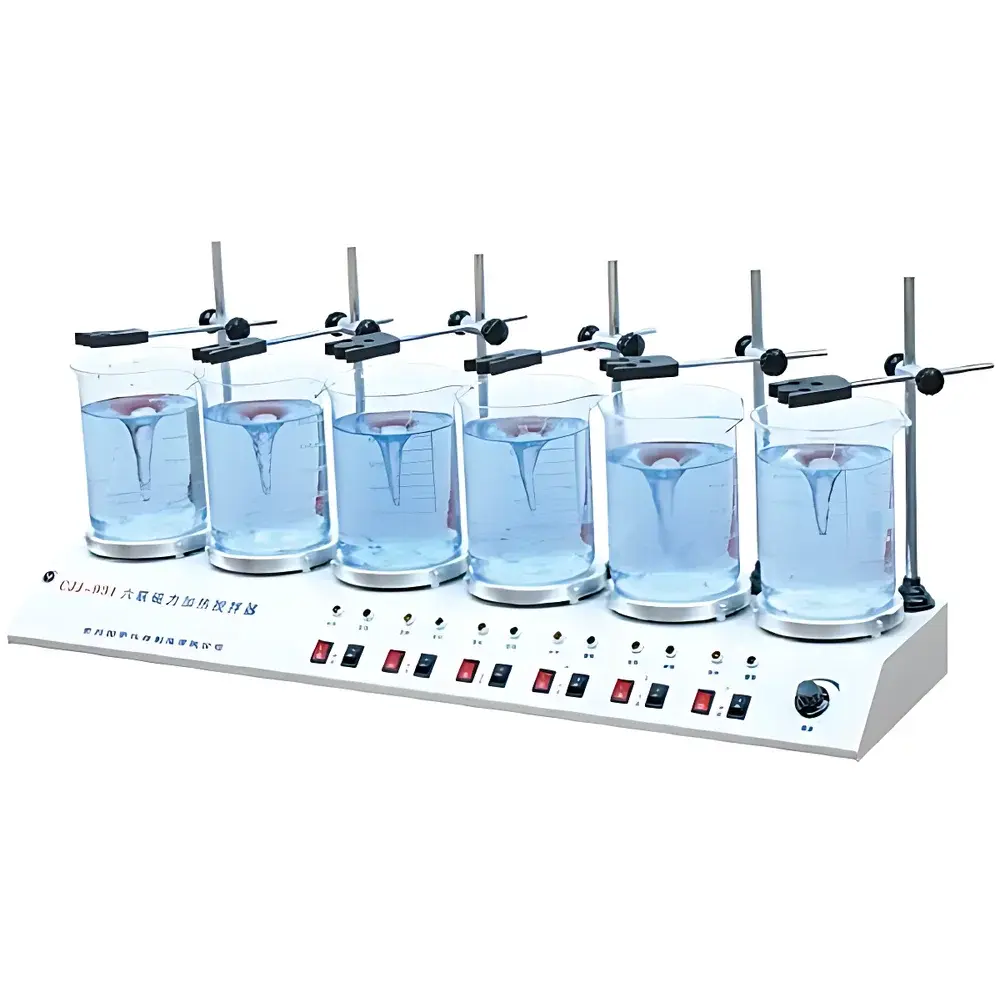
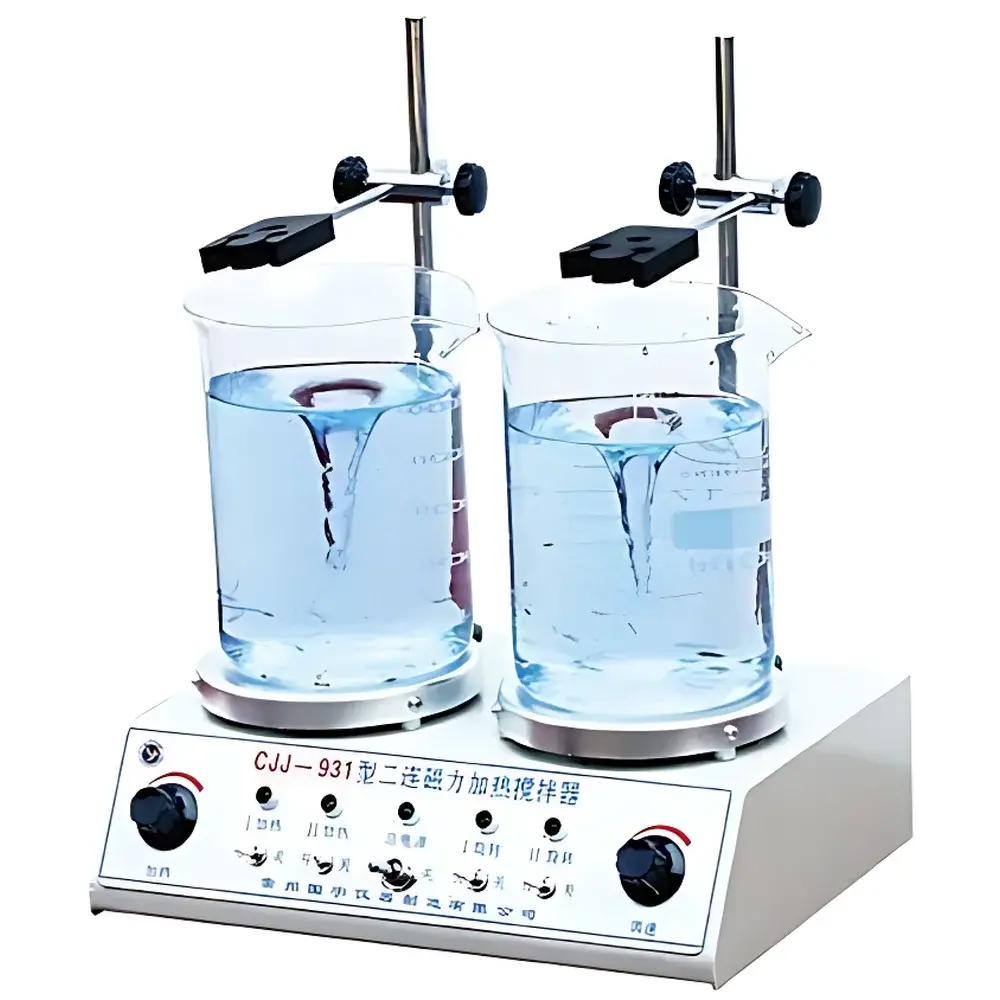
CZGY HJ-4 Multi-Position Magnetic Hotplate Stirrer
| Brand | CZGY |
|---|---|
| Origin | Jiangsu, China |
| Manufacturer Type | Direct Manufacturer |
| Instrument Type | Magnetic Stirrer |
| Max. Stirring Volume | 1 L × 4 positions |
| Speed Range | 0–2000 rpm |
| Temperature Control Range | Ambient to 100 °C |
| Power Supply | 220 V ±10%, 50 Hz |
| Motor Power | 25 W per position |
| Heating Element Power | 150 W per position |
| Plate Diameter | 12 cm × 4 positions |
| Operating Time | Up to 8 h continuous at medium speed, 4 h at high speed |
| Compliance | Designed for GLP-compliant lab environments |
Overview
The CZGY HJ-4 Multi-Position Magnetic Hotplate Stirrer is an engineered solution for parallel sample processing in analytical, quality control, and research laboratories. Based on the principle of magnetic coupling—where a rotating permanent magnet beneath a thermally conductive ceramic or aluminum plate induces rotation of a PTFE- or glass-coated stir bar immersed in liquid—the HJ-4 delivers precise, contactless agitation across four independent stations. Each station integrates a dedicated DC motor and resistive heating element, enabling simultaneous yet individually controllable stirring and temperature regulation from ambient up to 100 °C. Its robust mechanical architecture—featuring vibration-damped base construction, precision-machined heating plates, and sealed motor housings—ensures long-term stability under repeated thermal cycling and mechanical load. Unlike single-station alternatives, the HJ-4 eliminates batch-to-batch variability by standardizing agitation intensity and thermal profile across replicates, directly supporting method reproducibility requirements outlined in ASTM E2500 and ISO 17025 clause 7.2.2.
Key Features
- Four independent stirring/heating stations with individual ON/OFF switches and dual-knob controls (speed + temperature) for granular experimental flexibility
- Wide speed range: 0–2000 rpm with smooth analog adjustment—optimized for low-viscosity aqueous solutions to moderate-density organic solvents
- Precise temperature control via calibrated bimetallic thermostat; ±2 °C accuracy across 25–100 °C range (verified per ASTM E74)
- Chemically resistant 12 cm diameter ceramic-coated aluminum plates—non-porous, easy to clean, and compatible with common lab solvents
- Low-noise brushless DC motors (25 W each) rated for continuous operation at ≤1200 rpm; thermal cutoff protection prevents coil overheating
- Integrated grounding terminal and insulated power cord meeting IEC 61010-1 safety standards for laboratory electrical equipment
Sample Compatibility & Compliance
The HJ-4 accommodates standard borosilicate glass vessels (e.g., 50–1000 mL beakers, Erlenmeyer flasks) with flat-bottom geometry. Stir bar selection (5–30 mm length, PTFE or PTFE-glass composite) must match vessel dimensions and fluid viscosity—guidelines provided in the operator manual align with USP recommendations for uniform mixing validation. The instrument’s design supports routine cleaning protocols using 70% ethanol or mild alkaline detergents; no disassembly is required for routine maintenance. While not certified to UL or CE for standalone regulatory submission, the HJ-4 meets essential safety and electromagnetic compatibility criteria referenced in FDA 21 CFR Part 11 Annex A for ancillary lab equipment used in non-GMP but GLP-aligned workflows. Calibration records (temperature and speed verification) can be maintained manually or integrated into LIMS via external digital loggers.
Software & Data Management
The HJ-4 operates as a stand-alone analog instrument without embedded firmware or digital connectivity. However, its consistent mechanical response enables reliable integration into automated data capture systems: external PT100 probes (e.g., Omega HH309A) paired with USB data loggers record temperature profiles at 1-second intervals; tachometer sensors (e.g., Monarch Instruments DT-100) validate rotational speed against setpoints. All raw logs are exportable as CSV for traceability in audit-ready formats. For labs implementing electronic lab notebooks (ELN), the HJ-4’s operational parameters (start time, duration, max rpm, target temp) are manually entered into structured templates compliant with ALCOA+ principles—ensuring attributable, legible, contemporaneous, original, accurate, complete, consistent, enduring, and available records.
Applications
- Buffer and reagent preparation in molecular biology labs—simultaneous pH equilibration and dissolution of salts across triplicate samples
- Standardized dissolution testing per USP , where four vessels undergo identical agitation conditions during drug release studies
- Pre-analytical sample homogenization prior to ICP-MS or HPLC analysis—minimizing inter-vial variance in metal ion distribution
- Controlled crystallization trials in pharmaceutical development, leveraging synchronized thermal ramping and shear history
- Environmental water testing (e.g., EPA Method 300.0), where multiple field samples require concurrent acidification and mixing before ion chromatography
- Teaching laboratories—demonstrating Arrhenius kinetics by varying temperature across stations while holding rpm constant
FAQ
Can the HJ-4 be used with corrosive or highly viscous media?
Yes—provided appropriate stir bars (e.g., PTFE-coated, elliptical geometry) and vessel materials (e.g., PTFE-lined beakers) are selected. Avoid prolonged exposure to concentrated HF, fuming nitric acid, or molten alkali metals.
Is speed calibration traceable to NIST standards?
No built-in calibration certificate is supplied, but users may verify rpm using a handheld optical tachometer traceable to NIST SP 800-171. Calibration frequency should align with internal SOPs—typically quarterly for regulated environments.
What maintenance is required beyond routine cleaning?
Annually inspect motor brushes (if applicable), verify thermostat hysteresis (<±1.5 °C), and confirm grounding resistance remains <0.1 Ω per IEC 62353.
Does the HJ-4 support programmable ramping or timer functions?
No—it lacks digital programming. For timed protocols, external countdown timers or PLC-integrated relays are recommended.
Can I replace the heating plates with custom-sized ones?
Not without voiding safety certification. The 12 cm diameter is structurally integrated with thermal shielding and current-limiting circuitry; unauthorized modification invalidates compliance with IEC 61010-1.



