
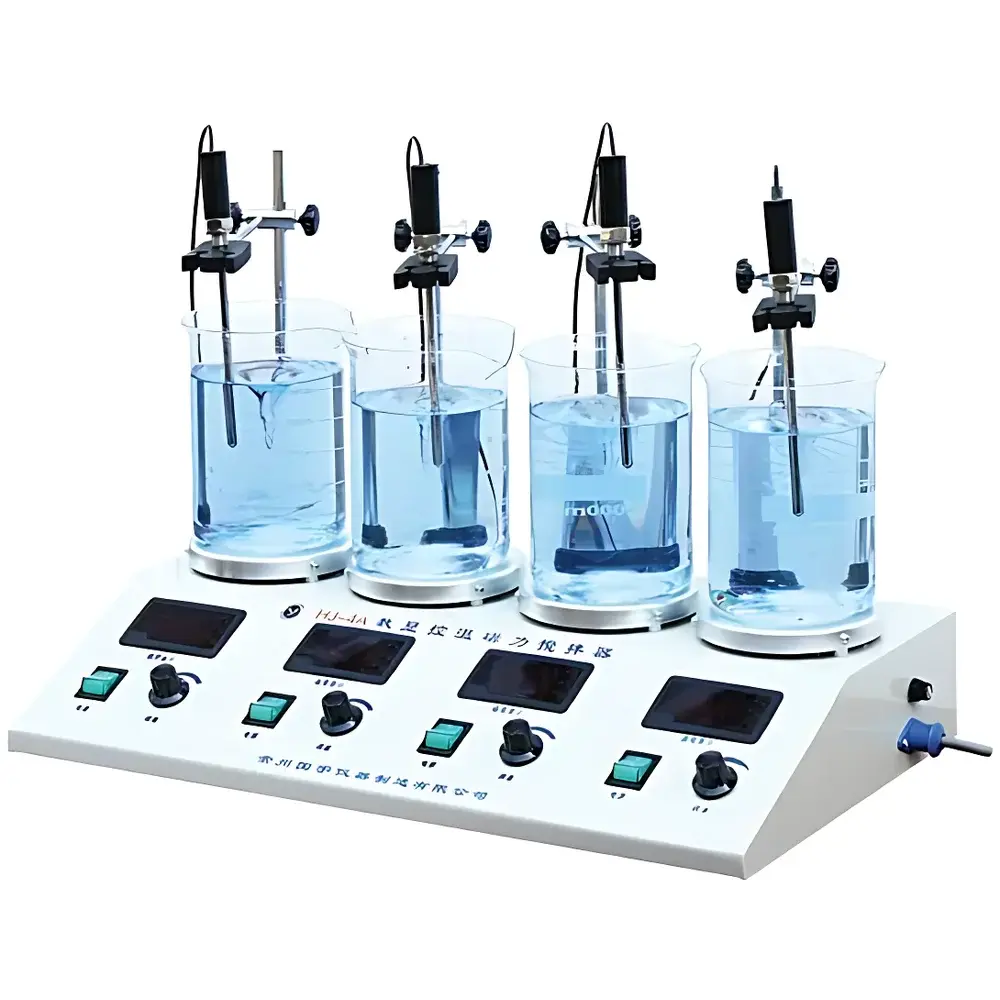
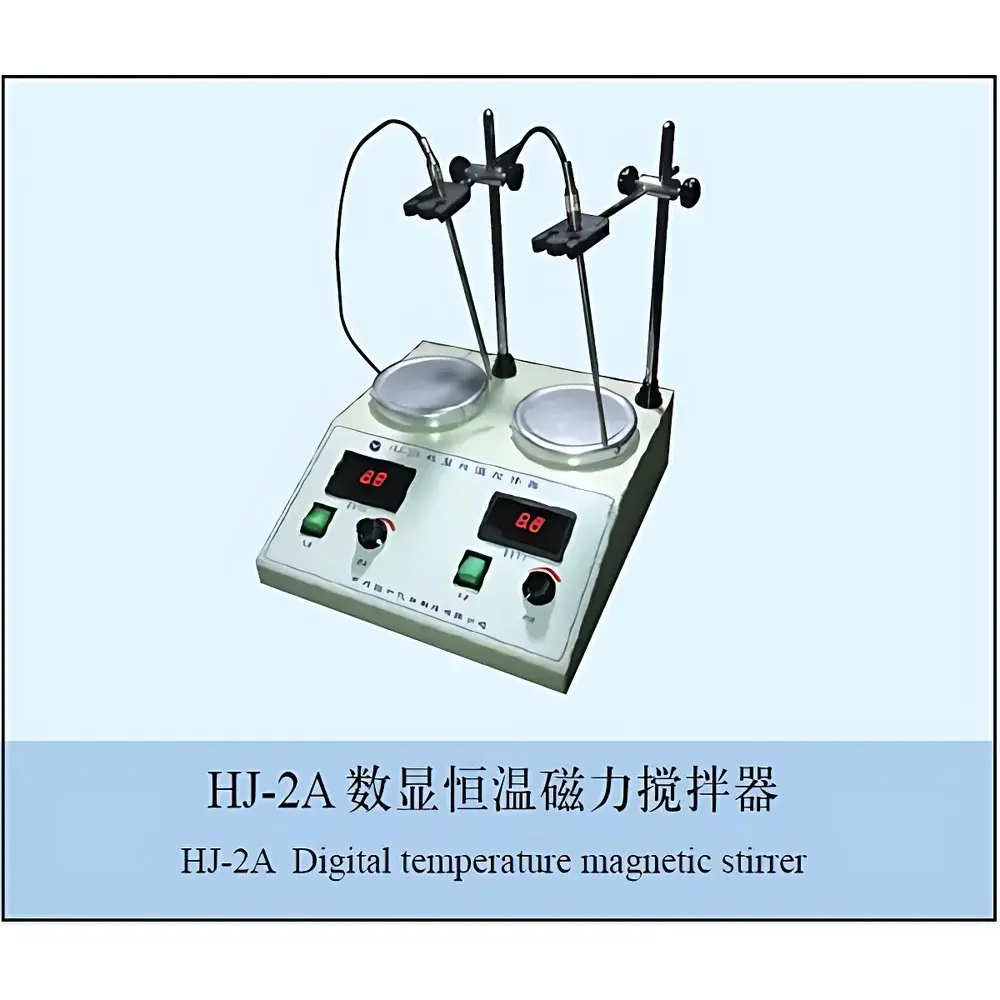
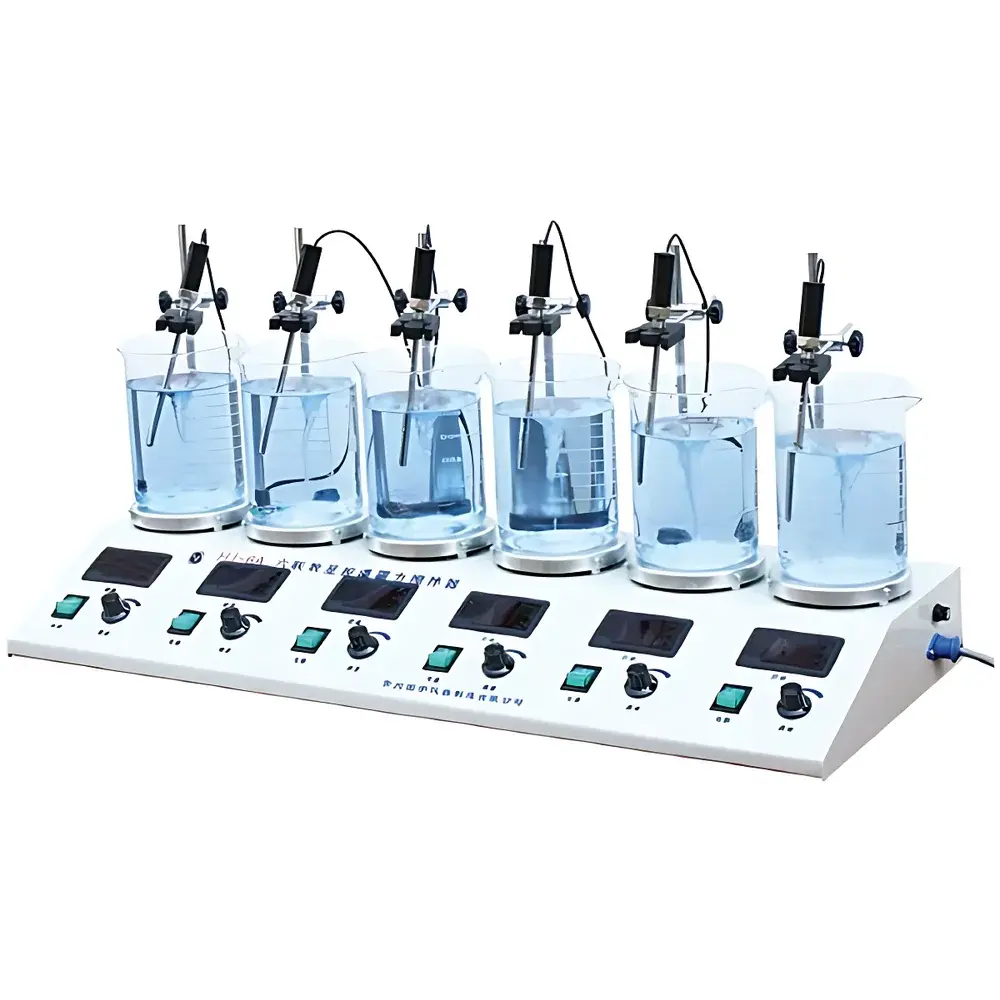
CZGY HJ-4A Digital Display Temperature-Controlled Magnetic Stirrer
| Brand | CZGY |
|---|---|
| Origin | Jiangsu, China |
| Manufacturer Type | Direct Manufacturer |
| Product Category | Domestic |
| Model | HJ-4A |
| Instrument Type | Magnetic Stirrer |
| Max Stirring Volume | 1 L × 4 stations |
| Speed Range | 0–2000 rpm |
| Temperature Control Range | Ambient to 100 °C |
Overview
The CZGY HJ-4A Digital Display Temperature-Controlled Magnetic Stirrer is a precision-engineered benchtop laboratory instrument designed for simultaneous thermal regulation and mechanical agitation across four independent reaction stations. Utilizing permanent magnet coupling and PTC-based heating elements, it delivers consistent rotational torque and uniform surface temperature distribution without direct mechanical drive shafts or external moving parts. This architecture eliminates contamination risks associated with overhead stirrers and ensures long-term operational stability in routine QC, synthetic chemistry, buffer preparation, and dissolution testing workflows. The device operates on standard 220 V ±10%, 50 Hz mains power and complies with IEC 61010-1 safety requirements for laboratory electrical equipment.
Key Features
- Four independent stirring/heating stations with individual digital LED displays for real-time speed (rpm) and temperature (°C) monitoring
- Adjustable speed control from 0 to 2000 rpm per station, with smooth ramp-up functionality to prevent magnetic stir bar slippage or vortex instability
- Precise thermostatic control over ambient to 100 °C, calibrated against NIST-traceable reference thermometers
- Each station features a 12 cm diameter chromium-plated ceramic-coated aluminum hotplate, offering high thermal conductivity and chemical resistance
- Dedicated heating and stirring toggle switches per station—enabling decoupled operation (e.g., heating without agitation, or vice versa)
- Integrated ground terminal compliant with IEC 60364-5-54; recommended for use with grounded outlets in GLP/GMP environments
- Compact footprint (approx. 280 × 220 × 120 mm) optimized for fume hood or laminar flow cabinet integration
Sample Compatibility & Compliance
The HJ-4A supports standard borosilicate glass vessels up to 1 L capacity per station—including beakers, Erlenmeyer flasks, and jacketed reactors—when used with appropriately sized magnetic stir bars (recommended length: 25–40 mm). Its surface temperature uniformity (±3 °C at 80 °C, measured per ASTM E2779) meets typical requirements for USP dissolution apparatus calibration verification and ISO 17025-accredited method development. While not certified for hazardous area use (ATEX/IECEx), the unit conforms to CE marking directives (EMC Directive 2014/30/EU and Low Voltage Directive 2014/35/EU) and carries RoHS 2011/65/EU compliance documentation.
Software & Data Management
As a standalone analog-digital hybrid instrument, the HJ-4A does not feature embedded microprocessor logging or USB/RS-232 connectivity. All operational parameters are manually set and visually monitored via front-panel LED displays. For regulated environments requiring audit trails, users may integrate external data loggers (e.g., Omega OM-DAQPRO-5300 series) connected to PT100 probe inputs—supporting 21 CFR Part 11-compliant electronic records when paired with validated software platforms such as LabArchives ELN or Thermo Fisher SampleManager LIMS. Calibration certificates for temperature and speed sensors are available upon request for IQ/OQ validation protocols.
Applications
- Multi-sample buffer equilibration in molecular biology labs (e.g., Tris-HCl, PBS, SDS-PAGE running buffers)
- Parallel synthesis screening in medicinal chemistry, including Grignard reactions and esterifications requiring controlled exotherm management
- Standardized dissolution rate testing per USP , particularly for immediate-release tablet formulations
- Environmental sample digestion (EPA Method 3050B, 3051A) using acid mixtures under reflux-mimicking conditions
- Preparation of homogeneous colloidal suspensions for DLS or zeta potential analysis
- QC release testing of pharmaceutical excipients where viscosity and solubility profiles must be assessed across multiple batches simultaneously
FAQ
What is the maximum continuous duty cycle at full speed and temperature?
At 2000 rpm and 100 °C, each station is rated for 4 hours of uninterrupted operation. At ≤1200 rpm and ≤80 °C, continuous operation up to 8 hours is permissible per IEC 60034-1 thermal class B insulation limits.
Can the HJ-4A accommodate non-standard vessel geometries, such as tall-form cylinders or round-bottom flasks?
Yes—provided the vessel base is flat, non-magnetic, and centered over the heating zone. Use extended-length stir bars (≥35 mm) and verify magnetic coupling efficiency empirically prior to method validation.
Is temperature calibration traceable to national standards?
Factory calibration uses NIST-traceable dry-block calibrators (Fluke 9142 series); optional on-site calibration services include documented uncertainty budgets per ISO/IEC 17025.
Does the unit support programmable ramp-hold temperature profiles?
No—temperature setpoints are static. For time-dependent thermal protocols, external PID controllers (e.g., Watlow F4T) may be interfaced via 0–10 V analog output modules.
What maintenance intervals are recommended for long-term reliability?
Inspect stir bar retention magnets and hotplate surface integrity every 6 months; clean with isopropyl alcohol and lint-free cloth. Verify grounding continuity annually using a calibrated earth bond tester (IEC 62353 pass threshold: <0.1 Ω).
Related Products



