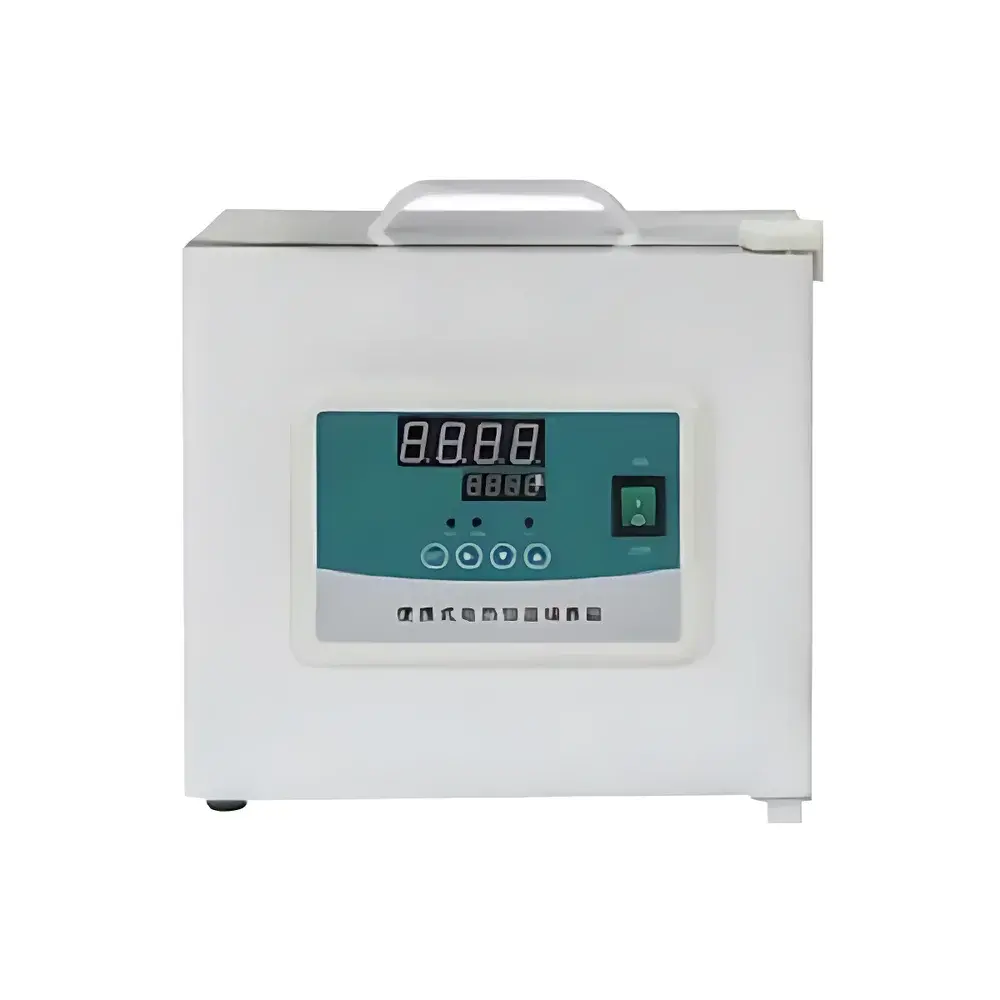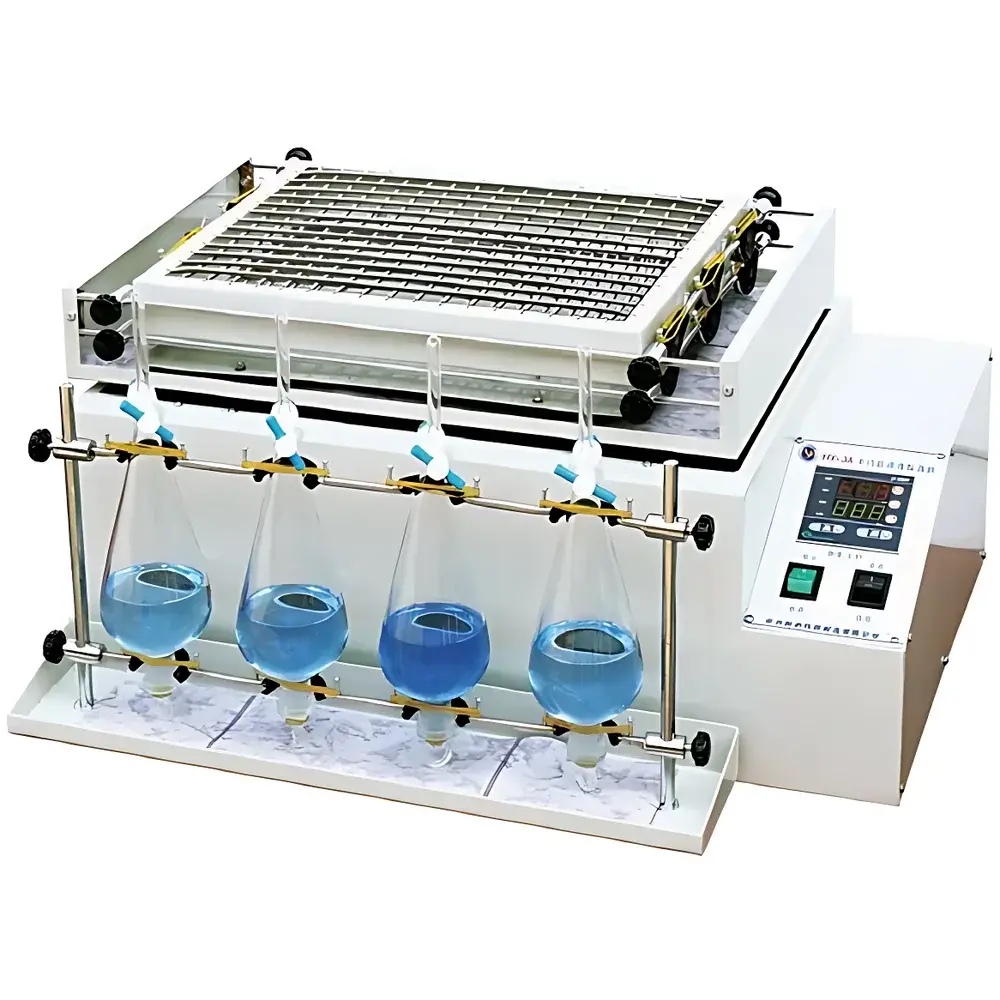
CZGY HY-3 Multi-Function Oscillator
| Brand | CZGY |
|---|---|
| Origin | Jiangsu, China |
| Manufacturer Type | Direct Manufacturer |
| Instrument Category | Domestic |
| Model | HY-3 |
| Pricing | USD 380 (approx.) |
| Instrument Type | General-Purpose Laboratory Shaker |
| Timing Range | 0–120 min |
| Oscillation Frequency | 60–300 rpm (adjustable via analog knob) |
| Oscillation Amplitude | 20 mm |
| Temperature Control | None |
| Platform Quantity | 1 platform |
| Load Capacity | 10 kg |
| Power Consumption | 150 W |
| Input Voltage | 220 V ±10%, 50 Hz |
| Platform Fixtures | 5× 250 mL separatory funnel clamps + universal mesh clamp for beakers, flasks, and test tubes |
| Motion Modes | Combined vertical and horizontal reciprocating oscillation |
Overview
The CZGY HY-3 Multi-Function Oscillator is an electromechanically driven laboratory shaker engineered for reproducible, low-maintenance sample agitation in life science and bioengineering workflows. Unlike single-mode orbital or reciprocating shakers, the HY-3 integrates dual-axis motion—simultaneous vertical and horizontal reciprocating oscillation—within a single compact chassis. This hybrid motion profile enhances mixing efficiency for heterogeneous suspensions, immunoassay plates, extraction protocols (e.g., liquid–liquid partitioning using separatory funnels), and cell suspension homogenization where gentle yet thorough agitation is required. The device operates on a brush-type AC motor with mechanical speed regulation via precision analog knobs, delivering stable output across its full 60–300 rpm range without digital feedback control. Its 20 mm amplitude ensures effective energy transfer to samples while minimizing shear stress on sensitive biological matrices. Designed for ambient-temperature benchtop use only, the HY-3 complies with IEC 61010-1 safety standards for electrical laboratory equipment and incorporates grounded chassis construction per EN 61326-1 for electromagnetic compatibility and operator protection.
Key Features
- Dual-motion capability: Independent yet synchronized vertical and horizontal reciprocating oscillation—enabling versatile agitation for both separatory funnel extractions and flask-based culture resuspension.
- Analog speed and timer controls: Robust rotary knobs provide tactile, drift-free adjustment of oscillation frequency (60–300 rpm) and timing (0–120 minutes), eliminating reliance on microprocessor-dependent interfaces and reducing failure points.
- Universal platform configuration: Equipped with five standardized 250 mL separatory funnel clamps and a reinforced stainless-steel mesh clamp system compatible with round-bottom flasks (up to 1 L), Erlenmeyer flasks, beakers (50–1000 mL), and multi-well plates (with optional adapter).
- High-load mechanical architecture: Cast-aluminum base and reinforced steel linkage mechanism support up to 10 kg total load while maintaining amplitude stability and minimizing resonance at higher frequencies.
- Energy-efficient operation: 150 W nominal power draw with thermal cutoff protection ensures sustained duty-cycle performance without overheating during extended runs.
Sample Compatibility & Compliance
The HY-3 accommodates standard laboratory glassware and plastic vessels used in molecular biology, clinical diagnostics, and environmental sample preparation—including but not limited to separatory funnels (250 mL), conical centrifuge tubes (15–50 mL), culture flasks (T25–T225), and assay plates. Its open-platform design allows rapid reconfiguration between vessel types without tools. The unit meets CE marking requirements under Directive 2014/30/EU (EMC) and 2014/35/EU (LVD), and conforms to ISO/IEC 17025-relevant mechanical stability criteria for routine QC testing environments. While not designed for GLP-regulated temperature-controlled applications, its consistent mechanical output supports method validation per ASTM D2240 (oscillation consistency testing) and USP auxiliary equipment qualification when deployed in non-sterile compounding support roles.
Software & Data Management
The HY-3 is a standalone hardware-only instrument with no embedded firmware, network interface, or data logging capability. All operational parameters are set manually and retained only as mechanical positions of the control knobs; no audit trail, electronic record, or time-stamped run history is generated. This architecture eliminates cybersecurity vulnerabilities and aligns with FDA 21 CFR Part 11 exemptions for non-critical, non-data-generating laboratory devices. For laboratories requiring traceable operation logs, external USB timers or PLC-integrated relay controllers may be interfaced via the unit’s dry-contact enable line (optional accessory port, not standard).
Applications
- Liquid–liquid extraction workflows using separatory funnels—particularly in pharmaceutical impurity profiling and environmental contaminant isolation (e.g., EPA Method 3510C).
- Resuspension of adherent mammalian cells prior to passaging or lysate preparation, where uniform low-shear mixing prevents premature membrane disruption.
- Antibody–antigen binding enhancement in ELISA plate pre-incubation steps, leveraging combined vertical/horizontal motion to reduce edge effects and improve well-to-well consistency.
- Soil and sediment leaching studies requiring repetitive agitation of solid–liquid mixtures under ambient conditions.
- Quality control of buffer formulation homogeneity, especially for viscous polymer-containing solutions where orbital motion alone yields incomplete dispersion.
FAQ
Does the HY-3 support programmable ramping or acceleration profiles?
No. Speed is adjusted manually via analog knob and remains constant once set; no acceleration/deceleration curves or multi-step programs are available.
Is the platform removable for cleaning or custom fixture installation?
Yes. The stainless-steel platform is secured with four M6 socket-head cap screws and can be detached in under 90 seconds using a standard hex key.
Can the HY-3 be operated continuously beyond 120 minutes?
Yes—setting the timer to “0 min” disables automatic shutdown, enabling indefinite continuous operation until manually stopped.
What maintenance is required for long-term reliability?
Biannual inspection of drive belt tension and lubrication of pivot joints with silicone-based grease (ISO-LGEP 2 specification); no scheduled motor servicing is required within the first 10,000 operating hours.
Is third-party calibration documentation available?
CZGY provides factory-verified oscillation frequency and amplitude certificates (traceable to NIM, China) upon request; on-site calibration services are supported through authorized regional partners in APAC and EMEA.