
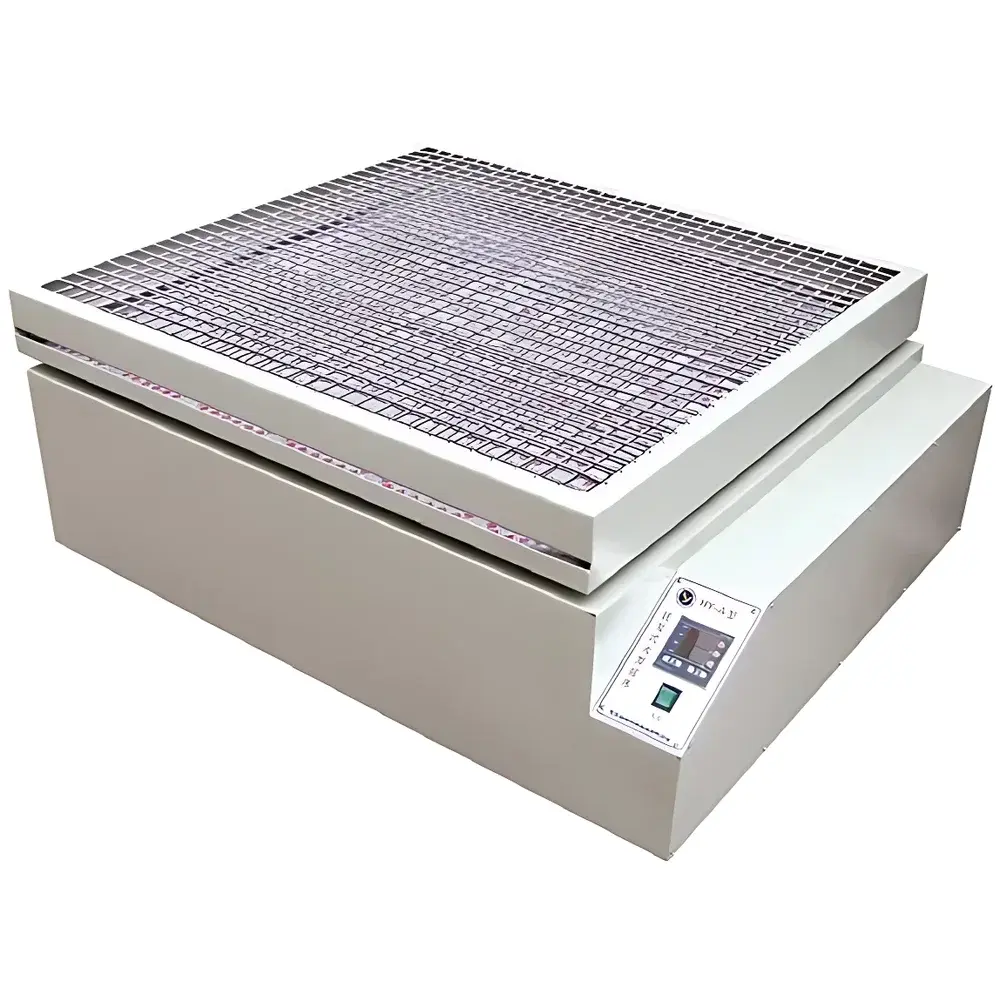
CZGY HY-A Reciprocating Large-Capacity Laboratory Shaker
| Brand | CZGY |
|---|---|
| Origin | Jiangsu, China |
| Manufacturer Type | Direct Manufacturer |
| Instrument Category | Domestic |
| Model | HY-A |
| Price | USD 1,080 (approx.) |
| Instrument Type | General-Purpose Reciprocating Shaker |
| Timer Range | 0–9999 min |
| Oscillation Frequency | 60–280 rpm |
| Stroke Amplitude | 20 mm |
| Temperature Control | None |
| Platform Quantity | 1 |
Overview
The CZGY HY-A Reciprocating Large-Capacity Laboratory Shaker is an engineered platform for high-throughput mixing, homogenization, and suspension-based sample preparation in life science, clinical diagnostics, environmental testing, and industrial R&D laboratories. Designed around a robust reciprocating motion principle—where the platform moves linearly along a horizontal axis with fixed stroke amplitude—the HY-A delivers consistent shear and mechanical agitation without rotational centrifugal forces. This makes it particularly suitable for applications requiring gentle yet effective suspension of dense or viscous samples, such as microbial culture propagation, reagent blending, immunoassay plate washing support, and solid-liquid extraction protocols. Its large 1000 × 940 mm working surface accommodates multiple flasks, bottles, trays, or custom fixtures simultaneously, supporting scalable workflows in academic core facilities, QC labs, and bioprocessing development environments.
Key Features
- Microprocessor-Controlled Speed Regulation: Digital PID-controlled motor drive ensures stable speed output across the full 60–280 rpm range, with built-in power compensation to maintain constant rotational velocity under variable load conditions (up to 40 kg).
- Precision Electronic Timer: Programmable timing function supports durations from 1 minute to 9999 minutes (≈7 days), enabling unattended overnight or extended-duration experiments with automatic shutdown.
- Large-Dimension Shaking Platform: Single 1000 × 940 mm stainless steel platform with integrated mesh-style clamping system—optimized for secure retention of heterogeneous vessel types including Erlenmeyer flasks (50–5000 mL), glass jars, plastic containers, and custom sample racks.
- Dual-Mode Operation: Switchable between manual voltage-adjustable mode (0–99% output) and auto-setpoint mode for repeatable protocol execution; front-panel controls include dedicated △/▽ keys for intuitive time and speed parameter entry.
- Industrial-Grade Construction: Reinforced chassis with anti-slip rubber feet; designed for continuous operation up to 8 hours per cycle; electrical safety compliant with IEC 61010-1 for laboratory equipment (220 V, 50 Hz, 200 W).
Sample Compatibility & Compliance
The HY-A shaker accommodates a broad spectrum of sample containers—from standard conical flasks and serum bottles to custom trays and multi-well plates mounted on auxiliary platforms. Its reciprocating motion minimizes vortex formation while maximizing bulk fluid displacement, making it ideal for cell suspension maintenance, antigen-antibody mixing in ELISA workflows, and dissolution testing of particulate formulations. While not temperature-controlled, the unit may be operated inside environmental chambers or cold rooms when paired with external thermal management systems. The device meets basic electromagnetic compatibility (EMC) and electrical safety requirements per GB/T 14710 (Chinese national standard equivalent to IEC 61326-1) and is suitable for use in GLP-compliant laboratories where mechanical mixing steps are documented within validated SOPs. It does not incorporate FDA 21 CFR Part 11-compliant audit trails but supports manual logbook recording of operational parameters.
Software & Data Management
The HY-A operates via embedded firmware without external software dependency. All operational parameters—including set speed, elapsed time, remaining time, and mode status—are displayed on a dual-line LED interface. No USB, Ethernet, or Bluetooth connectivity is provided; data logging requires manual transcription or integration with external time-lapse imaging or vibration-sensing peripherals. For laboratories requiring electronic records, the instrument can be included in broader lab-wide asset tracking systems using its model number (HY-A) and serial identifier (assigned at factory). Firmware updates are not field-upgradable; calibration verification is performed through periodic tachometer validation against displayed rpm values.
Applications
- Microbial culture expansion in aerobic fermentation studies (e.g., E. coli, yeast, filamentous fungi)
- Homogenization of soil, sediment, or food matrices prior to microbiological analysis
- Preparation of calibration standards and reference materials in environmental monitoring labs
- Supporting antigen retrieval and blocking steps in histopathology and immunohistochemistry workflows
- Agitation of immunoaffinity columns and magnetic bead-based purification systems
- Extraction of bioactive compounds from plant tissues or marine biomass under non-thermal conditions
FAQ
What is the maximum load capacity of the HY-A shaker?
The platform is rated for a static load of up to 40 kg, distributed evenly across the surface. Dynamic stability is maintained best at speeds ≤220 rpm when fully loaded.
Can the HY-A be used inside a cold room or incubator?
Yes—provided ambient temperature remains between 5 °C and 40 °C and relative humidity does not exceed 80% RH non-condensing. Ensure adequate ventilation around the motor housing.
Is the stroke amplitude adjustable?
No—the reciprocating motion is mechanically fixed at 20 mm. This design prioritizes repeatability and structural rigidity over variable amplitude control.
Does the unit include CE or UL certification?
The HY-A complies with GB/T 14710 and meets essential safety requirements for laboratory equipment in China. CE marking is not affixed; UL listing is not available. Customers requiring third-party certification should consult local regulatory advisors for conformity assessment pathways.
How often should speed calibration be verified?
We recommend quarterly verification using a non-contact optical tachometer, especially after transportation or prolonged high-speed operation (>240 rpm).
Related Products




