
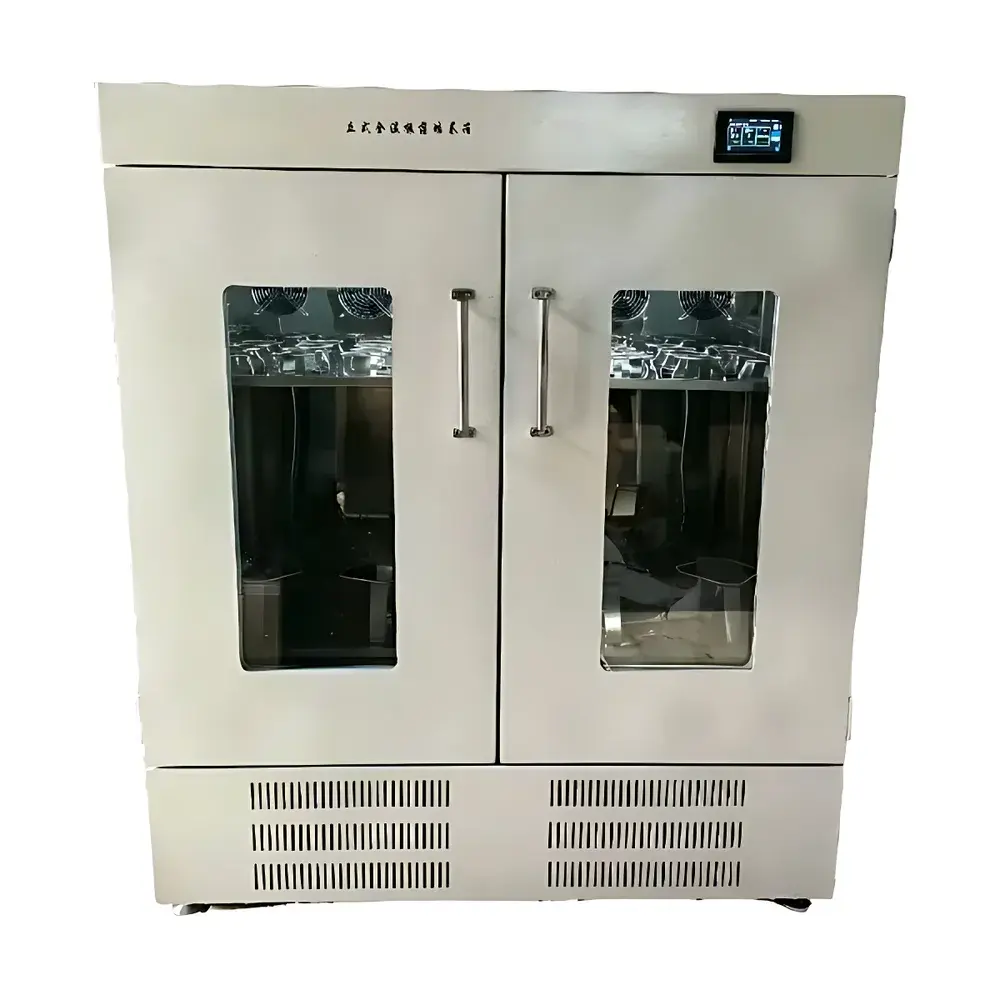
CZGY HYG-B Full-Temperature Orbital Shaking Incubator
| Brand | CZGY |
|---|---|
| Origin | Jiangsu, China |
| Manufacturer Type | Direct Manufacturer |
| Instrument Type | Full-Temperature Orbital Shaker & Incubator |
| Model | HYG-B |
| Temperature Range | 4–60 °C |
| Temperature Uniformity | ±1 °C (at 37 °C) |
| Temperature Control Accuracy | ±0.5 °C |
| Oscillation Frequency | 10–300 rpm |
| Frequency Accuracy | ±1 rpm |
| Orbit Diameter | 26 mm |
| Timer Range | Temperature & Oscillation Timing: 0–9999 min |
| Number of Shaking Platforms | 2 |
| Platform Dimensions (L×W) | 1260 × 510 mm per layer |
| Display | 4.3″ True-Color Touchscreen |
| Control Algorithm | PID Microcomputer Intelligent Control |
| Air Circulation | Forced Convection |
| Chamber Interior | Stainless Steel |
| UV Sterilization Lamp | Integrated |
| Oxygenation Port | Equipped |
| Power Supply | AC 220 V ±10%, 50–60 Hz |
| External Dimensions (L×W×H) | 1440 × 810 × 1800 mm |
| Chamber Dimensions (L×W×H) | 1340 × 610 × 1090 mm |
| Net Weight | 400 kg |
| Standard Fixture Configuration | 36 × 500 mL stainless steel spring clamps (Layer 1) |
Overview
The CZGY HYG-B Full-Temperature Orbital Shaking Incubator is an integrated laboratory instrument engineered for simultaneous temperature-controlled incubation and orbital shaking—designed specifically for microbial culture expansion, cell suspension maintenance, enzyme reaction kinetics, and aerobic fermentation studies. It operates on the principle of horizontal orbital motion with a fixed 26 mm diameter orbit, ensuring uniform mixing while minimizing shear stress on sensitive biological samples. Unlike standard benchtop shakers, the HYG-B integrates a dual-layer stainless steel chamber with forced-air convection and PID-driven thermal regulation, enabling stable, reproducible environmental control across the full operational range of 4–60 °C. Its structural architecture supports continuous unattended operation over extended durations (up to 9999 minutes per timer channel), making it suitable for overnight cultures, multi-day bioprocess monitoring, and GLP-compliant routine QC workflows in academic, pharmaceutical, and industrial biotechnology laboratories.
Key Features
- Dual independent shaking platforms (1260 × 510 mm each), permitting concurrent experiments under identical or differentiated conditions
- Precision servo motor drive system delivering consistent rotational output with ±1 rpm frequency accuracy across the full 10–300 rpm range
- 4.3-inch true-color touchscreen interface with intuitive PID parameter navigation, real-time graphing of temperature and speed profiles, and user-accessible calibration offsets
- Stainless steel interior chamber with seamless welding and high-efficiency insulation—optimized for thermal retention and corrosion resistance in humid or sterilant-exposed environments
- Integrated germicidal UV lamp (254 nm) and dedicated oxygenation port to support strict anaerobic/aerobic protocol requirements
- Double-door access with magnetic door seal and viewing window—enabling minimal thermal disturbance during sample loading/unloading
- Robust mechanical design (400 kg net weight) with vibration-dampening feet and reinforced platform support structure to maintain stability at maximum oscillation speeds
Sample Compatibility & Compliance
The HYG-B accommodates standard Erlenmeyer flasks (50–5000 mL), culture bottles, and custom vessels via its configurable stainless steel spring clamp system. Fixture layouts are modular and field-adjustable without tools. The unit meets general safety requirements per IEC 61010-1 for laboratory electrical equipment and incorporates over-temperature cut-off, motor stall protection, and door-open interlock mechanisms. While not pre-certified to ISO/IEC 17025 or FDA 21 CFR Part 11 out-of-the-box, its PID logging capability, timestamped event records (start/stop/timer expiry), and password-protected parameter settings provide foundational traceability for internal validation protocols aligned with GMP/GLP documentation standards.
Software & Data Management
The onboard microcontroller stores up to 10 programmable protocols, each containing independent setpoints for temperature, speed, and dual-stage timing (incubation-only vs. oscillation-enabled intervals). All runtime data—including actual temperature, measured rpm, elapsed time, and alarm history—are retained in non-volatile memory and exportable via USB flash drive in CSV format. No proprietary software is required; exported logs are compatible with common LIMS platforms, Excel-based trend analysis, and statistical process control (SPC) packages. Audit trail functionality includes operator ID tagging (via optional network integration) and immutable timestamping of all critical parameter modifications.
Applications
- Microbial growth curve analysis (E. coli, yeast, Bacillus spp.) under controlled aeration and thermal gradients
- Recombinant protein expression in shake-flask bioreactors prior to scale-up
- Suspension cell culture maintenance (CHO, HEK293) requiring low-shear agitation
- Biochemical assay development where temperature-dependent enzyme activity must be assessed across multiple shaking conditions
- Environmental microbiology studies involving soil slurry or wastewater enrichment under aerobic incubation
- Quality control testing of media sterility and lot-to-lot performance consistency
FAQ
What is the maximum flask capacity per shelf?
Each shelf supports up to 36 × 500 mL Erlenmeyer flasks (standard configuration); larger vessels (e.g., 5000 mL) may be accommodated with reduced quantity—consult fixture layout diagrams for load distribution guidelines.
Can the two shelves operate at different temperatures or speeds?
No—the HYG-B maintains uniform temperature and synchronized oscillation across both platforms; independent control per shelf is not supported.
Is remote monitoring or Ethernet connectivity available?
The base model lacks built-in network interfaces; however, analog voltage outputs (0–5 V) for temperature and rpm signals are accessible via terminal block for third-party SCADA integration.
How often does the UV lamp require replacement?
Germicidal UV-C lamps degrade gradually; CZGY recommends replacement every 1000 hours of cumulative use or annually—whichever occurs first—to ensure ≥90% irradiance retention.
Does the unit comply with electromagnetic compatibility (EMC) directives for EU laboratories?
The HYG-B conforms to EN 61326-1:2013 for EMC in laboratory environments; CE marking documentation is provided upon request for import compliance verification.



