
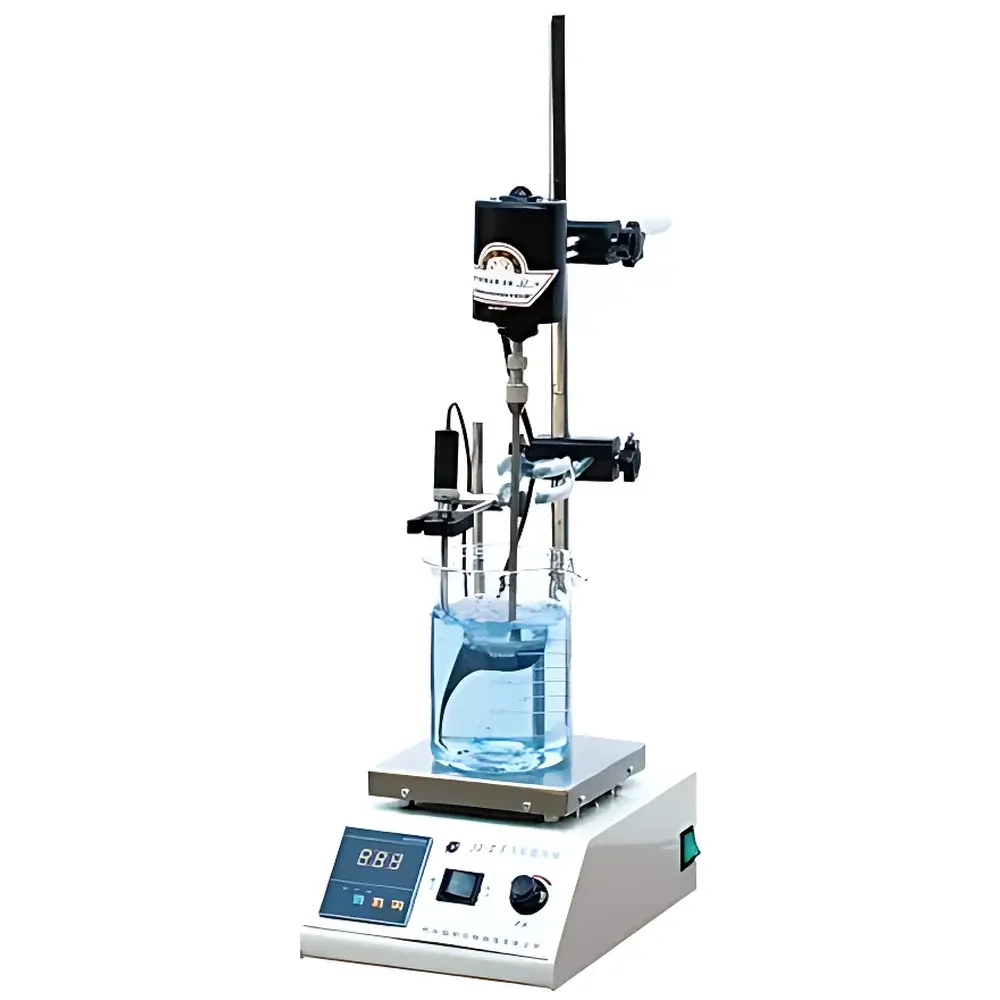
CZGY JJ-2 Temperature-Controlled Electric Stirrer
| Brand | CZGY |
|---|---|
| Origin | Jiangsu, China |
| Manufacturer Type | Direct Manufacturer |
| Instrument Type | Electric Stirrer |
| Max. Mixing Volume | 20 L |
| Speed Range | 0–3000 rpm (Continuously Adjustable) |
| Temperature Control Range | Ambient to 100 °C |
| Power Supply | 220 V ±10%, 50 Hz |
| Motor Power | 60 W |
| Heating Power | 500 W |
| Work Surface | 16 × 16 cm |
| Stirring Shaft Material | Stainless Steel (Corrosion-Resistant) |
Overview
The CZGY JJ-2 Temperature-Controlled Electric Stirrer is an integrated laboratory mixing system engineered for precision temperature-regulated agitation of low-to-medium viscosity liquids in open or covered vessels. It operates on a permanent-magnet DC motor drive architecture, delivering stable rotational torque across its full speed range without electromagnetic noise or speed drift under load—critical for reproducible homogenization, dissolution, and reaction kinetics studies. Unlike basic magnetic stirrers, the JJ-2 employs direct mechanical coupling via a stainless-steel stirring rod, enabling effective mixing of heterogeneous suspensions, viscous solutions, and particulate-laden media up to 20 L volume. Its built-in resistive heating plate and PID-based digital temperature controller allow simultaneous control of both rotational dynamics and thermal environment—supporting applications such as accelerated solubility testing, polymer dissolution, buffer equilibration, and pre-heating prior to analytical sample preparation.
Key Features
- Permanent-magnet DC motor with 60 W nominal output, ensuring consistent torque delivery and minimal thermal drift during extended operation
- 0–3000 rpm continuously variable speed control with analog dial interface and real-time LED RPM display
- Integrated 500 W resistive heating module with digital PID temperature regulation (ambient to 100 °C), ±1 °C accuracy at setpoint
- Corrosion-resistant 304 stainless-steel stirring shaft and clamp assembly, compatible with aqueous, mildly acidic, and organic solvent systems
- Dual-function digital controller supporting both temperature setpoint configuration and internal PID parameter tuning (P, T, E values)
- 16 × 16 cm ceramic-coated aluminum heating platform with uniform thermal distribution and overtemperature cutoff protection
- Robust mechanical design featuring adjustable vertical support column (16 mm diameter), secure motor mounting, and vibration-damped base
Sample Compatibility & Compliance
The JJ-2 is designed for use with standard laboratory glassware including beakers (50 mL to 5000 mL), Erlenmeyer flasks, and jacketed reactors. Its open-bath configuration supports compatibility with non-hermetic vessels and accommodates custom probe insertion (e.g., pH, conductivity, or temperature sensors). The unit complies with IEC 61010-1:2010 safety requirements for electrical equipment for measurement, control, and laboratory use. While not certified for Class I Div 1 hazardous locations, it meets general-purpose lab environmental standards for indoor operation under GLP-aligned workflows. All electrical insulation, grounding continuity, and thermal cut-off mechanisms are factory-verified per manufacturer QC protocols.
Software & Data Management
The JJ-2 operates via embedded microcontroller firmware with no external software dependency. Temperature and speed settings are retained across power cycles. The digital interface supports manual calibration offset entry for temperature sensor drift correction—a feature commonly referenced in ASTM E2251-22 (Standard Practice for Calibration of Liquid-in-Glass Thermometers) and ISO/IEC 17025:2017 clause 7.7.1 (Measurement Traceability). Although the device lacks USB or RS-232 connectivity, its front-panel SET/↑/↓ key sequence enables full access to PID tuning parameters (P = proportional band, T = cycle time, E = heating anticipation offset), facilitating optimization for specific thermal mass profiles—particularly valuable in method development per USP or guidelines for compounding and analytical sample prep.
Applications
- Controlled-rate dissolution testing of pharmaceutical actives in simulated gastric/intestinal fluids
- Preparation of homogeneous calibration standards and reference materials in QC laboratories
- Thermal equilibration of buffers and reagents prior to HPLC, titration, or spectrophotometric analysis
- Dispersion of nanoparticles and colloidal suspensions under defined thermal conditions
- Accelerated stability studies requiring concurrent agitation and elevated temperature exposure
- Teaching laboratory demonstrations of Newtonian fluid behavior, heat transfer coefficients, and mixing time constants
FAQ
What is the maximum recommended vessel height for stable operation?
The vertical support column allows adjustment up to 450 mm; for optimal stability with 20 L volumes, vessel height should not exceed 300 mm to prevent top-heavy oscillation.
Can the unit maintain temperature while operating at maximum speed?
Yes—the motor and heating circuits are electrically isolated and thermally decoupled; full-speed agitation does not compromise temperature stability within ±1.2 °C at 100 °C setpoint.
Is the temperature sensor calibrated to NIST-traceable standards?
The embedded PT100 sensor is factory-calibrated against reference standards; users may perform two-point verification using certified thermometer baths per ISO/IEC 17025 section 6.6.
Does the JJ-2 support external temperature probe input?
No—it uses only the integrated surface-mounted sensor; for immersion temperature monitoring, a separate calibrated probe must be used alongside the unit’s setpoint control.
What maintenance intervals are recommended for long-term reliability?
Motor brush inspection every 12 months (if operated >4 hrs/day); cleaning of heating surface and shaft threads after each use with isopropyl alcohol; annual verification of thermal cutoff function using controlled overtemperature test.



