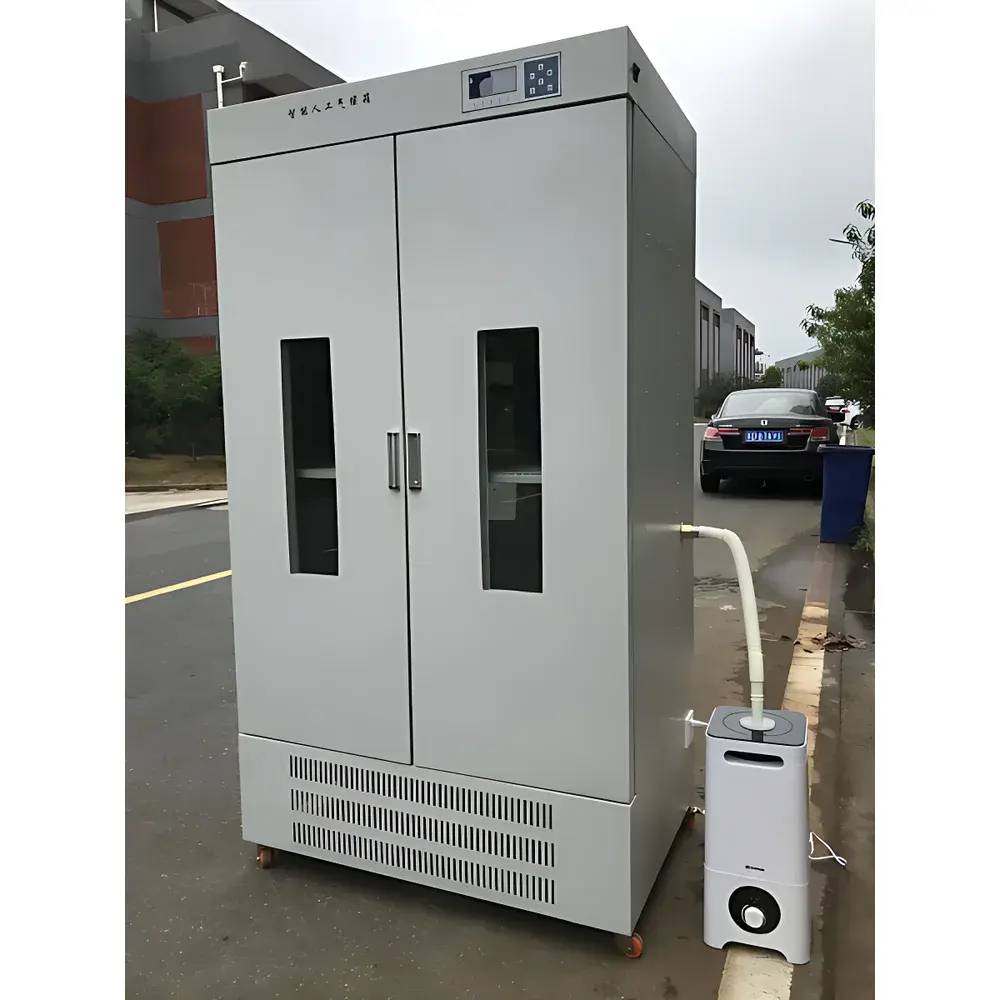
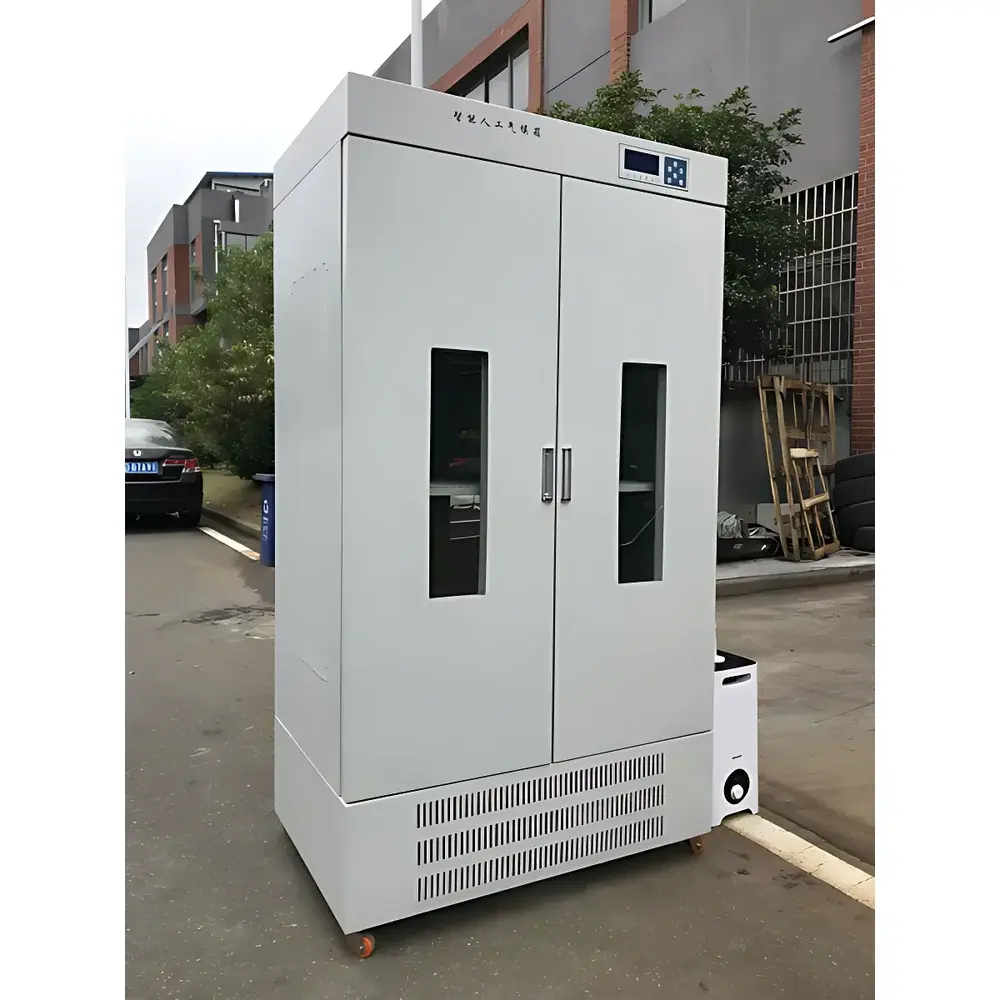
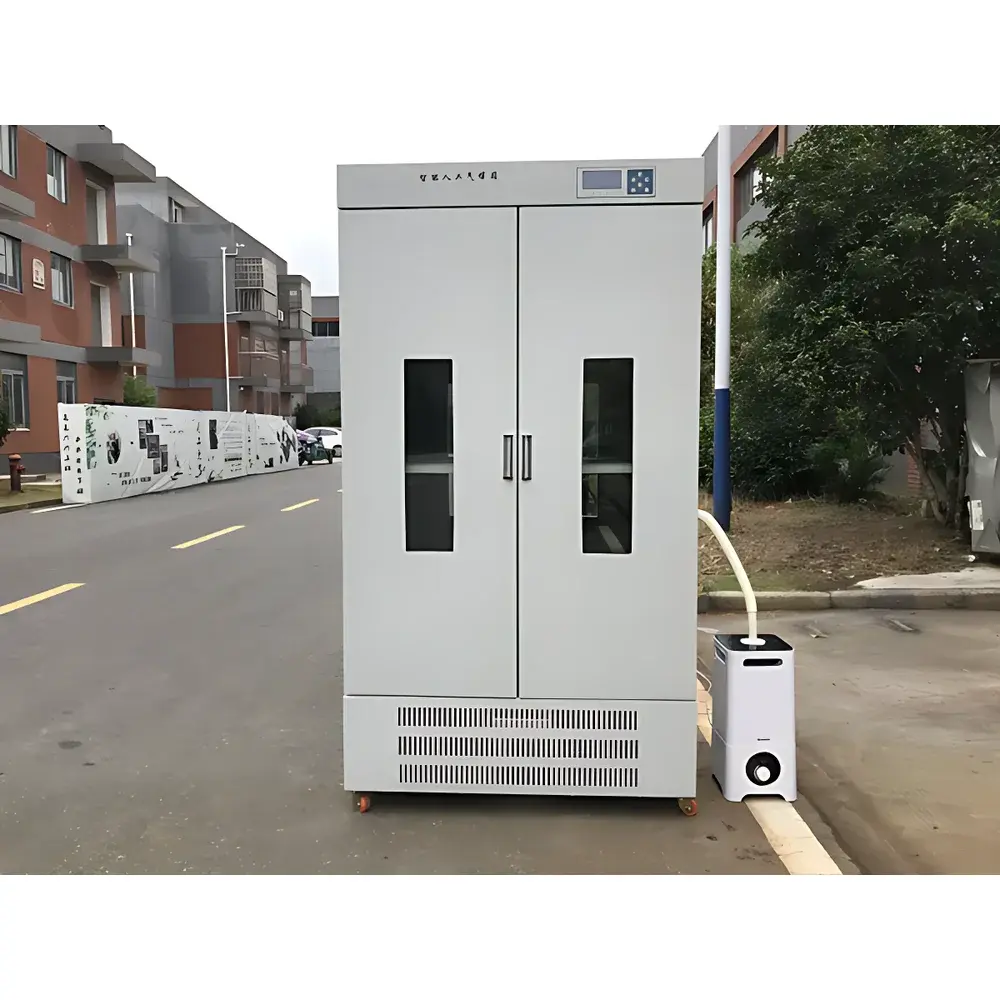
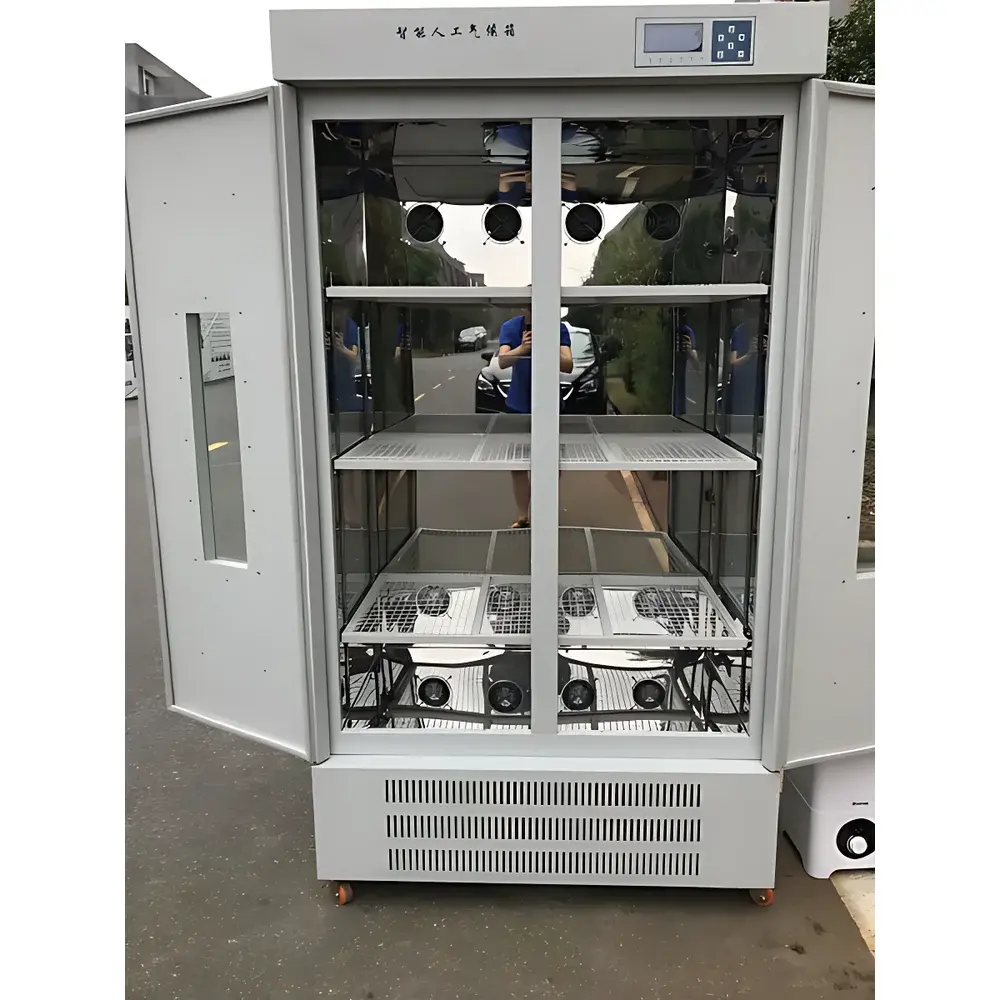
CZGY LHP-700HE Large-Capacity Plant Growth Chamber
| Brand | CZGY |
|---|---|
| Origin | Jiangsu, China |
| Manufacturer Type | Direct Manufacturer |
| Model | LHP-700HE |
| Temperature Range (with light) | 10–50°C |
| Temperature Range (dark) | 0–50°C |
| Chamber Volume | 722 L |
| Humidity Range | 30–90% RH |
| Humidity Fluctuation | ±5% RH |
| Temperature Uniformity | ±2°C |
| Temperature Stability | ±0.5°C |
| Illumination Intensity | ≤12,000 lx (6-step adjustable, triple-sided LED lighting) |
| Inner Dimensions (W×D×H) | 980 × 530 × 1390 mm |
| Outer Dimensions (W×D×H) | 1100 × 720 × 2030 mm |
| Humidifier Capacity | 13 L |
| Heating Power | 1200 W |
| Dual Compressor Cooling Power | 2 × 800 W |
| Circulation Fan Power | 200 W |
| Timer Range | 0–9999 min/h |
| Cycle Programming | up to 99 cycles, 1–30 segments per cycle |
| Control System | Microprocessor-based programmable controller with LCD display |
| Refrigerant | Eco-friendly non-CFC refrigerant |
| Construction | Cold-rolled steel exterior with powder coating |
Overview
The CZGY LHP-700HE Large-Capacity Plant Growth Chamber is a precision-engineered environmental simulation system designed for reproducible, long-term cultivation of photobiological specimens under tightly controlled temperature, humidity, and illumination conditions. Built upon the principles of forced-air convection thermoregulation and photometrically calibrated LED irradiation, it enables stable emulation of diurnal cycles, seasonal gradients, and climate-specific growth environments. Its 722 L working volume supports multi-tiered shelving configurations, making it suitable for high-throughput plant phenotyping, seed germination assays, tissue culture propagation, microbial preservation, and small-animal acclimation studies. The chamber operates across two distinct thermal regimes—0–50°C in darkness and 10–50°C under illumination—ensuring compatibility with both cryotolerant and thermophilic biological systems. All thermal and hygric control loops are independently validated for stability and repeatability, meeting baseline operational requirements for GLP-compliant experimental workflows.
Key Features
- Triple-sided, spectrally balanced LED lighting system delivering uniform irradiance up to 12,000 lx, with six discrete intensity levels programmable per segment
- Dual high-efficiency compressors (800 W each) using R134a or R600a refrigerant, compliant with international ozone-safe standards (Montreal Protocol Annex A)
- Microprocessor-based programmable controller with intuitive LCD interface, supporting up to 99 multi-stage cycles and 30 segments per cycle
- Stainless steel (AISI 304) inner chamber with seamless welds and rounded corners for ease of decontamination and ISO Class 5-compatible cleaning protocols
- External humidification module (13 L reservoir) with auto-refill detection and anti-scale heating elements to ensure consistent RH delivery across 30–90% range
- Forced convection via axial fan (200 W) with laminar airflow optimization, achieving ±2°C spatial uniformity and ±0.5°C temporal stability over 24-hour operation
- Double-pane, low-E observation window with anti-fog coating and UV-blocking interlayer, minimizing radiant heat loss while enabling real-time visual monitoring
Sample Compatibility & Compliance
The LHP-700HE accommodates a broad spectrum of life science samples—including Arabidopsis thaliana seedlings, rice callus cultures, fungal spore suspensions, nematode colonies, and juvenile Drosophila melanogaster—without cross-contamination risk. Its stainless steel interior and removable perforated shelves support autoclave-compatible accessory integration. The unit complies with IEC 61000-6-3 (EMC emissions), IEC 61000-6-2 (immunity), and GB/T 2423.1–2008 / GB/T 2423.2–2008 (environmental testing standards for temperature/humidity). While not certified to UL/CSA or CE for North American/EU market placement without regional adaptation, its control architecture and sensor calibration methodology align with foundational requirements for FDA 21 CFR Part 11 data integrity readiness when paired with external audit-trail logging software.
Software & Data Management
The embedded controller logs timestamped temperature, humidity, light intensity, and operational status at user-defined intervals (1–60 min). Data export is supported via USB 2.0 port in CSV format, compatible with MATLAB, Python (pandas), and JMP for downstream statistical analysis. Optional RS485 Modbus RTU interface enables integration into centralized BMS platforms for facility-wide environmental monitoring. Though no proprietary cloud platform is included, the device’s deterministic polling response and CRC-16 checksum validation ensure reliable SCADA interoperability in industrial lab settings.
Applications
- Controlled-environment agriculture (CEA) research: photoperiod optimization for crop yield enhancement
- Phytopathology: host–pathogen interaction studies under defined abiotic stress gradients
- Biopharmaceutical upstream development: mammalian cell line adaptation under variable O2/CO2-independent conditions
- Ecophysiology: thermal performance curve (TPC) generation for invasive species modeling
- Veterinary science: preclinical housing standardization for zebrafish or rodent developmental toxicity screening
- Quality control in biobanking: viability assessment of cryopreserved algal strains post-thaw recovery
FAQ
Does the LHP-700HE support CO2 concentration control?
No—this model is configured exclusively for temperature, relative humidity, and photoperiod regulation. CO2 modulation requires optional gas-mixing hardware not included in the base configuration.
Can the LED lighting spectrum be customized (e.g., red/blue ratio)?
The standard configuration uses full-spectrum white LEDs optimized for PAR (Photosynthetically Active Radiation) delivery. Spectral tuning is not available without factory retrofitting.
Is remote monitoring possible via Ethernet or Wi-Fi?
The unit lacks built-in network connectivity. Remote access requires third-party IoT gateways interfacing via Modbus RTU or analog voltage outputs.
What maintenance intervals are recommended for the humidification system?
The external humidifier reservoir should be drained and rinsed weekly; descaling is advised every 3 months using 5% citric acid solution, depending on local water hardness.
Are validation documents (IQ/OQ/PQ protocols) provided?
Factory-issued calibration certificates for temperature and humidity sensors are supplied. Site-specific IQ/OQ documentation must be generated by the end user per ISO/IEC 17025 or GxP guidelines.