
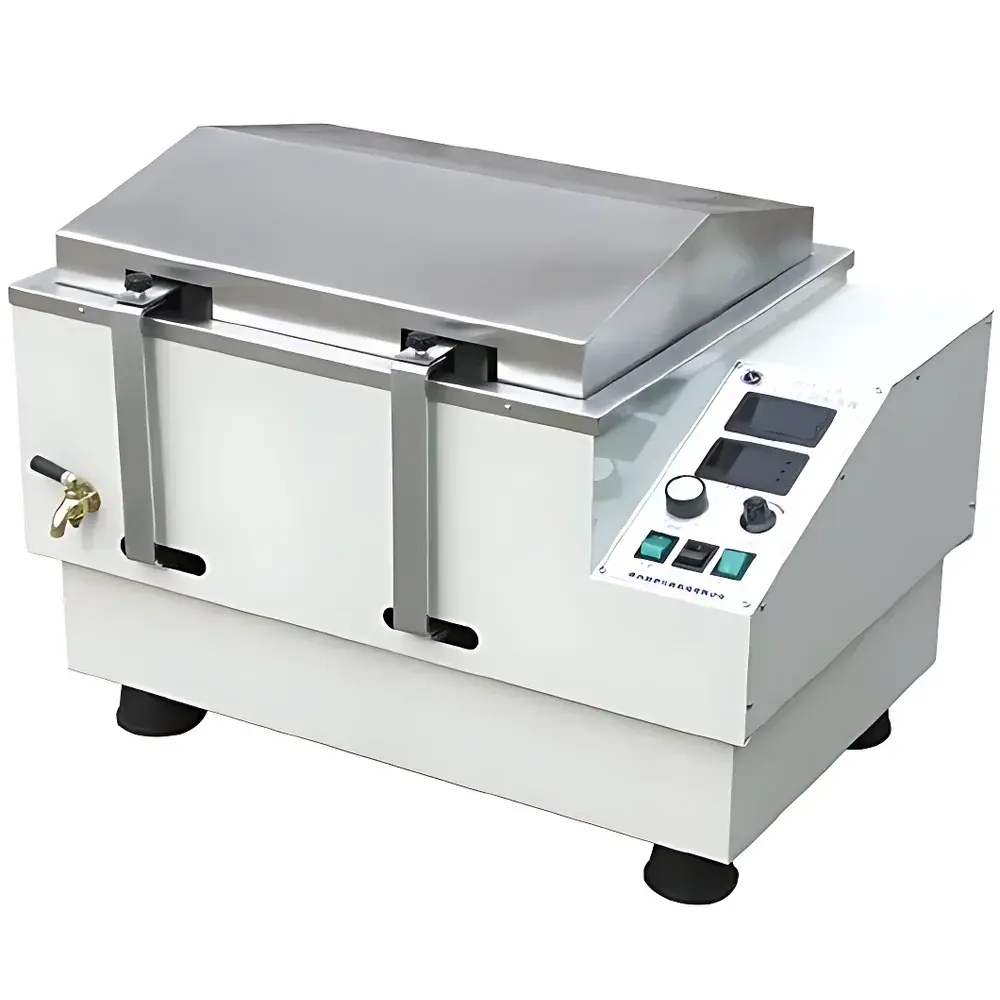
CZGY SHA-B Water Bath Constant-Temperature Orbital & Reciprocal Shaker
| Brand | CZGY |
|---|---|
| Origin | Jiangsu, China |
| Manufacturer Type | Direct Manufacturer |
| Instrument Type | Water Bath Constant-Temperature Shaker |
| Timer Range | 0–120 min |
| Oscillation Frequency | 0–300 rpm |
| Amplitude | 20 mm |
| Temperature Range | Ambient to 100 °C |
| Shelf Quantity | 1 platform |
| Temperature Uniformity | ≤ ±0.5 °C |
| Temperature Stability | ≤ ±0.5 °C |
| Heating Power | 1500 W |
| Power Supply | 220 V ±10%, 50 Hz ±1 Hz |
| Dimensions (L×W×H) | 700 × 550 × 490 mm |
| Compatible Vessels | φ16 × 300 mm test tubes |
Overview
The CZGY SHA-B Water Bath Constant-Temperature Orbital & Reciprocal Shaker is an integrated laboratory instrument engineered for precision-controlled incubation and agitation of biological and biochemical samples in aqueous environments. It combines a thermostatically regulated water bath with dual-mode mechanical oscillation—supporting both orbital (circular) and reciprocal (linear back-and-forth) motion—to accommodate diverse culturing, solubilization, extraction, and suspension protocols. Its operational principle relies on Peltier-free resistive heating and PID-controlled thermal feedback within a stainless-steel water chamber, ensuring rapid heat-up and high reproducibility across the full temperature range (ambient to 100 °C). The shaker’s mechanical drive employs a robust eccentric cam mechanism with spring-suspended platform support, enabling stable, low-vibration motion at speeds from 0 to 300 rpm and a fixed 20 mm amplitude—optimized for uniform mixing without splashing or foaming. Designed for compliance with standard laboratory safety and performance expectations, it serves as a foundational tool in cell culture preparation, microbial growth studies, enzyme kinetics assays, and reagent equilibration workflows.
Key Features
- Dual oscillation modes: switchable orbital and reciprocal motion via front-panel controls—enabling method-specific optimization for suspension homogeneity, cell monolayer detachment, or gentle particle resuspension.
- Digital LED display for simultaneous real-time monitoring of set/actual temperature and rotational speed—enhancing protocol traceability and operator confidence.
- Precision PID temperature control with ≤ ±0.5 °C stability and uniformity—validated across the entire water bath volume using calibrated reference probes.
- Stainless-steel inner chamber (SUS304 grade) with seamless welding—resistant to corrosion from saline buffers, acidic/basic solutions, and repeated sterilization cycles.
- Adjustable timer function (0–120 minutes) with auto-shutdown capability—supporting unattended operation while mitigating risk of sample overheating or over-agitation.
- Universal spring-loaded clamping system—compatible with standard glassware including test tubes (φ16 × 300 mm), Erlenmeyer flasks (100–250 mL), and custom vessel configurations.
- Thermally insulated outer housing and anti-slip rubber feet—reducing ambient heat loss and preventing lateral displacement during high-speed operation.
Sample Compatibility & Compliance
The SHA-B accommodates common laboratory vessels used in life science applications, including cylindrical test tubes, conical flasks, and multi-well plate carriers (with optional adapters). Its water bath design ensures uniform thermal transfer to samples immersed directly in the heated medium—ideal for temperature-sensitive biologicals such as primary cells, bacterial cultures, and protein solutions. The unit complies with general electrical safety standards IEC 61010-1 (Laboratory Equipment) and meets CE marking requirements for electromagnetic compatibility (EMC Directive 2014/30/EU). While not certified for GMP or GLP environments out-of-the-box, its digital parameter logging, stable thermal performance, and mechanical repeatability support integration into validated workflows under ISO/IEC 17025-accredited laboratories when paired with external calibration records and maintenance logs.
Software & Data Management
The SHA-B operates as a standalone analog-digital hybrid instrument with no embedded firmware or network connectivity. All operational parameters—including temperature setpoint, speed, and timer duration—are configured manually via tactile rotary dials and push-button interface. No proprietary software is required or provided; however, users may integrate the device into broader lab data ecosystems by pairing it with external environmental loggers (e.g., HOBO UX100 series) or LIMS-compatible sensors for time-stamped temperature and runtime tracking. For audit readiness, manual entry of operating conditions into electronic lab notebooks (ELNs) is recommended, particularly when supporting FDA 21 CFR Part 11-compliant documentation practices in regulated QC/QA settings.
Applications
- Microbial culture expansion in liquid media (E. coli, yeast, mammalian suspension lines)
- Antibiotic susceptibility testing (AST) requiring controlled temperature and agitation
- Enzyme reaction kinetics under thermally stabilized conditions
- DNA/RNA extraction buffer equilibration and lysis step enhancement
- Antigen-antibody binding optimization in immunoassay development
- Preparation of homogeneous cell suspensions prior to flow cytometry or plating
- Accelerated stability studies of biopharmaceutical formulations in aqueous matrices
FAQ
Can the SHA-B operate continuously without the timer?
Yes—the timer can be disabled to enable indefinite operation; the unit will maintain set temperature and speed until manually powered off.
Is the water bath depth sufficient for submerging 250 mL flasks?
Yes—the bath chamber accommodates standard 250 mL Erlenmeyer flasks up to 12 units simultaneously, with minimum water level requirements specified in the user manual (≥60 mm above flask base).
Does the unit support external temperature probe input for sample-core monitoring?
No—temperature control is based solely on internal bath sensor feedback; external probe integration requires third-party data acquisition hardware.
What maintenance is required to ensure long-term thermal accuracy?
Biannual verification using NIST-traceable thermometer and annual cleaning of heater element surface with mild citric acid solution to prevent scale buildup.
Can orbital and reciprocal modes be used simultaneously?
No—modes are mutually exclusive and selected manually; simultaneous activation is mechanically prohibited by the drive architecture.






