
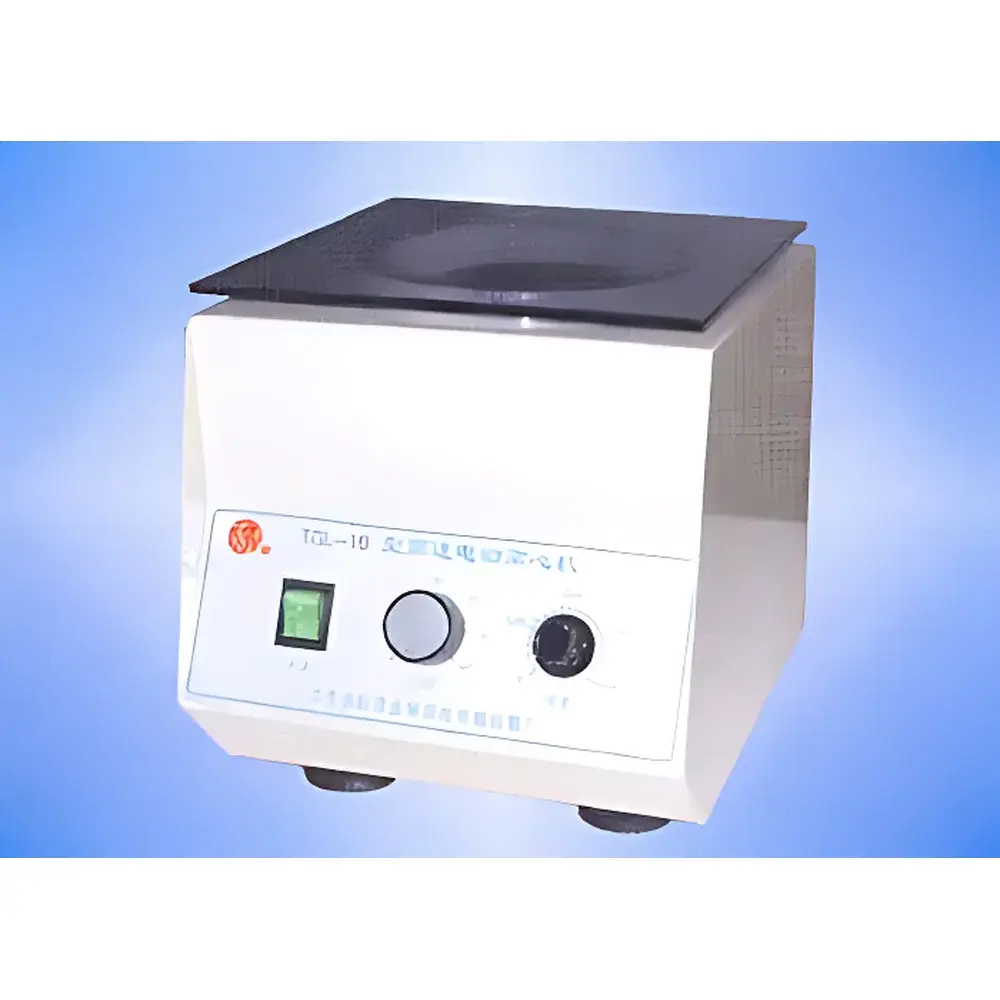
CZGY TGL-16 High-Speed Benchtop Centrifuge
| Brand | CZGY |
|---|---|
| Origin | Jiangsu, China |
| Manufacturer | CZGY Instrument Co., Ltd. |
| Model | TGL-16 |
| Max Speed | 16000 rpm |
| Max RCF | 17000 × g |
| Capacity | 12 × 1.5 mL or 12 × 0.5 mL microtubes |
| Timer Range | 0–60 min |
| Power Supply | 220 V, 50 Hz, 250 W |
| Dimensions (W×D×H) | 290 × 330 × 260 mm |
| Weight | Approx. 18 kg |
| Rotor Material | Anodized Aluminum Alloy |
| Safety Certification | CE-compliant design per IEC 61010-2-020 (Centrifuges) |
Overview
The CZGY TGL-16 is a high-speed benchtop centrifuge engineered for precision microsample separation in research and quality control laboratories. Operating on the principle of radial acceleration-induced sedimentation, it generates up to 17,000 × g at its maximum rotational speed of 16,000 rpm—sufficient to pellet subcellular organelles, nucleic acids, and protein complexes from microliter-scale volumes. Designed with direct-drive brushless motor technology and passive air-cooling architecture, the unit delivers stable rotational performance with low acoustic emission (<58 dB(A)) and minimal thermal drift during extended runs. Its compact footprint (290 × 330 × 260 mm) and integrated vacuum suction feet enable secure placement on standard lab benches, cold rooms (4 °C), or refrigerated workstations—subject to ambient humidity control and post-run drying protocols as specified in operational guidelines.
Key Features
- High-efficiency brushless DC motor delivering consistent torque across the full speed range (0–16,000 rpm) with ±50 rpm speed accuracy
- Dual-layer stainless steel safety housing with interlocked lid mechanism compliant with IEC 61010-2-020 mechanical hazard requirements
- Auto-balancing rotor assembly accommodating twelve 0.5 mL or twelve 1.5 mL conical microcentrifuge tubes (polypropylene, polyethylene, or polycarbonate; max tube mass: 1.2 g)
- Precise digital timer (0–60 min, 1-second resolution) with automatic rotor deceleration and audible end-of-run signal
- Low-thermal-load design: temperature rise ≤ 8 °C after 30-min continuous operation at 16,000 rpm under ambient conditions (25 °C, 50% RH)
- Vibration-dampened chassis and precision-machined aluminum rotor ensure long-term mechanical stability and reproducible RCF values
Sample Compatibility & Compliance
The TGL-16 supports routine use with standard ISO 7218-compliant microcentrifuge tubes (0.5 mL and 1.5 mL formats), including those certified for low-binding applications in nucleic acid isolation workflows. Rotor geometry is optimized for uniform radial distribution of centrifugal force, minimizing shear-induced degradation of sensitive biomolecules. While not validated for biosafety level 3 (BSL-3) containment, the unit meets general laboratory safety standards for non-aerosolizing applications in GLP-aligned environments. All electrical components conform to CE marking requirements under Directive 2014/30/EU (EMC) and 2014/35/EU (LVD). Documentation includes factory-calibrated speed verification reports traceable to national metrology institutes.
Software & Data Management
As a manually operated analog-digital hybrid instrument, the TGL-16 does not incorporate embedded firmware or network connectivity. Operational parameters are set via front-panel membrane switches with LED display feedback. No electronic audit trail or 21 CFR Part 11 compliance is provided; however, users may integrate manual logbook entries into existing LIMS or ELN systems following SOP-defined procedures for equipment usage tracking. Routine maintenance records—including rotor usage cycles, cleaning logs, and calibration verifications—should be retained per institutional GLP/GMP documentation policies.
Applications
- Routine pelleting of bacterial cells, yeast, and mammalian cell lysates prior to SDS-PAGE or Western blot analysis
- Clarification of PCR reaction mixtures and spin-column-based DNA/RNA purification workflows
- Concentration of dilute protein solutions (e.g., antibody eluates, affinity-purified enzymes) in microvolume formats
- Phase separation in small-scale solvent extraction protocols (e.g., phenol-chloroform RNA isolation)
- Preparative centrifugation of nanoscale particles (e.g., exosomes, liposomes) when combined with appropriate density gradients
- Quality assurance testing of reagent stability and particulate contamination in diagnostic assay development
FAQ
What is the maximum relative centrifugal force (RCF) achievable with the TGL-16?
The TGL-16 achieves a maximum RCF of 17,000 × g at 16,000 rpm with the standard fixed-angle rotor (radius = 8.4 cm).
Can the centrifuge be operated inside a cold room or refrigerator?
Yes—provided ambient humidity remains below 70% RH and the unit is run unloaded for 5 minutes post-use to prevent condensation-induced corrosion.
Is rotor imbalance detection automated?
No. The TGL-16 relies on visual symmetry checking of tube placement and mass equivalence (±0.1 g tolerance recommended); automatic imbalance sensing is not implemented.
What voltage stabilization is required for reliable operation?
A line-regulated AC supply (220 V ± 5%, 50 Hz) is mandatory; in regions with unstable grid voltage, an external servo-controlled voltage stabilizer (≥500 VA rating) is advised.
Does the unit include rotor lifetime tracking or usage logging?
No. Rotor service life must be managed manually per manufacturer’s recommendation (maximum 10,000 cycles or 5 years, whichever occurs first), with periodic visual inspection for stress cracks or pitting.



