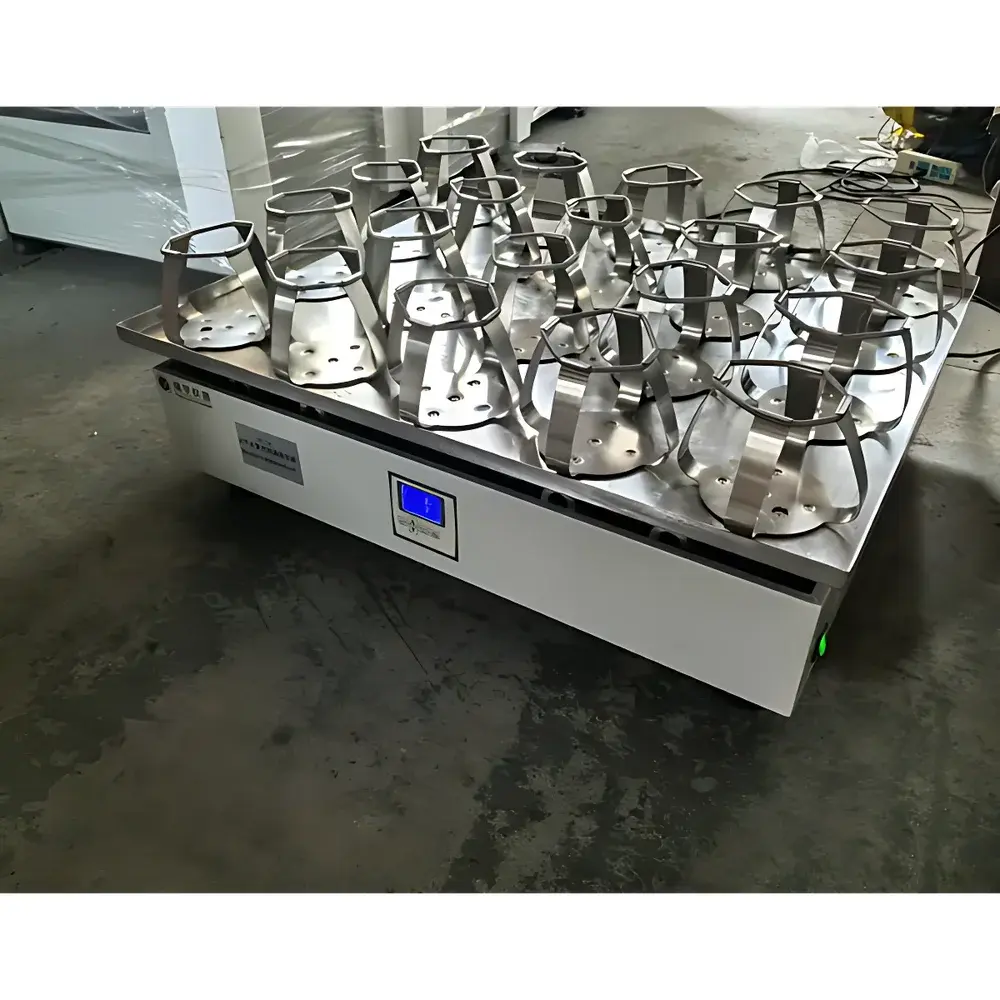
CZGY ZW08A20 Horizontal Tumbling Shaker for Toxicity Characterization of Solid Waste
| Brand | CZGY |
|---|---|
| Origin | Jiangsu, China |
| Manufacturer Type | Direct Manufacturer |
| Instrument Category | Domestic |
| Model | ZW08A20 |
| Price Range | USD 350–630 (FOB) |
| Instrument Type | Horizontal Reciprocating Shaker |
| Timer Range | 0–9999 seconds / minutes / hours |
| Oscillation Frequency | 30–200 rpm |
| Speed Accuracy | ±1 rpm |
| Oscillation Mode | Reciprocating |
| Amplitude | 40 mm |
| Number of Platforms | 1 |
| Platform Material | Stainless Steel |
| Clamp Configuration | 20 × 2-L PE bottle clamps |
| Enclosure Material | Powder-coated cold-rolled steel |
| Motor Type | Brushless DC motor |
| Power Supply | 220 V, 50 Hz |
| Compliance | HJ 557–2010, HJ/T 299–2007 (modified), HJ 2009–2011 |
Overview
The CZGY ZW08A20 Horizontal Tumbling Shaker is a purpose-engineered laboratory instrument designed specifically to perform standardized leaching procedures for toxicity characterization of solid waste in accordance with the People’s Republic of China Environmental Protection Standard HJ 557–2010 – Leaching Procedure for Toxicity Identification of Solid Waste: Horizontal Tumbling Method. This method simulates the physicochemical interaction between solid waste and aqueous leachate under controlled mechanical agitation—mimicking field conditions such as landfill percolation or surface water runoff. The shaker facilitates reproducible extraction of soluble contaminants—including heavy metals (e.g., Pb, Cd, Cr, Hg), cyanide, fluoride, and organic pollutants—enabling quantitative assessment against regulatory threshold limits. As defined in national hazardous waste identification protocols, exceeding these thresholds classifies the material as hazardous, thereby triggering specific handling, transport, treatment, and disposal requirements under China’s Ministry of Ecology and Environment (MEE) framework. The ZW08A20 implements a robust reciprocating motion profile at precisely regulated frequencies and amplitude, ensuring uniform energy transfer across heterogeneous solid matrices without particle attrition or preferential channeling.
Key Features
- Brushless DC motor drive delivering stable rotational output from 30 to 200 rpm with ±1 rpm speed accuracy—engineered for long-term duty cycles under continuous load without thermal drift or maintenance.
- Single stainless-steel oscillating platform (40 mm reciprocating amplitude) supporting up to twenty 2-L polyethylene (PE) bottles simultaneously—compatible also with borosilicate glass and PTFE containers per HJ 557–2010 Section 6.2.
- Full-function LCD control interface enabling programmable timer settings in seconds, minutes, or hours (0–9999 units), real-time RPM display, and immediate start/pause/resume functionality.
- Powder-coated cold-rolled steel enclosure with stainless-steel interior chamber and platform—resistant to chemical corrosion, moisture ingress, and mechanical wear during routine decontamination.
- Low-noise operation (<55 dB[A] at 1 m) achieved through precision-balanced drive train and vibration-damped mounting—suitable for shared laboratory environments requiring acoustic compliance.
Sample Compatibility & Compliance
The ZW08A20 accommodates standard leaching vessels specified in HJ 557–2010 and its technical corollaries (e.g., HJ/T 299–2007 modified TCLP analog, HJ 2009–2011). It supports 2-L PE bottles (ASTM D5233-compliant material grade), Type I borosilicate glass jars, and fluoropolymer-lined containers for aggressive analytes. All clamp fixtures are passivated stainless steel (AISI 304), minimizing metal ion leaching during extended runs. The instrument meets structural and operational criteria outlined in HJ 2009–2011 “Technical Specifications for Equipment Used in Solid Waste Leaching Tests”, including platform flatness tolerance (±0.5 mm), amplitude consistency (±2 mm), and mechanical stability under full load (20 × 2 L @ 1.2 g/mL density). While not certified to ISO/IEC 17025, its design aligns with GLP principles for method validation documentation, audit-ready parameter logging, and traceable calibration records.
Software & Data Management
The ZW08A20 operates via embedded firmware with no external PC dependency. All timing and speed parameters are stored in non-volatile memory and retain settings after power interruption. Though it lacks Ethernet or USB data export, the device supports manual logging integration into LIMS or ELN platforms via timestamped operator records. For laboratories operating under FDA 21 CFR Part 11 or CNAS-CL01:2018 requirements, users may implement supplementary procedural controls—including dual-operator verification of setpoints, pre-run checklist sign-offs, and post-run printout archiving—to satisfy electronic record integrity expectations. Firmware version and serial number are engraved on the rear panel for configuration management.
Applications
- Toxicity characteristic leaching procedure (TCLP)-equivalent testing for municipal, industrial, and mining solid wastes.
- Leachate generation for subsequent analysis by ICP-MS, AAS, IC, or GC-MS per HJ 442.7–2020 and EPA Method 6010D/7000B.
- Soil and sediment contaminant mobilization studies under simulated rainfall or groundwater infiltration scenarios.
- Method development and inter-laboratory comparison trials for regulatory round-robin programs administered by provincial EPBs.
- Academic research in environmental geochemistry, landfill bioreactor modeling, and stabilization/solidification efficacy evaluation.
FAQ
Is the ZW08A20 compliant with international standards such as EPA SW-846 Method 1311?
The ZW08A20 conforms to HJ 557–2010, which is China’s nationally adopted equivalent to EPA Method 1311. While mechanical specifications (amplitude, frequency range, vessel support) overlap significantly, formal cross-validation per ASTM D5233 or ISO 11268-2 requires lab-specific performance qualification.
Can the shaker accommodate vessels other than 2-L PE bottles?
Yes—custom clamp adapters can be fabricated for 1-L glass jars, 500-mL PTFE vials, or stacked multi-compartment leaching cells, provided total mass per platform remains ≤40 kg and center-of-gravity alignment is maintained.
What maintenance is required for the brushless DC motor?
None—brushless architecture eliminates commutator wear, carbon dust accumulation, and periodic brush replacement. Annual inspection of belt tension (if equipped) and platform bearing lubrication is recommended per manufacturer guidelines.
Does the instrument include validation documentation for GLP audits?
Factory calibration certificates and mechanical verification reports (amplitude, speed, timer accuracy) are provided upon request. Full IQ/OQ documentation packages are available as optional add-ons for regulated laboratories.
Is remote monitoring or network connectivity supported?
No—this is a standalone benchtop instrument. Integration with building management systems or SCADA networks requires third-party IoT gateway hardware and custom protocol mapping.