
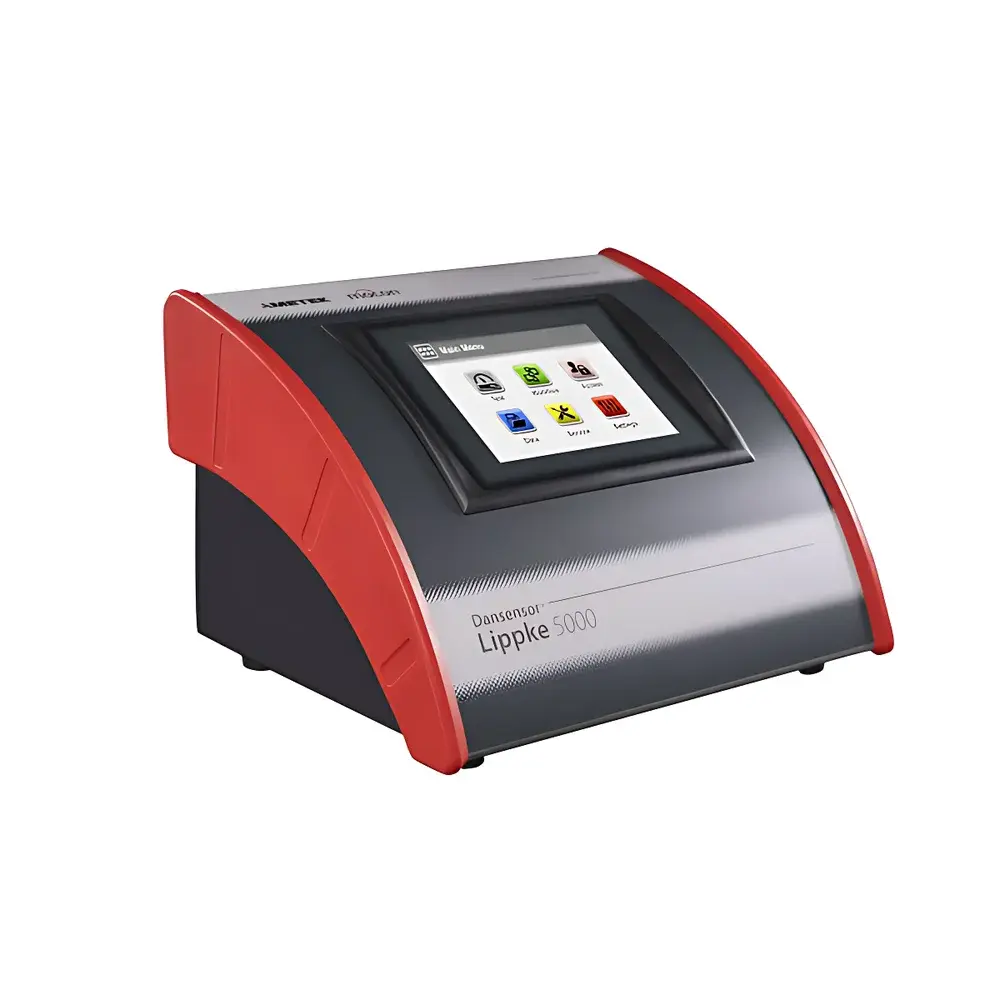
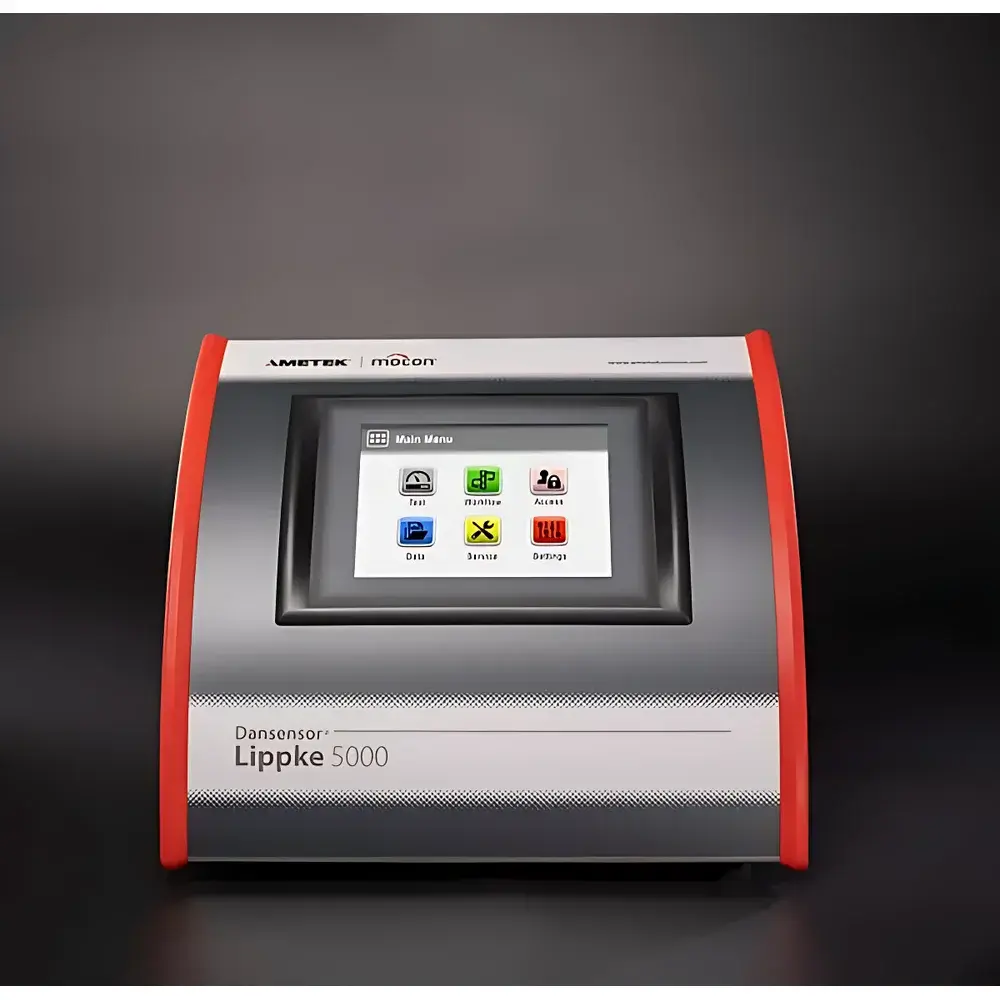
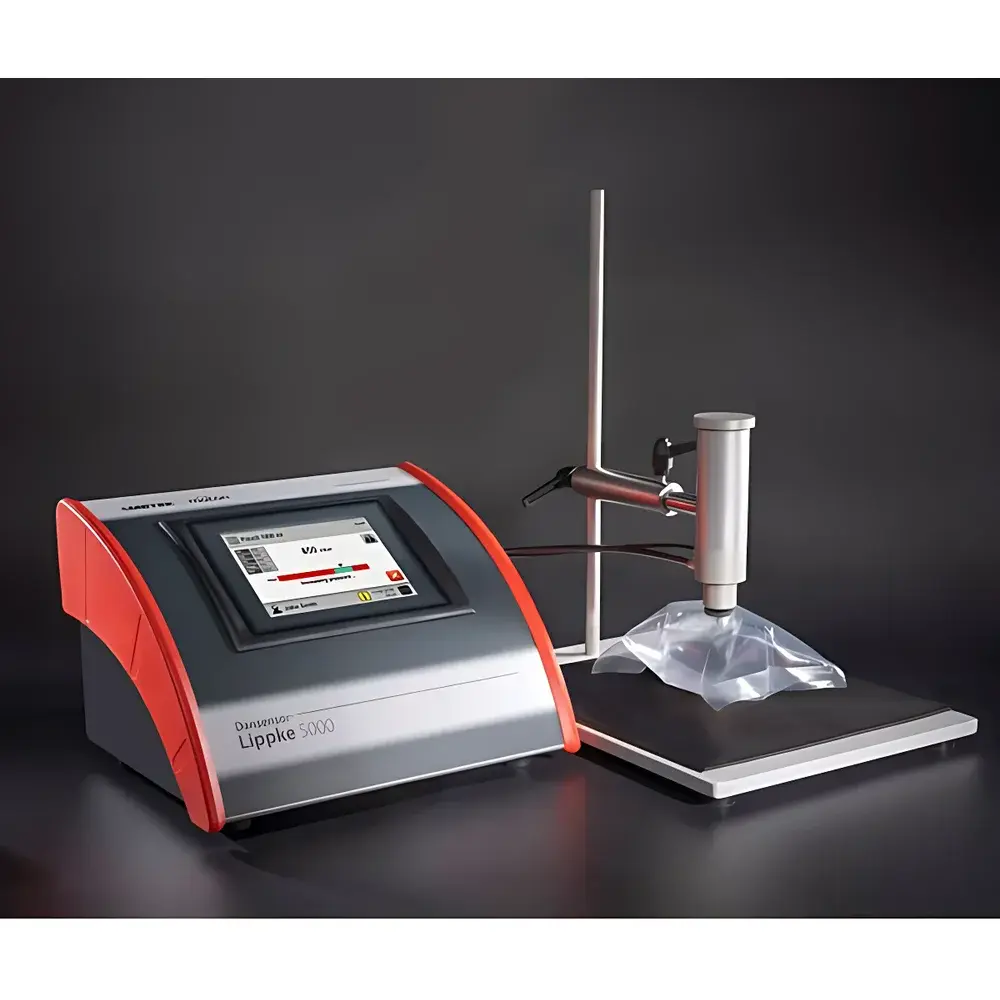
Dansensor Lippke 5000 Packaging Integrity Tester
| Brand | MOCON |
|---|---|
| Origin | Denmark |
| Model | Lippke 5000 |
| Test Pressure Range | 10–5000 mbar |
| Resolution | 0.1 mbar (0–1000 mbar), 1 mbar (1000–5000 mbar) |
| Accuracy | ±0.5 mbar or ±1% of reading (whichever is greater) |
| Test Volume Capacity | 0–90,000 mL |
| Test Duration | 1–500 s |
| Data Storage | >1,000,000 records |
| Interface | USB 2.0 (Host & Device), RJ-45 Ethernet |
| Compliance | ASTM F1140, F2054, F2095, F2096 |
Overview
The Dansensor® Lippke 5000 Packaging Integrity Tester is a benchtop pressure-based leak and seal strength measurement system engineered for high-reproducibility evaluation of sterile and modified-atmosphere packaging across pharmaceutical, medical device, food, and consumer health sectors. It operates on the principle of controlled pneumatic pressurization—introducing regulated compressed air into sealed packages and quantifying pressure decay, sustained pressure response, or catastrophic failure under defined load conditions. Unlike tracer-gas methods, the Lippke 5000 requires no external gas supply or consumables, delivering rapid, deterministic results through direct mechanical assessment of package integrity. Its architecture supports five standardized test modalities—burst, leak (pressure decay), creep, bubble, and combinational protocols—each aligned with internationally recognized test standards. Designed for both QC laboratories and production-floor environments, the instrument delivers traceable, auditable, and statistically robust data without compromising operational simplicity.
Key Features
- Multi-modal testing capability: Burst (ASTM F2054), pressure decay leak (ASTM F2095), creep (ASTM F1140), bubble (ASTM F2096), and programmable combinations (e.g., creep + burst, creep + leak + burst) via optional PC software
- Extended volume range: Validated for packages up to 90 L (90,000 mL), accommodating pouches, trays, blister cards, rigid containers, and foil-laminated structures
- High-resolution pressure sensing: 0.1 mbar resolution below 1000 mbar; ±0.5 mbar absolute accuracy or ±1% of reading (whichever is greater)
- Integrated graphical user interface (GUI): Multilingual touchscreen interface with intuitive navigation, real-time pressure curve visualization, and on-device pass/fail logic
- Regulatory-compliant data handling: Built-in audit trail, electronic signatures, and data export in CSV format via dual USB ports (Type A host, Type B device); fully compliant with FDA 21 CFR Part 11 requirements
- Modular accessory ecosystem: Optional barcode scanner, thermal label printer, handheld probe kit, and needle-probe fixture for flexible sample interfacing
- Enhanced pneumatic efficiency: Reduced fill time, minimized overpressure overshoot, and stable pressure ramping across full 10–5000 mbar range (0.145–72.5 psi)
Sample Compatibility & Compliance
The Lippke 5000 accommodates diverse packaging formats—including flexible laminates, semi-rigid thermoformed trays, aluminum foil composites, porous medical packaging, and multilayer barrier films—without requiring material-specific calibration. Its pressure-based methodology eliminates dependency on gas permeability or diffusion kinetics, making it universally applicable to non-porous and low-permeability structures. All test methods are explicitly referenced in globally accepted regulatory frameworks: ASTM F1140 (burst and creep without restraining plate), ASTM F2054 (burst with restraining plate), ASTM F2095 (pressure decay leak testing), ASTM F2096 (bubble emission detection), and ISO 11607-1/-2 (packaging for terminally sterilized medical devices). The system supports IQ/OQ documentation packages and integrates seamlessly into GLP- and GMP-aligned quality systems, including validation workflows requiring documented traceability, change control, and user access management.
Software & Data Management
The embedded firmware provides local test execution, result classification, and immediate statistical summary (mean, SD, min/max, CPK). For advanced analysis, the optional Lippke PC Software extends functionality with multi-curve overlay, trend charting, SPC control charts, batch-level reporting, and automated PDF certificate generation. All data—including raw pressure vs. time traces, operator ID, timestamp, environmental metadata (ambient T/RH), and test parameters—is stored in an encrypted internal database with write-once-read-many (WORM) protection. USB export preserves full metadata fidelity; Ethernet connectivity enables remote monitoring and integration with LIMS or MES platforms. Audit logs record every configuration change, user login/logout, and result modification event—satisfying 21 CFR Part 11’s requirements for electronic records and signatures.
Applications
- Pharmaceutical primary packaging: Seal integrity verification of blister packs, sachets, and vial stoppers prior to release
- Sterile medical device packaging: Validation of peel seals, heat seals, and form-fill-seal integrity per ISO 11607-2
- Food packaging QA: Detection of micro-leaks in vacuum-sealed pouches, MAP trays, and retortable containers
- R&D process development: Quantitative comparison of sealant formulations, sealing parameter optimization (time/temperature/pressure), and aging studies
- Supplier qualification: Objective benchmarking of contract manufacturer seal performance against internal specifications
- Regulatory submissions: Generation of repeatable, standard-compliant datasets for FDA 510(k), PMA, or EU MDR technical files
FAQ
Does the Lippke 5000 require helium or other tracer gases?
No. It uses compressed air as the test medium and relies on pressure decay or mechanical response—eliminating gas sourcing, calibration drift, and safety concerns associated with flammable or asphyxiant gases.
Can it test porous packaging such as Tyvek® lids?
Yes. The system distinguishes between inherent material permeability and defect-driven leakage by applying standardized dwell times and pressure thresholds per ASTM F2095 and F2096.
Is IQ/OQ support available?
Yes. MOCON provides factory-validated Installation Qualification (IQ) and Operational Qualification (OQ) documentation kits, including test scripts, acceptance criteria, and completed templates for immediate use in regulated environments.
What is the maximum recommended ambient temperature for operation?
The instrument is rated for continuous operation between +2 °C and +25 °C. Storage is permitted from –20 °C to +60 °C, though condensation must be avoided during transitions.
How is data security ensured under 21 CFR Part 11?
Through role-based user authentication, electronic signature capture, immutable audit trails, automatic backup logging, and encrypted local storage—all implemented at the firmware level and verified during OQ.
Related Products





