
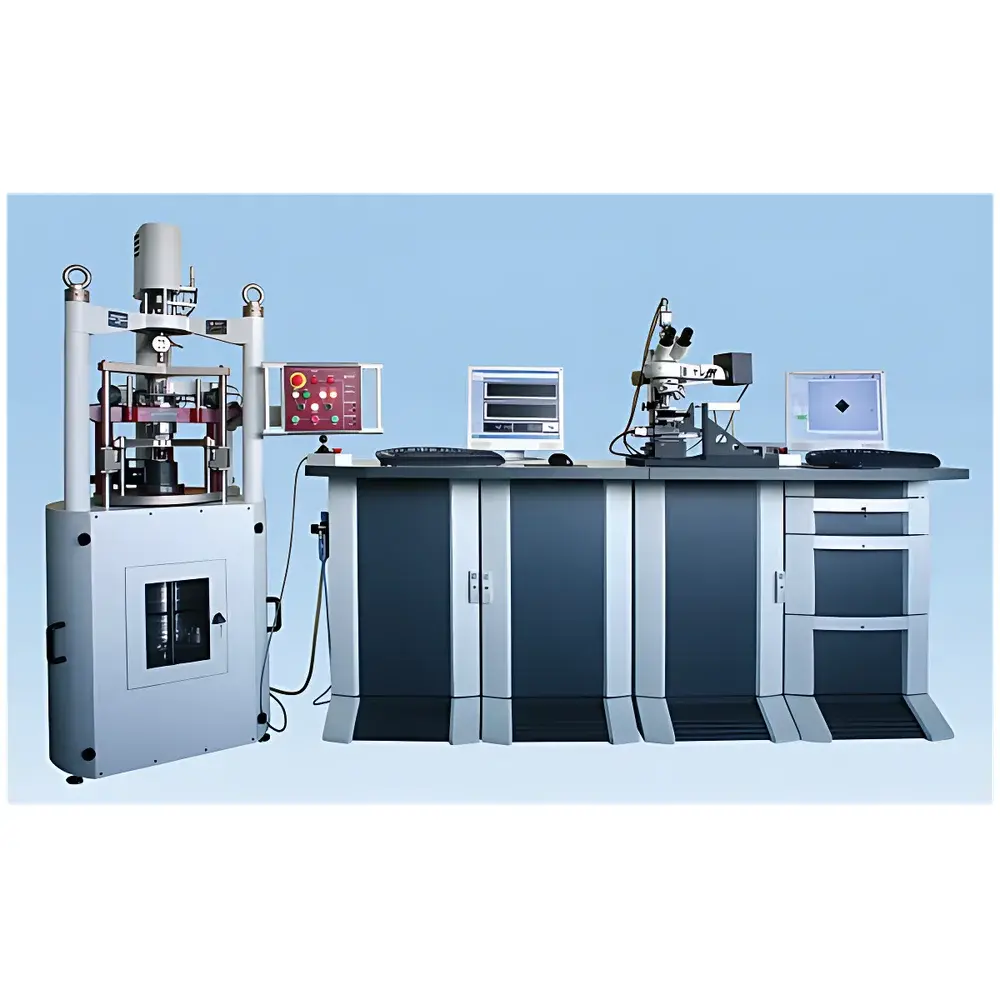
Dantsin Galieo Standard Hardness Tester
| Brand | Dantsin |
|---|---|
| Origin | Switzerland |
| Manufacturer Type | Authorized Distributor |
| Origin Category | Imported |
| Model | Galieo |
| Pricing | Upon Request |
Overview
The Dantsin Galieo Standard Hardness Tester is a precision-engineered metrological instrument developed in collaboration with the Italian National Institute of Metrology (INRIM). Designed for primary and secondary hardness calibration laboratories, it serves as a reference-grade system compliant with international hardness standardization frameworks—including ISO 6506 (Brinell), ISO 6507 (Vickers), ISO 6508 (Rockwell), and ASTM E10, E384, and E18. Its mechanical architecture follows classical dead-weight loading principles, ensuring traceable force application without electronic load cell drift or servo-loop artifacts. The Galieo operates exclusively in manual or semi-automated mode, prioritizing mechanical stability, long-term repeatability, and direct SI-traceable force generation—making it suitable for national metrology institutes (NMIs), accredited calibration labs, and ISO/IEC 17025-certified testing facilities requiring definitive hardness reference values.
Key Features
- Traceable force generation via calibrated dead-weight system with lever amplification, eliminating dependency on electronic transducers
- Modular indenter turret supporting Brinell (HBW), Vickers (HV), and Rockwell (HRC, HRB, HRA) configurations with certified geometry and surface finish per ISO 6507-2 and ISO 6508-2
- Rigid C-frame construction with granite base and hardened steel load train to minimize deflection under test loads (ranging from 1 kgf to 3000 kgf depending on configuration)
- Optical measurement system featuring dual-axis micrometric eyepiece with calibrated reticle for manual indentation dimension assessment; compatible with optional digital image analysis modules meeting ISO 6507-3 requirements
- Compliance-ready mechanical design enabling full auditability of force path, alignment, and environmental influence factors (e.g., temperature drift, vibration isolation)
Sample Compatibility & Compliance
The Galieo accommodates flat, parallel, and polished specimens up to 250 mm in height and 300 mm in diameter, with minimum thickness ≥ 10× indentation depth. It supports metallic materials including steels, aluminum alloys, copper, titanium, and cast irons—as well as sintered metals and hard-facing coatings where standardized indentation methods apply. All operational procedures align with ISO/IEC 17025:2017 clause 7.2 (method validation) and clause 7.7 (equipment verification). Calibration certificates issued by NMIs using the Galieo are accepted by EURAMET, APMP, and BIPM-associated intercomparisons. The system meets the mechanical integrity requirements outlined in ISO 6506-2 Annex A and ISO 6507-2 Annex B for reference hardness testers.
Software & Data Management
While the Galieo Standard model emphasizes mechanical integrity over embedded automation, it integrates seamlessly with third-party metrology software platforms compliant with ISO/IEC 17025 data integrity protocols. Optional PC-based control modules support GLP/GMP-compliant data capture—including user authentication, electronic signatures, and full audit trails per FDA 21 CFR Part 11. Raw indentation measurements (d1/d2 for Vickers/Brinell; depth for Rockwell) are exportable in CSV and XML formats. Uncertainty budgets can be generated in accordance with GUM (JCGM 100:2008) and EURAMET cg-19 guidelines for hardness calibration.
Applications
- Primary calibration of hardness reference blocks at national metrology institutes (e.g., NIST, NPL, PTB, KRISS, NIM)
- Verification and recalibration of industrial hardness testers across automotive, aerospace, and energy sectors
- Participation in international key comparisons (KCDB entries) under CIPM MRA framework
- Validation of hardness testing procedures in ISO 9001 and AS9100 quality management systems
- Research into indentation size effect (ISE), strain-rate sensitivity, and anisotropic hardness behavior in advanced alloys and additively manufactured components
FAQ
Is the Galieo Standard Hardness Tester certified for use in ISO/IEC 17025 laboratories?
Yes—it meets the mechanical and metrological requirements specified in ISO/IEC 17025:2017 clauses 6.4 (equipment) and 7.2 (method validation), and has been deployed in over 12 accredited NMIs worldwide.
Does the system support automated indentation measurement?
The base Galieo Standard model uses manual optical measurement; however, optional digital imaging modules with NIST-traceable pixel calibration are available for semi-automated analysis per ISO 6507-3.
What hardness scales can be performed with this instrument?
Brinell (HBW 1–3000), Vickers (HV 1–1000), and Rockwell (A, B, C, D, E, F, G, K, L, M, P, R, S, T scales) configurations are supported through interchangeable indenters and load units.
How is force traceability maintained?
Force is generated via certified stainless-steel dead weights, independently verified against national mass standards; lever ratio is mechanically fixed and documented in the type evaluation report issued by INRIM.
Can the Galieo be used for uncertainty budgeting in calibration reports?
Yes—its deterministic mechanical design enables rigorous Type A and Type B uncertainty evaluation per GUM, with documented contributions from alignment error, surface flatness, indenter geometry, and environmental thermal expansion.



