
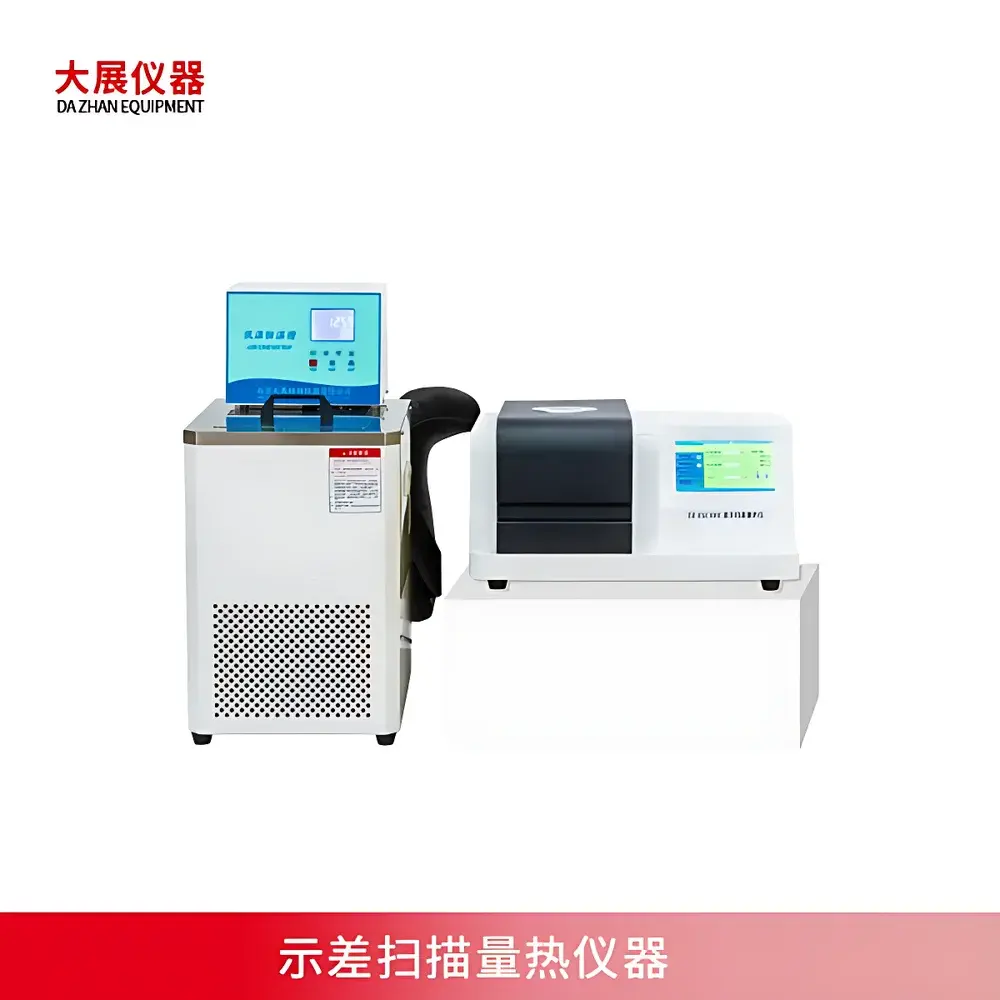
DAZHAN DZ-DSC300C Differential Scanning Calorimeter
| Brand | DAZHAN |
|---|---|
| Origin | Jiangsu, China |
| Model | DZ-DSC300C |
| Temperature Range | −40 to 600 °C |
| Heating/Cooling Rate | 0.1–100 K/min (heating), 0.1–40 K/min (cooling) |
| DSC Signal Range | 0–±800 mW (expandable) |
| Temperature Stability | ±0.01 °C |
| Temperature Resolution | 0.001 °C |
| DSC Sensitivity | 0.001 mW |
| Atmosphere Control | Dual-gas auto-switching (up to 200 mL/min, ≤0.5 MPa), plus dedicated purge gas inlet |
| Thermal Program | Up to 6-segment ramp/hold |
| Display | 7-inch 24-bit color LCD touchscreen |
| Interface | Standard USB with auto-reconnect capability |
| Power Supply | AC 220 V / 50 Hz (customizable) |
| Calibration Standards Included | Indium, Tin, Lead |
Overview
The DAZHAN DZ-DSC300C is a high-stability, microprocessor-controlled differential scanning calorimeter engineered for precise thermal characterization of solid and semi-crystalline materials across a broad operational temperature range (−40 °C to 600 °C). Based on the heat-flux DSC principle, the instrument measures the difference in heat flow between a sample and an inert reference as both are subjected to identical, programmable thermal profiles—enabling quantitative determination of endothermic and exothermic transitions including glass transition (Tg), melting point (Tm), crystallization onset (Tc), enthalpy of fusion (ΔHf), degree of crystallinity, cure kinetics, oxidative induction time (OIT), and phase transformation behavior. Its low-temperature capability down to −40 °C supports analysis of polymers, elastomers, pharmaceutical amorphous dispersions, and cryogenic formulations—making it suitable for R&D laboratories and QC environments where reproducible thermodynamic data under GLP-aligned conditions is required.
Key Features
- Metal-furnace architecture with optimized thermal mass and symmetrical sensor design, delivering superior baseline flatness and long-term signal stability (±0.01 °C temperature fluctuation).
- Intelligent dual-mode control system enabling fully synchronized operation via integrated 7-inch 24-bit color touchscreen or external PC software—eliminating workflow bottlenecks during method development or multi-user deployment.
- Dual independent gas channels with automatic switching logic and dedicated inert purge line; supports precise atmosphere management (N2, Ar, O2, air) at flow rates up to 200 mL/min and pressures ≤0.5 MPa—critical for oxidation studies, polymer degradation analysis, and moisture-sensitive samples.
- High-resolution thermal programming engine supporting up to six user-defined ramp/hold segments, variable heating/cooling rates (0.1–100 K/min heating; 0.1–40 K/min cooling), and extended isothermal holds up to 24 hours.
- USB 2.0 interface with fault-tolerant auto-reconnect protocol ensures uninterrupted data streaming and robust file transfer—even during transient power or cable disconnection events.
- Factory-calibrated with certified reference materials (indium, tin, lead); traceable temperature and enthalpy calibration procedures comply with ISO 11357 and ASTM E794 standards.
Sample Compatibility & Compliance
The DZ-DSC300C accommodates standard aluminum, gold-plated aluminum, and hermetic stainless-steel crucibles (20–50 µL capacity), supporting solids, powders, films, gels, and small-volume liquid samples (≤20 mg typical). It meets essential requirements for regulated environments: raw data files include full audit trails (timestamp, operator ID, method parameters, gas settings, calibration history), supporting alignment with FDA 21 CFR Part 11 when deployed with compliant LIMS or ELN systems. The instrument’s thermal program logic and sensor response characteristics conform to ISO 11357-1 through -7 series for polymer characterization, and its OIT measurement protocol aligns with ASTM D3895 and ISO 11357-6 for oxidative stability assessment.
Software & Data Management
Bundled Windows-based acquisition and analysis software provides real-time curve visualization, baseline correction (tangent, step, polynomial), peak integration, multi-curve overlay, and customizable report generation (PDF, CSV, Excel). All raw data (.dsc binary format) retain embedded metadata—including furnace temperature, DSC signal, gas flow status, and event markers—ensuring full traceability. Software supports batch processing of sequential runs, comparative kinetic modeling (e.g., Ozawa-Flynn-Wall), and export of processed results to third-party platforms such as OriginLab or MATLAB. Optional validation packages include IQ/OQ documentation templates aligned with GMP Annex 15 and ISO/IEC 17025 laboratory accreditation criteria.
Applications
- Materials Science: Quantification of crystallinity in polyolefins, Tg mapping of copolymer blends, cold-crystallization kinetics in PET, and filler-matrix interaction analysis in composites.
- Pharmaceutical Development: Polymorph screening, amorphous content verification, excipient compatibility testing, and thermal stability profiling of lyophilized biologics and hot-melt extrudates.
- Food Science: Fat crystallization behavior, starch gelatinization enthalpy, protein denaturation temperatures, and shelf-life prediction via accelerated oxidation studies.
- Energy Materials: Phase-change material (PCM) enthalpy cycling stability, solid-state electrolyte decomposition onset, and cathode/anode thermal runaway threshold evaluation.
- Quality Control: Batch-to-batch consistency checks for Tm, ΔHf, and OIT; release testing per internal SOPs or pharmacopoeial monographs (e.g., USP <1163>).
FAQ
What reference materials are supplied with the DZ-DSC300C?
Indium (Tm = 156.60 °C, ΔHf = 28.45 J/g), tin (Tm = 231.93 °C), and lead (Tm = 327.50 °C) are included for routine temperature and enthalpy calibration.
Is the instrument compatible with nitrogen and oxygen atmospheres?
Yes—dual-gas auto-switching supports N2, O2, Ar, and synthetic air; optional mass flow controllers enable precise stoichiometric control for combustion or oxidation studies.
Can the DZ-DSC300C perform modulated DSC (MDSC®)?
No—this model implements conventional heat-flux DSC only; MDSC functionality requires additional hardware modules not supported by the DZ-DSC300C platform.
What is the minimum detectable heat flow change?
The instrument achieves a DSC sensitivity of 0.001 mW, validated using low-mass indium standards under ISO 11357-2 conditions.
Does the system support 21 CFR Part 11 compliance out of the box?
The hardware and firmware provide foundational audit-trail capabilities; full Part 11 compliance requires implementation of validated electronic signatures, role-based access control, and secure archive protocols via third-party LIMS or validated software extensions.
Related Products



