
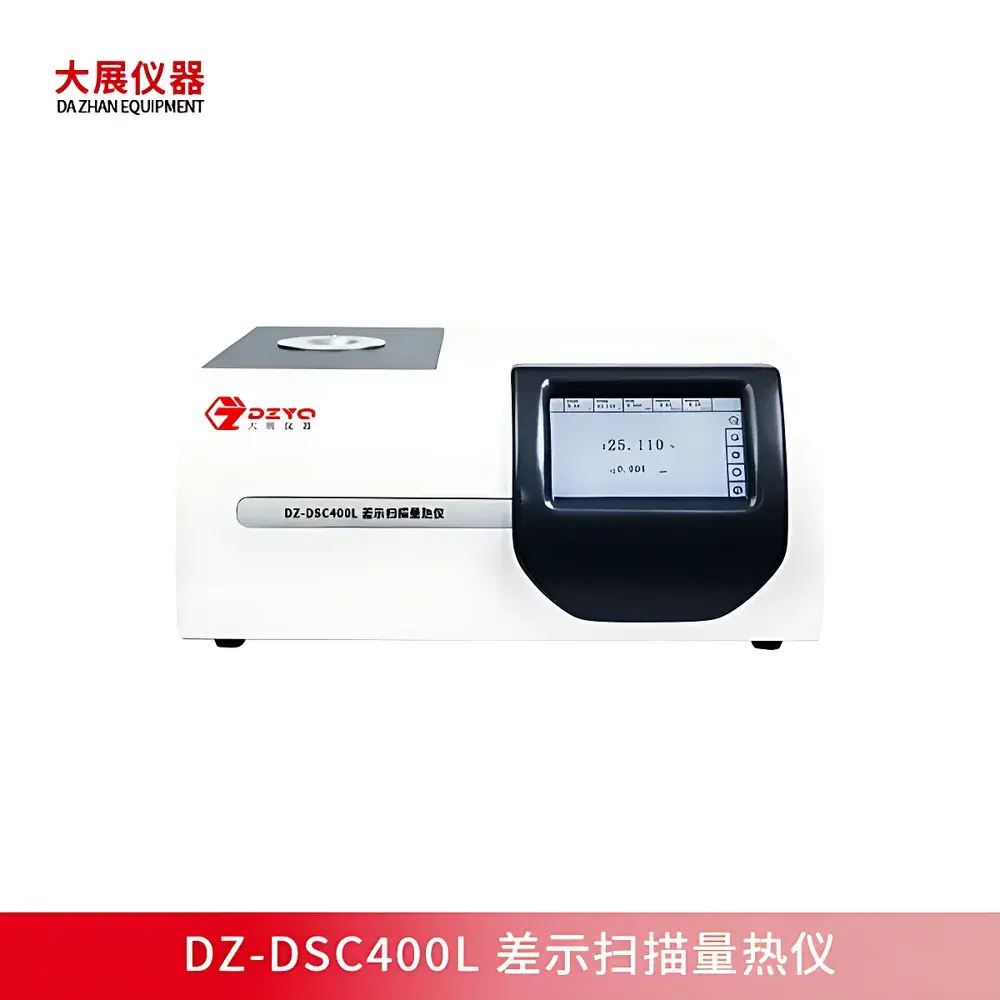
DAZHAN DZ-DSC400L Low-Temperature Differential Scanning Calorimeter
| Brand | DAZHAN |
|---|---|
| Origin | Jiangsu, China |
| Manufacturer Type | Authorized Distributor |
| Country of Origin | China |
| Model | DZ-DSC400L |
| Sample Capacity | Single |
| Instrument Type | Differential Scanning Calorimeter (DSC) |
| Temperature Range | −170 °C to 600 °C |
| Programmable Temperature Control | Intelligent PID |
| Temperature Accuracy | ±0.001 °C |
| Heating/Cooling Rate | 0.1–100 K/min (heating), −0.1 to −80 K/min (cooling) |
| Scan Modes | Isothermal, Heating, Cooling |
| DSC Signal Range | ±1000 mW |
| DSC Sensitivity | 0.0001 mW |
| Temperature Resolution | 0.001 °C |
| Gas Flow Control | Dual-channel mass flow controller (0–200 mL/min, expandable), plus dedicated purge/protect gas inlet |
| Cooling Method | Liquid nitrogen cryogenic cooling (supplemented by optional air-cooling, Peltier, or mechanical refrigeration modules) |
Overview
The DAZHAN DZ-DSC400L is a high-precision low-temperature differential scanning calorimeter engineered for rigorous thermal characterization across academic, industrial, and regulatory laboratory environments. It operates on the principle of heat-flux DSC, measuring the differential heat flow between a sample and an inert reference as both are subjected to identical, precisely controlled temperature programs. This enables quantitative determination of endothermic and exothermic transitions—including glass transition (Tg), melting point (Tm), crystallization onset, solid-solid phase changes, enthalpy of fusion/crystallization, oxidative induction time (OIT), and thermal stability profiles. Its extended low-temperature capability down to −170 °C—achieved via integrated liquid nitrogen cryogenic cooling—makes it uniquely suited for characterizing cryo-sensitive polymers, pharmaceutical amorphous dispersions, battery electrolyte formulations, and low-Tg elastomers where conventional DSC systems fail to resolve critical transitions.
Key Features
- Ultra-low temperature range: −170 °C to 600 °C, enabling full thermal profiling of thermoplastics, biopolymers, cryogenic composites, and advanced battery materials.
- Intelligent dual-loop PID temperature control with real-time feedback, ensuring exceptional thermal stability (<±0.001 °C accuracy) and reproducibility across repeated heating/cooling cycles.
- Modular cooling architecture: Primary liquid nitrogen cooling supplemented by optional Peltier, forced-air, or mechanical refrigeration—allowing user-selectable cooling rates up to −80 K/min and rapid thermal equilibration.
- Optimized furnace design featuring indirect conductive heating, minimizing radiative thermal gradients and delivering superior baseline flatness and signal-to-noise ratio.
- Dual independent mass flow controllers (MFCs) with automatic switching between reactive (e.g., O2, N2) and inert (e.g., Ar, He) atmospheres; includes dedicated third gas inlet for sample protection during sensitive measurements.
- High-dynamic-range DSC sensor: ±1000 mW full-scale output with 0.0001 mW resolution, supporting both macro- and micro-sample analysis (0.1–50 mg) without hardware recalibration.
Sample Compatibility & Compliance
The DZ-DSC400L accommodates standard hermetic and vented aluminum, gold-plated, or stainless-steel crucibles (6.7 mm OD). It supports volatile, hygroscopic, and oxygen-sensitive samples through programmable gas purging and pressure-stabilized atmosphere control. The system complies with core thermal analysis standards including ASTM E794 (melting point), ASTM E1356 (Tg determination), ISO 11357 series (polymer DSC), and USP (pharmaceutical thermal analysis). Data acquisition and instrument operation support audit trails, electronic signatures, and user-access-level permissions—facilitating alignment with GLP, GMP, and FDA 21 CFR Part 11 requirements when deployed with validated software configurations.
Software & Data Management
Control and analysis are performed via DAZHAN’s proprietary Thermal Analysis Suite (v4.2+), a Windows-based platform supporting multi-step temperature programming, automatic peak detection, baseline correction (tangent, step, polynomial), and quantitative enthalpy integration. Raw data are stored in vendor-neutral ASCII (.csv) and universal .tdms formats. The software includes built-in reporting templates compliant with ISO/IEC 17025 documentation requirements, export-ready graphs (SVG/PNG/PDF), and batch processing for comparative studies. All method parameters, calibration logs, and instrument status metadata are embedded in each data file to ensure full traceability.
Applications
- Polymers & Plastics: Quantification of Tg, cold crystallization, melting enthalpy, degree of crystallinity, and aging-induced embrittlement.
- Pharmaceuticals: Solid-state form screening (polymorphs, hydrates, amorphous content), excipient compatibility, and lyophilized product stability assessment.
- Food Science: Fat crystallization kinetics, starch gelatinization, protein denaturation, and shelf-life prediction via OIT under accelerated oxidation conditions.
- Electrochemical Materials: Thermal runaway onset evaluation in cathode/anode materials, SEI layer formation enthalpy, and electrolyte decomposition thresholds.
- Adhesives & Coatings: Cure kinetics modeling, post-cure exotherms, and thermal degradation onset for quality release testing.
FAQ
What cooling methods does the DZ-DSC400L support, and how is liquid nitrogen consumption managed?
The system uses a closed-cycle liquid nitrogen delivery module with automated level sensing and flow regulation. Typical consumption is 1.2–1.8 L/h at −100 °C hold; optional pre-cooling stages reduce LN2 demand by up to 40%. Air-cooling and Peltier modules can be engaged for milder sub-ambient protocols.
Is the instrument compatible with regulated environments requiring 21 CFR Part 11 compliance?
Yes—when operated with validated Thermal Analysis Suite v4.2+ and configured with role-based user accounts, electronic signature workflows, and immutable audit logs, the system meets predicate rules for electronic records and signatures in pharmaceutical and medical device QA/QC labs.
Can the DZ-DSC400L perform simultaneous DSC-TGA coupling?
No—the DZ-DSC400L is a dedicated DSC platform. However, its modular gas manifold and standardized sample pan geometry allow seamless method transfer to DAZHAN’s hybrid DSC-TGA systems (e.g., DZ-DSC/TGA-5000) for correlative thermal analysis.
What calibration standards are recommended for routine verification?
Indium (Tm = 156.60 °C, ΔHfus = 28.45 J/g), zinc (Tm = 419.53 °C), and sapphire (for heat capacity calibration) are recommended per ASTM E967 and ISO 11357-2. DAZHAN provides NIST-traceable calibration kits with certificate of analysis.
Does the system support custom crucible types such as high-pressure or magnetic-field-compatible pans?
Standard configurations use aluminum and gold-plated pans. Custom stainless-steel high-pressure crucibles (up to 10 MPa) and non-magnetic titanium variants are available as OEM options upon request and require firmware configuration validation.



