
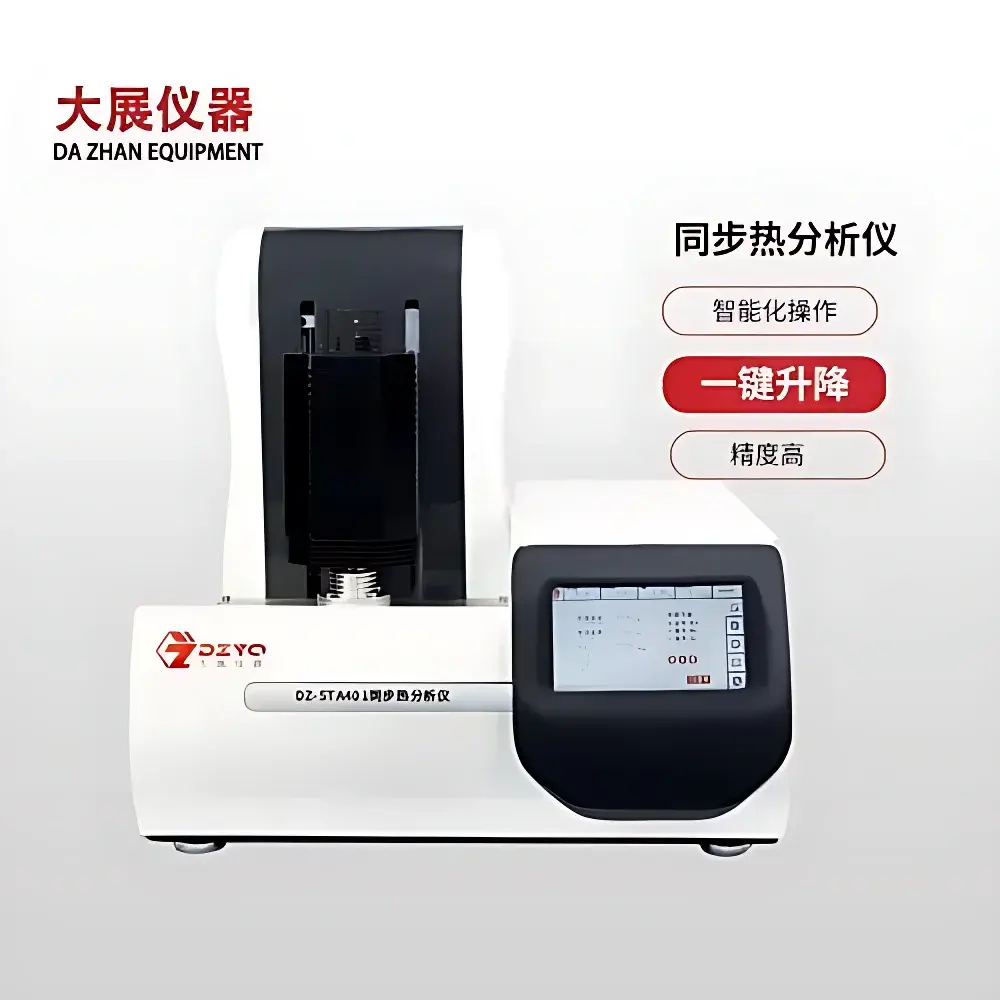
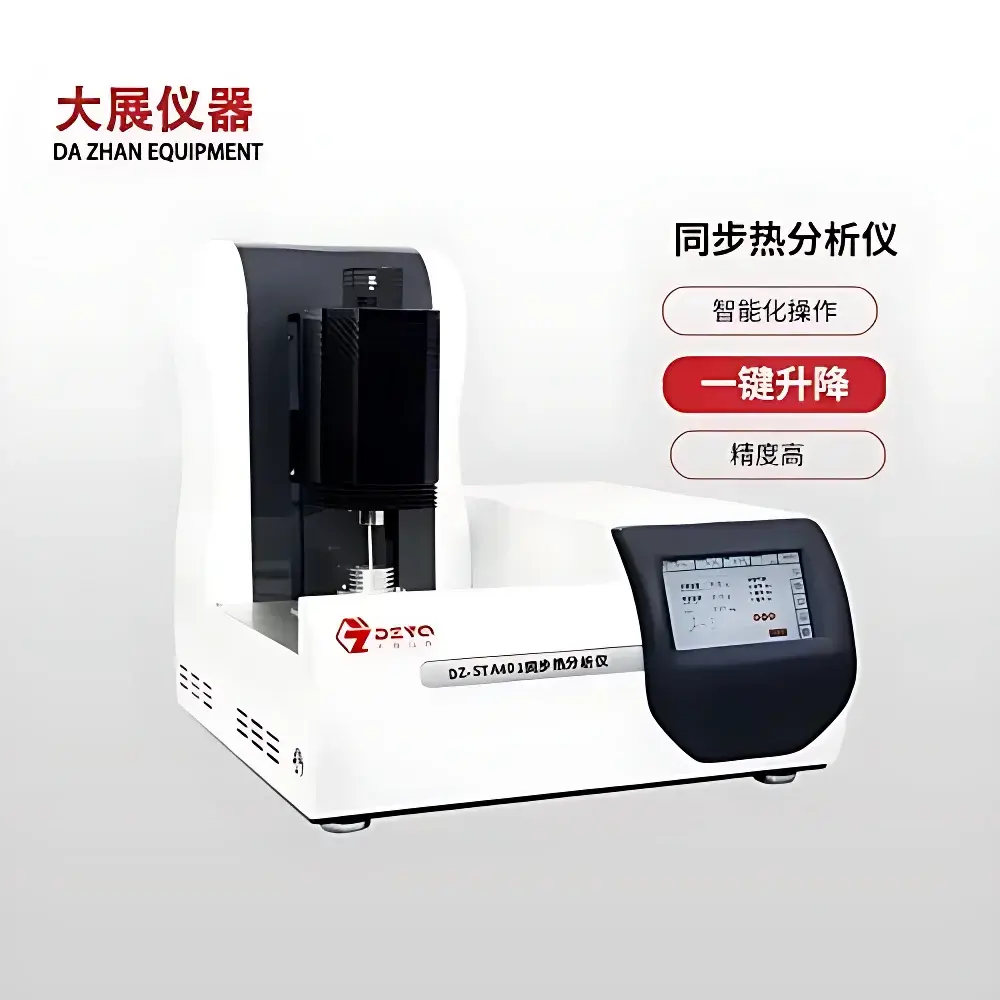
DAZHAN DZ-STA401 Automated-Lift Simultaneous Thermal Analyzer (TG-DSC)
| Brand | DAZHAN |
|---|---|
| Origin | Jiangsu, China |
| Manufacturer Type | Authorized Distributor |
| Country of Origin | China |
| Model | DZ-STA401 |
| Price | Upon Request |
| Temperature Range | Ambient to 1250 °C |
| Heating/Cooling Rate | 0.1–100 °C/min (heating), −0.1 to −40 °C/min (cooling) |
| Temperature Stability | ±0.01 °C |
| Temperature Resolution | 0.001 °C |
| Sample Capacity | 30 g max |
| Mass Measurement Range | 0.01 mg–3 g (expandable to 50 g) |
| Mass Accuracy | 0.01 mg |
| Mass Resolution | 0.01 µg |
| DSC Range | ±1000 mW |
| DSC Sensitivity | 0.0001 mW |
| Atmosphere Control | Integrated Digital Mass Flow Controller |
| Cooling Mode | Optional External Water Chiller (−10 to 60 °C) |
Overview
The DAZHAN DZ-STA401 is a high-performance simultaneous thermal analyzer engineered for precise, synchronized measurement of thermogravimetric (TG) and differential scanning calorimetry (DSC) signals under controlled atmospheric conditions. Based on the principle of coupled thermal–mass response detection, the instrument employs a dual-sensor architecture: a high-stability microbalance with sub-10 µg resolution monitors mass change in real time, while a symmetric heat-flux DSC sensor quantifies enthalpic transitions with sub-μW sensitivity. Its defining mechanical feature—a motorized, pneumatically assisted furnace lift mechanism—enables rapid thermal isolation between measurements, significantly reducing inter-test thermal carryover and accelerating cooldown cycles (e.g., from 1000 °C to 50 °C in ≤15 minutes). This design supports rigorous method development and high-throughput screening in regulated environments where thermal history control is critical.
Key Features
- Automated furnace lift system with programmable vertical travel and position-locking capability—minimizes operator intervention and improves repeatability across sequential runs.
- Dual-zone thermal insulation with low-thermal-mass platinum–rhodium (Pt/Rh) heating elements wound in parallel configuration—ensures linear temperature ramps, reduced thermal lag, and extended service life at temperatures up to 1250 °C.
- Separately housed power supply, cooling circuitry, and main electronics chassis—mechanically and thermally decoupled from the microbalance assembly to suppress vibration-induced noise and thermal drift.
- Integrated digital mass flow controller (MFC) supporting inert, oxidative, reductive, or reactive gas atmospheres—including N2, Ar, O2, CO, H2, and synthetic air—with flow accuracy ±1% FS and programmable ramping profiles.
- Modular interface for hyphenated analysis: standardized gas outlet port and synchronization TTL signal output enable seamless coupling with FTIR, MS, or GC-MS systems for evolved gas analysis (EGA).
- Active water-chilled base plate (operating range −10 to 60 °C) isolates the microbalance from furnace radiative heat—maintaining baseline stability during prolonged high-temperature holds.
Sample Compatibility & Compliance
The DZ-STA401 accommodates solid, powder, granular, and thin-film samples in standard ceramic, alumina, or platinum crucibles (up to 30 g gross weight). Its open-sample-access geometry facilitates loading of irregular or fragile specimens without compromising thermal contact integrity. The system complies with core thermal analysis standards including ASTM E1131 (TG), ASTM E1269 (DSC), ISO 11358 (polymer thermal degradation), and ISO 17269 (oxidation induction time). Data acquisition and reporting support audit-ready workflows aligned with GLP and GMP requirements: full electronic signatures, user access levels, and timestamped metadata logging are embedded within the software architecture. Optional 21 CFR Part 11 compliance modules provide electronic record integrity, change tracking, and secure archival per FDA guidelines.
Software & Data Management
DAZHAN SmartTherm v4.x is a Windows-based platform offering real-time dual-channel visualization, automated baseline correction, peak deconvolution, kinetic modeling (e.g., Kissinger, Ozawa-Flynn-Wall), and multi-step temperature program scripting. Raw data files (.dtc) store all instrument parameters, environmental logs, and calibration certificates in a non-proprietary hierarchical structure compatible with third-party analysis tools (OriginLab, MATLAB, Thermo-Calc). The software supports customizable report templates compliant with internal SOPs or external regulatory submissions. Data sampling intervals are configurable from 0.1 s to 10 s; hold durations are user-defined up to 600 minutes per step. Automatic scaling, derivative (DTG) overlay, and comparative curve alignment functions enhance qualitative interpretation and quantitative benchmarking across sample batches.
Applications
- Decomposition kinetics and activation energy determination of polymers, pharmaceuticals, and energetic materials.
- Oxidation resistance evaluation of alloys, coatings, and refractory ceramics under dynamic air/N2 switching protocols.
- Crystallinity assessment and cold-crystallization behavior in semi-crystalline thermoplastics (e.g., PET, PP, PEEK).
- Hydration/dehydration mechanisms in clays, MOFs, and battery cathode precursors (e.g., LiCoO2, NMC).
- Glass transition (Tg) identification and enthalpy relaxation studies in amorphous pharmaceuticals and optical glasses.
- Corrosion product evolution analysis via TG-FTIR coupling—identifying volatile species (H2O, CO2, SOx, NOx) released during metal oxidation.
- Thermal stability screening of catalysts, adsorbents, and nanocomposites under simulated process conditions.
FAQ
What is the maximum operating temperature and certified accuracy at 1250 °C?
The furnace is rated for continuous operation up to 1250 °C. Temperature accuracy is ±2 °C at 1250 °C, traceable to NIST-certified reference materials (e.g., Ni, Cu, Al melting points) per ISO/IEC 17025 calibration procedures.
Can the DZ-STA401 perform controlled cooling experiments below ambient temperature?
No—the system does not include cryogenic cooling. Its cooling capability is limited to forced-air or optional water-chilled base-assisted passive cooling down to ambient (~25 °C); active sub-ambient cooling requires external cryo-cooling accessories not supplied by default.
Is the microbalance sensitive to vibration from nearby equipment?
Yes—while the instrument incorporates passive damping and structural isolation, optimal performance requires installation on a vibration-isolated optical table or granite slab, especially when operating at <0.1 mg resolution.
Does the software support automated calibration routines for mass and temperature?
Yes—built-in calibration wizards guide users through multi-point mass verification (using certified weights) and temperature calibration (using standard metals), with results stored in encrypted calibration logs.
How is gas atmosphere purging managed during DSC-only measurements?
The integrated MFC maintains constant flow throughout the entire test sequence—including DSC-only runs—ensuring consistent buoyancy correction and minimizing convective artifacts in heat-flow signals.



