
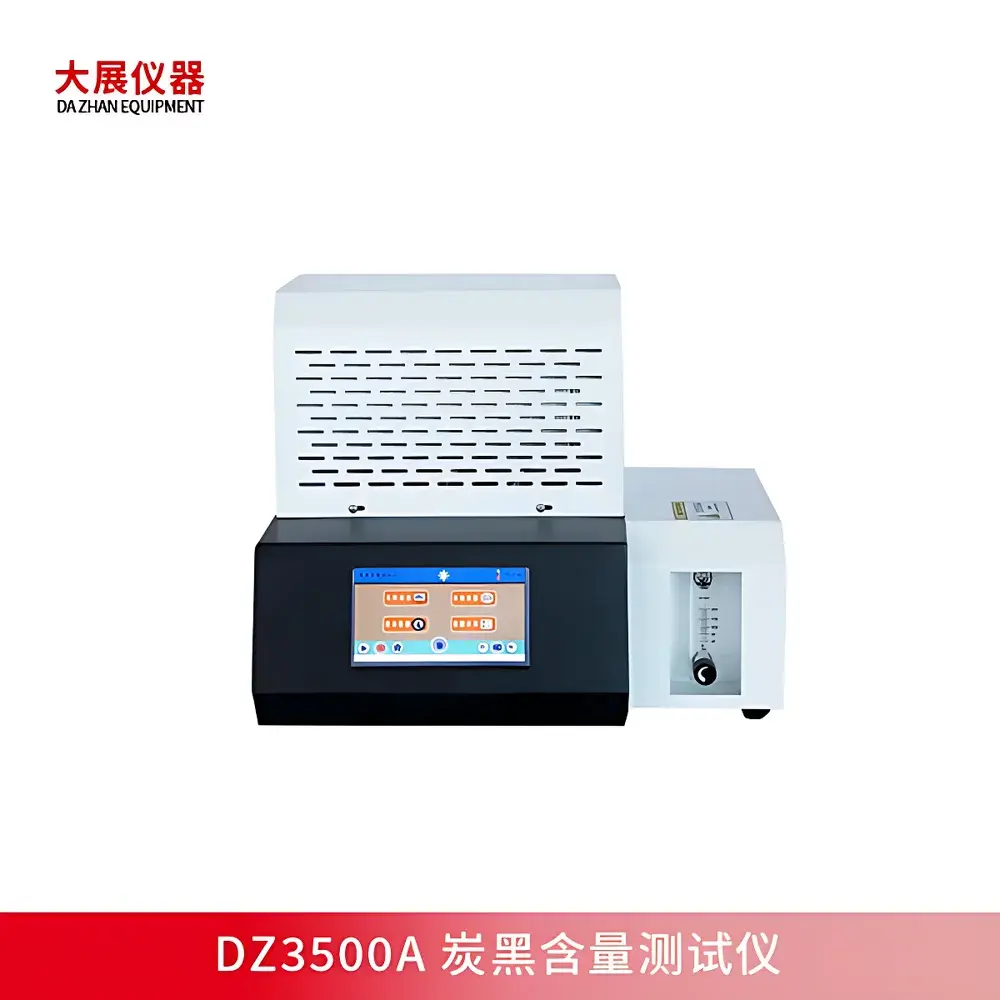
DAZHAN DZ3500A Carbon Black Content Analyzer
| Brand | DAZHAN |
|---|---|
| Origin | Jiangsu, China |
| Manufacturer Type | Authorized Distributor |
| Country of Origin | China |
| Model | DZ3500A |
| Price Range | USD 2,100 – 4,200 |
| Display | Color TFT Touchscreen |
| Furnace Tube Dimensions | Φ30 × 400 ±5 mm |
| Heating Element | High-Temperature Alloy Wire |
| Heating Zone Length | 200 mm |
| Uniform Temperature Zone Length | 150 mm |
| Operating Temperature Range | Ambient to 990 °C |
| Temperature Control | Intelligent Programmable PID Controller |
| Power Supply | AC 220 V, 50/60 Hz |
Overview
The DAZHAN DZ3500A Carbon Black Content Analyzer is a dedicated thermal gravimetric instrument engineered for precise quantification of carbon black and ash content in thermoplastic polymers—primarily polyethylene (PE) and polypropylene (PP). It operates on the principle of controlled pyrolysis under inert nitrogen atmosphere, where organic polymer matrices are thermally decomposed while carbon black and inorganic fillers remain as non-volatile residues. This method conforms to standardized test protocols including ASTM D1606, ISO 6964, and GB/T 3512—widely adopted in cable manufacturing, pipe extrusion, masterbatch formulation, and quality assurance laboratories serving the rubber and plastics supply chain. The instrument features a physically decoupled furnace module and control unit, enabling rapid thermal cycling and minimizing downtime between sequential analyses.
Key Features
- Modular furnace architecture with independent cooling path—reduces cooldown time from 990 °C to 100 °C in under 25 minutes, significantly improving throughput for high-volume QC labs.
- Multi-stage programmable temperature ramping (up to 5 segments), supporting complex thermal profiles required for differentiated decomposition kinetics of polymer blends or filled compounds.
- Integrated calculation engine automatically computes carbon black content (%) and ash content (%) based on pre- and post-pyrolysis mass measurements, eliminating manual transcription errors and reducing operator dependency.
- 7-inch full-color capacitive touchscreen interface with intuitive icon-driven navigation, real-time temperature curve visualization, and on-screen data logging summary.
- High-stability high-temperature alloy heating elements ensure uniform axial temperature distribution across the 150 mm isothermal zone (±2 °C), critical for reproducible residue yield across sample batches.
- Nitrogen purge system with calibrated mass flow controller (MFC) maintains oxygen concentration below 10 ppm during pyrolysis, preventing oxidative loss of carbon black and ensuring measurement fidelity.
Sample Compatibility & Compliance
The DZ3500A accommodates solid granules, pellets, extruded strands, and molded specimens weighing 0.5–2.0 g, with minimal size restriction due to its 30 mm internal diameter quartz tube. It is validated for use with cross-linked PE (XLPE), HDPE, LDPE, PP homopolymers and copolymers, and halogen-free flame-retardant (HFFR) compounds containing Mg(OH)₂ or Al(OH)₃. Instrument design complies with IEC 61000-6-3 (EMC emissions) and IEC 61010-1 (safety requirements for laboratory equipment). Data integrity meets GLP/GMP-aligned workflows: all temperature setpoints, actual furnace temperatures, mass readings, gas flow rates, and calculation timestamps are logged internally with user ID tagging and exportable via USB to CSV format—supporting audit readiness per FDA 21 CFR Part 11 when paired with appropriate lab information management systems (LIMS).
Software & Data Management
The embedded firmware provides local storage for up to 500 test records, each including raw mass values (tare, initial, residue), derived percentages, thermal profile parameters, and operator annotations. USB export enables seamless integration with Excel-based QA templates or enterprise LIMS platforms. Optional PC software (DZ-Link v2.1) adds batch reporting, statistical process control (SPC) charting (X-bar/R), calibration certificate generation, and electronic signature support for regulated environments. All data fields are write-protected after finalization; modification requires administrator-level authentication and generates an immutable audit trail.
Applications
- Verification of carbon black loading consistency in black masterbatches used for UV stabilization of outdoor PE pipes.
- Quality release testing of insulation compounds for power cables, where carbon black content directly correlates with electrical resistivity and weathering resistance.
- Process validation of extrusion lines producing telecom fiber-optic cable jackets—ensuring ≤2.6% ±0.15% carbon black per IEC 60502-1 specifications.
- R&D screening of novel conductive composites, where residual carbon black quantification informs dispersion efficiency and percolation threshold modeling.
- Third-party certification testing per UL 2556 and CSA C22.2 No. 0.3 for flame-retardant plastic materials requiring documented filler composition.
FAQ
What standards does the DZ3500A comply with for carbon black analysis?
ASTM D1606, ISO 6964, GB/T 3512, and IEC 60811-401 are fully supported through configurable thermal programs and residue calculation logic.
Can the instrument distinguish between carbon black and other carbonaceous residues?
No—it measures total non-volatile carbonaceous residue under inert conditions; differentiation from coke or incomplete combustion byproducts requires complementary techniques such as Raman spectroscopy or TEM.
Is nitrogen purity critical for accurate results?
Yes. Use ≥99.995% pure N₂ with dew point ≤−40 °C; lower purity increases oxide formation and underestimates carbon black content by up to 0.3% absolute.
How often does the furnace require recalibration?
Temperature sensor drift is typically <0.5 °C/year; annual verification using traceable PtRh thermocouples is recommended per ISO/IEC 17025.
Does the system support automated sample loading?
Not natively—the DZ3500A is manually loaded; however, its modular footprint and RS-232 interface allow integration with third-party robotic arms via custom API scripting.





