
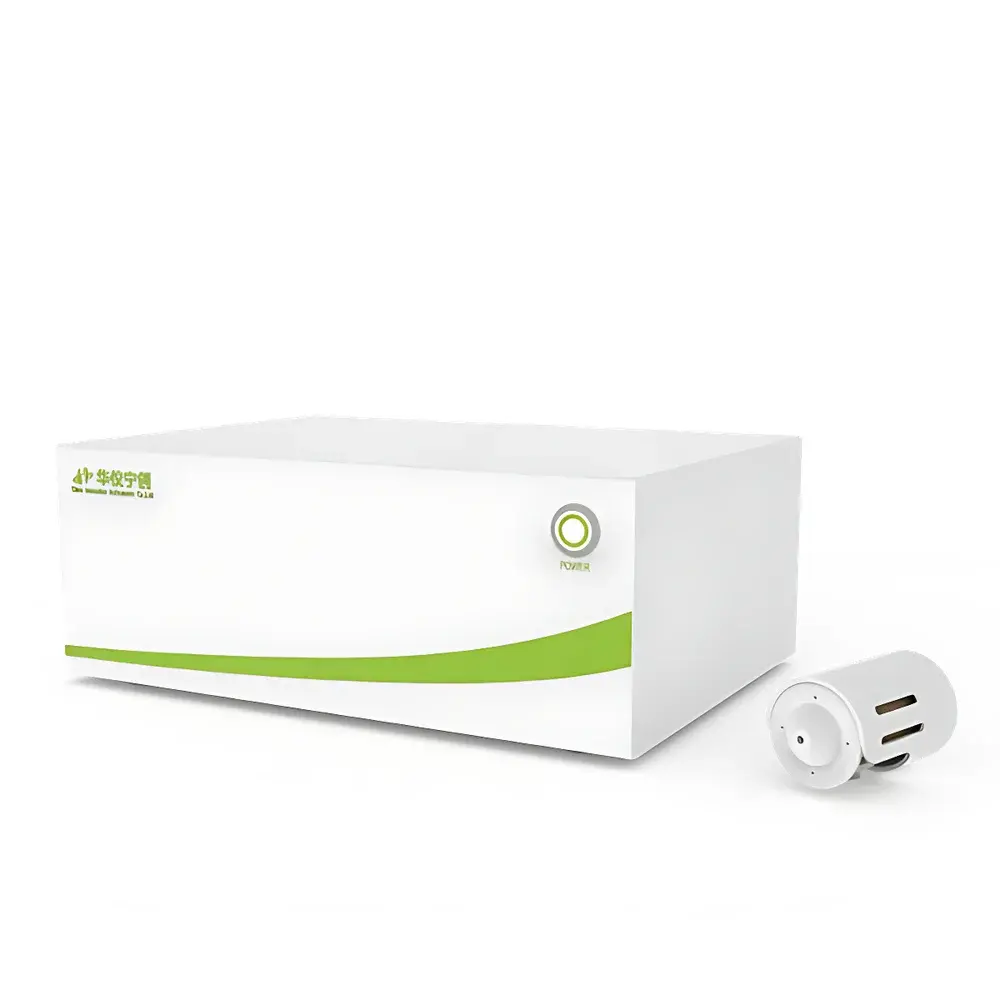
DBDI-200 Solid-Phase Microextraction Integrated Direct Barrier Discharge Ion Source
| Brand | China Innovation Instrument (CII) |
|---|---|
| Model | DBDI-200 |
| Ionization Principle | Dielectric Barrier Discharge (DBD) Coupled with SPME |
| Compatibility | Universal MS Interfaces (ESI, APCI, and Atmospheric Pressure Inlet Ports) |
| Origin | Zhejiang, China |
| Regulatory Compliance | Designed for GLP/GMP-aligned workflows |
| Pricing | Available upon technical consultation |
Overview
The DBDI-200 Solid-Phase Microextraction Integrated Direct Barrier Discharge Ion Source is an ambient ionization platform engineered for rapid, solvent-free, and minimally invasive analysis of trace-level small-molecule analytes directly from complex matrices. It combines dielectric barrier discharge (DBD) plasma generation with a thermally regulated solid-phase microextraction (SPME) sampling module to achieve selective preconcentration and in situ desorption/ionization. Unlike conventional electrospray or electron ionization sources, the DBDI-200 operates at atmospheric pressure without requiring high-voltage electrodes in contact with the sample, enabling robust ionization of thermally labile, nonvolatile, and low-polarity compounds—including narcotics, pesticides, veterinary drug residues, endogenous hormones, and explosive precursors. Its open-air operation eliminates the need for vacuum lock cycles or extensive sample preparation, reducing analysis time to seconds per sample while maintaining compatibility with benchtop, portable, and high-resolution mass spectrometers.
Key Features
- Integrated SPME-DBD architecture: Combines fiber-based analyte enrichment with spatially confined, low-temperature plasma discharge for enhanced sensitivity and matrix tolerance.
- Universal MS interface: Adapts to standard atmospheric pressure inlets (e.g., ESI, APCI, and API ports) via modular flange mounting; no instrument modification required.
- Real-time thermal control: SPME fiber heating (up to 250 °C) and precise plasma power regulation (1–15 W adjustable) enable method optimization across volatile and semi-volatile analytes.
- Robust plasma stability: Ceramic-dielectric barrier design ensures consistent discharge characteristics over extended operation (>1000 h mean time between failures).
- Low carryover design: Automated fiber desorption and plasma self-cleaning reduce cross-contamination; validated residual levels <0.1% for target analytes in forensic swab testing.
- Compact footprint & field-deployable form factor: Dimensions 180 × 120 × 95 mm; powered by 24 V DC input, suitable for mobile labs and on-site screening.
Sample Compatibility & Compliance
The DBDI-200 supports direct analysis of untreated solids (e.g., powders, plant tissues, fabric swabs), liquids (blood spots, beverage extracts, environmental water filtrates), and headspace vapors. It has been validated per ASTM E2912–22 (Standard Guide for Sampling and Analysis of Chemical Warfare Agents Using Ambient Ionization Mass Spectrometry) and aligns with ISO/IEC 17025 requirements for method validation in forensic toxicology laboratories. Data integrity meets FDA 21 CFR Part 11 expectations through audit-trail-enabled software integration, supporting electronic signatures, user access controls, and immutable acquisition logs. All hardware materials comply with RoHS 3 and REACH SVHC directives.
Software & Data Management
Controlled via CII IonControl Suite v3.2—a Windows-based application supporting method scripting, real-time spectral preview, and synchronized SPME desorption timing. The software exports peak-integrated data in mzML format for downstream processing in open-source platforms (e.g., MZmine, XCMS) or commercial packages (e.g., Compound Discoverer, Skyline). Built-in calibration curve tools support internal standard quantification using deuterated analogs. Audit trails record operator ID, parameter changes, acquisition timestamps, and instrument status—fully traceable for GLP audits and regulatory submissions.
Applications
- Forensic toxicology: Rapid identification of fentanyl analogs, synthetic cannabinoids, and novel psychoactive substances (NPS) from buccal swabs and seized powders.
- Food safety monitoring: Screening of chloramphenicol in aquaculture products, aflatoxin M1 in milk, and glyphosate metabolites in cereal grains—without derivatization.
- Pharmaceutical quality control: Detection of residual solvents and genotoxic impurities in active pharmaceutical ingredients (APIs) per ICH Q3C guidelines.
- Environmental surveillance: On-site detection of organophosphate flame retardants in dust and polycyclic aromatic hydrocarbons (PAHs) in soil particulates.
- Academic research: Method development for in vivo microsampling, single-cell metabolomics, and reaction monitoring in catalytic chemistry.
FAQ
Can the DBDI-200 be coupled with high-resolution mass spectrometers such as Orbitrap or TOF systems?
Yes—it interfaces seamlessly with any mass spectrometer equipped with an atmospheric pressure ion source inlet, including Thermo Scientific Orbitrap Exploris, Waters SYNAPT G2-Si, and Bruker timsTOF platforms.
Is SPME fiber replacement automated or manual?
Fiber exchange is manual but standardized via a quick-release cartridge system; typical lifetime exceeds 200 extractions under routine forensic use.
Does the system require carrier gas or external vacuum support?
No—operation is fully self-contained at ambient pressure; no nitrogen, helium, or vacuum pump is needed.
What validation documentation is provided for regulatory submissions?
CII supplies full IQ/OQ/PQ protocols, system suitability test reports, and method validation templates compliant with ISO/IEC 17025 and USP <1225>.
Is remote operation supported for centralized lab networks?
Yes—IonControl Suite includes secure TLS-encrypted remote desktop access and RESTful API endpoints for LIMS integration.






