
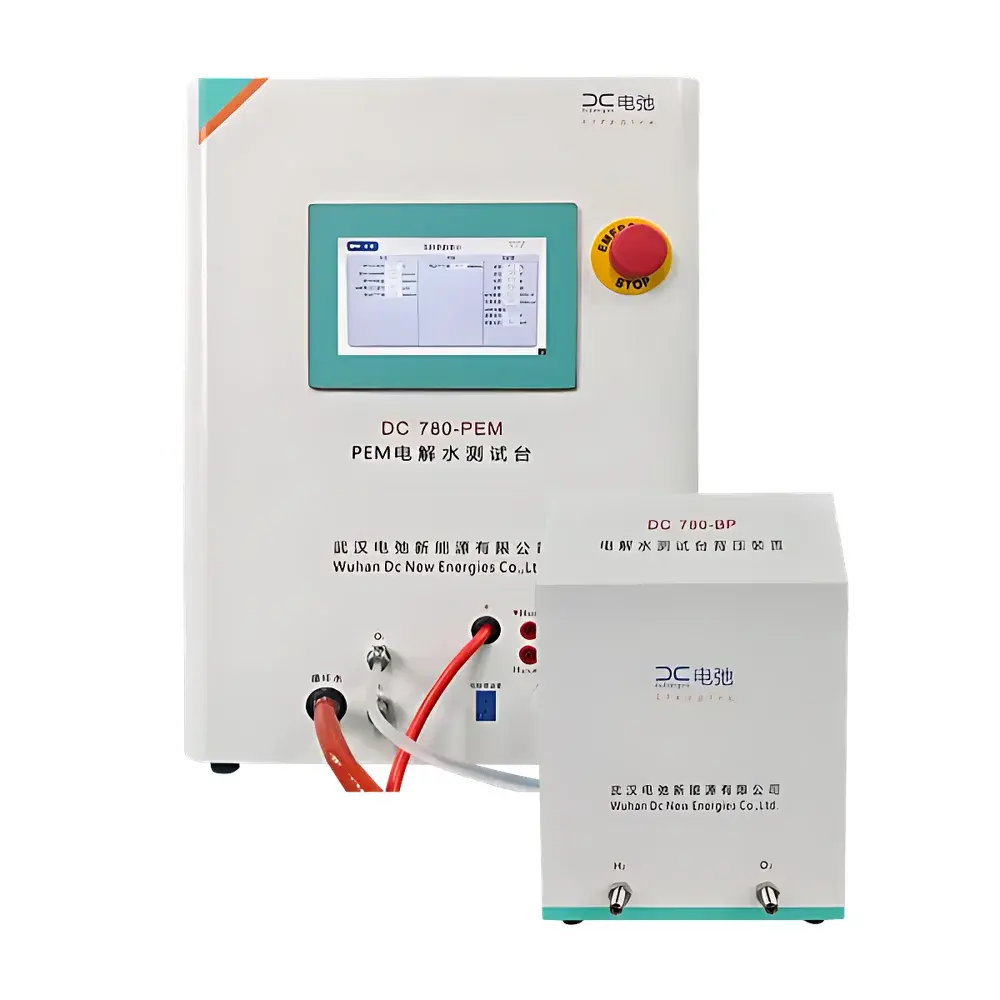
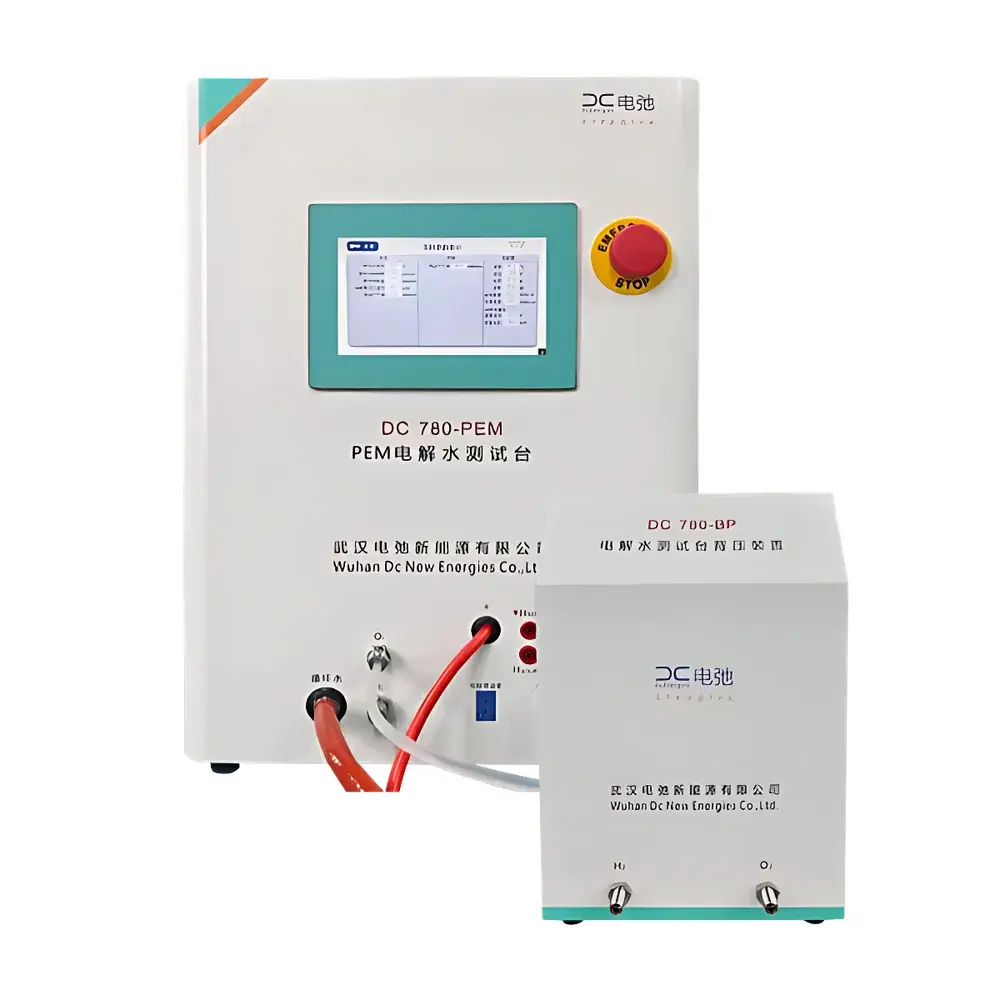
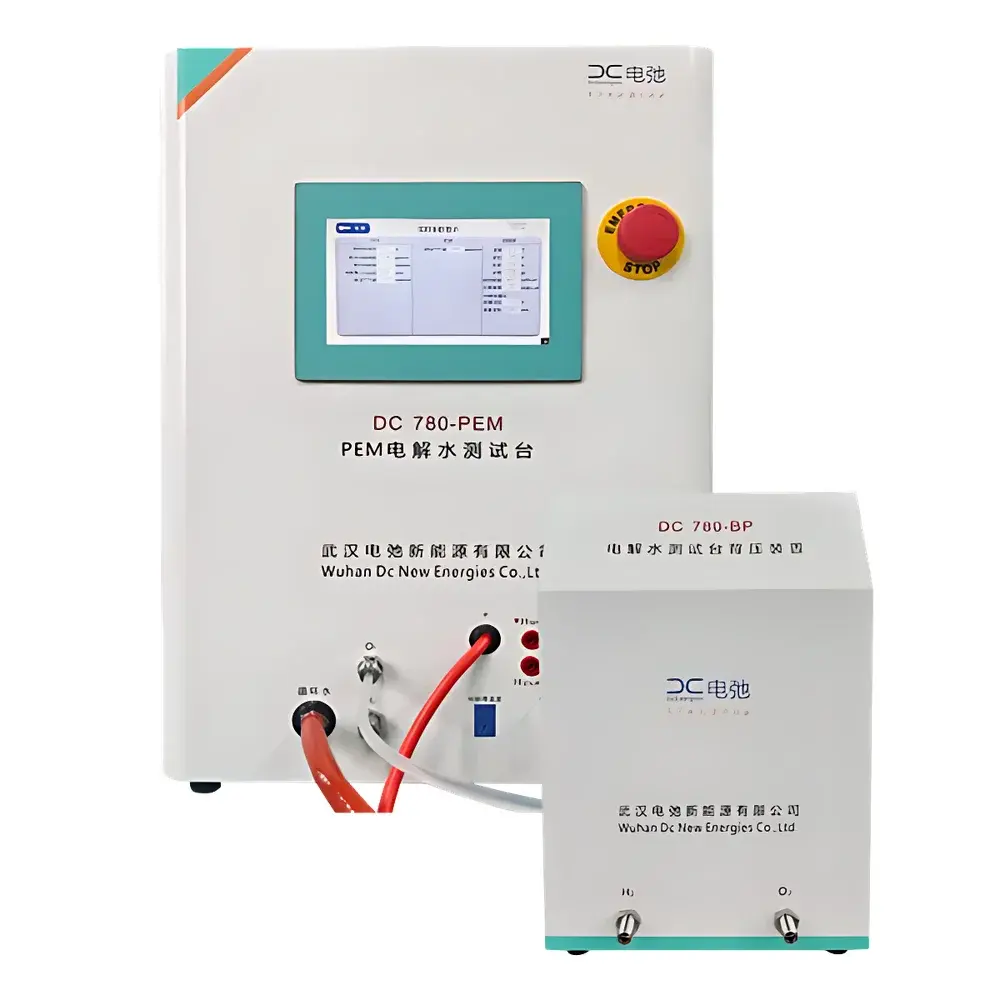
DC 780 Desktop PEM/AEM Water Electrolysis Testing Station
| Brand | DC-Energies |
|---|---|
| Model | DC 780 |
| Origin | Hubei, China |
| Manufacturer | Wuhan DC-Energies New Energy Co., Ltd. |
| Type | Benchtop Electrolyzer Test System |
| H₂/O₂ Flow Measurement Accuracy | ±1% FS |
| Operating Pressure Range | 1–10 bar (adjustable via high-precision back-pressure regulator) |
| Temperature Control Stability | ±0.5 °C |
| Data Acquisition Rate | 5 Hz |
| Flow Control | Mass Flow Controllers (MFCs) for H₂ and O₂ |
| Software Compliance | Audit Trail Ready, User Access Levels, Test Parameter Locking (GLP/GMP-aligned architecture) |
Overview
The DC 780 Desktop PEM/AEM Water Electrolysis Testing Station is a compact, laboratory-grade electrochemical test platform engineered for quantitative performance evaluation of proton exchange membrane (PEM) and anion exchange membrane (AEM) electrolyzers. It operates on the fundamental principle of water electrolysis—electrochemically decomposing H₂O into stoichiometric H₂ and O₂ gases under controlled DC current, in accordance with Faraday’s laws of electrolysis. Designed for R&D laboratories, university research groups, and component validation teams, the DC 780 enables precise measurement of key metrics including cell voltage, current density, gas evolution rates, energy efficiency (kWh/kg H₂), faradaic efficiency, and long-term stability under variable load, pressure, and temperature conditions. Its benchtop form factor (W × D × H: 600 × 450 × 350 mm) ensures seamless integration into standard fume hoods or glovebox environments without compromising functional integrity.
Key Features
- Dual-membrane compatibility: Native support for both PEM and AEM electrolyzer cells—no hardware modification required. Electrical interface, gas routing, and thermal management are optimized for either configuration.
- Benchtop engineering: Fully self-contained unit with integrated power supply, gas handling subsystem (MFCs, back-pressure regulation, condensers), and environmental control—eliminates external manifold dependencies.
- High-fidelity gas metrology: Dual-channel mass flow controllers (H₂ and O₂) calibrated to ISO/IEC 17025 traceable standards; real-time flow data synchronized with electrical signals at 5 Hz sampling rate.
- Stable thermal and pressure environment: PID-controlled heating/cooling jacket maintains electrode temperature within ±0.5 °C; digitally actuated back-pressure valve sustains setpoint pressure from 1 to 10 bar with <±0.02 bar hysteresis.
- Modular gas conditioning: Onboard condensation trap, desiccant dryer, and particulate filter ensure clean, dry, particle-free gas streams prior to flow measurement—critical for sensor longevity and data reproducibility.
Sample Compatibility & Compliance
The DC 780 accommodates single-cell electrolyzer stacks with active areas ranging from 5 cm² to 100 cm² and standard gasketed flange interfaces (e.g., 1/4″ NPT, CF-35). It supports both liquid-fed and vapor-fed configurations and is compatible with common catalyst-coated membranes (CCMs) and membrane-electrode assemblies (MEAs) used in academic and industrial prototyping. All gas pathways are constructed from electropolished 316L stainless steel and PTFE-lined components to prevent catalytic surface contamination or corrosion. The system adheres to IEC 62282-3-100 (fuel cell and electrolyzer safety), UL 61010-1 (electrical safety), and incorporates fail-safes aligned with ISO 22734 (hydrogen generators) — including overpressure venting, hydrogen leak detection interlock, and automatic shutdown on thermal runaway or open-circuit conditions.
Software & Data Management
The proprietary DC-TestSuite software provides full instrument control, real-time visualization, and structured data export. It features a modular, checkbox-based test sequence builder—enabling rapid setup of constant-current, constant-voltage, polarization sweep, or accelerated stress tests (ASTs) without scripting. All user actions—including parameter edits, start/stop commands, and calibration events—are logged with timestamps and operator IDs, satisfying GLP and GMP audit requirements per FDA 21 CFR Part 11 (electronic records and signatures). Raw data is stored in HDF5 format with embedded metadata (test ID, cell ID, ambient conditions, firmware version); CSV exports include SI-unit–normalized columns for direct import into MATLAB, Python (Pandas), or commercial electrochemical analysis tools. Eight DC 780 units can be synchronized under one master instance for parallel comparative studies—ideal for catalyst screening or membrane durability benchmarking.
Applications
- Quantitative evaluation of novel PEM/AEM membranes, catalysts, and porous transport layers (PTLs)
- Determination of voltage efficiency, system-level energy consumption (kWh/Nm³ H₂), and degradation kinetics under dynamic loading
- Validation of MEA manufacturing processes across batch lots
- Support for DOE Hydrogen Program targets (e.g., 40 kWh/kg H₂ by 2030) through standardized testing protocols
- Integration into university curricula for hands-on electrochemistry and green hydrogen technology education
- Pre-commercial qualification of stack components prior to multi-kW system integration
FAQ
Is the DC 780 compliant with international testing standards such as ASTM D7219 or ISO 22734?
Yes—the DC 780 implements measurement methodologies consistent with ASTM D7219 (standard test method for fuel cell membrane electrode assemblies) and ISO 22734-1 (hydrogen generators using water electrolysis), particularly regarding gas flow accuracy, pressure control tolerance, and electrical measurement traceability.
Can third-party potentiostats or data acquisition systems be integrated?
The DC 780 provides analog voltage/current output ports and Modbus TCP interface for external synchronization; however, full functionality—including gas flow correlation, safety interlocks, and automated test sequencing—is only available via DC-TestSuite.
What maintenance intervals are recommended for the integrated gas conditioning module?
Desiccant cartridges require replacement every 200 operational hours under typical lab humidity conditions; condensate traps should be drained daily; MFC recalibration is advised every 6 months or after 1,000 test cycles.
Does the system support automated AST protocols such as potential cycling or hold tests?
Yes—DC-TestSuite includes preconfigured templates for IEC 62282-3-100 Annex C-compliant ASTs, including 1.4–1.8 V vs. RHE cycling, 1.6 V hold at 1 A/cm², and humidity ramp profiles.
Is remote monitoring and control supported over LAN or VPN?
Full GUI access and real-time data streaming are enabled via secure TLS-encrypted web interface (HTTPS), supporting remote operation from any location with authenticated network access.




