
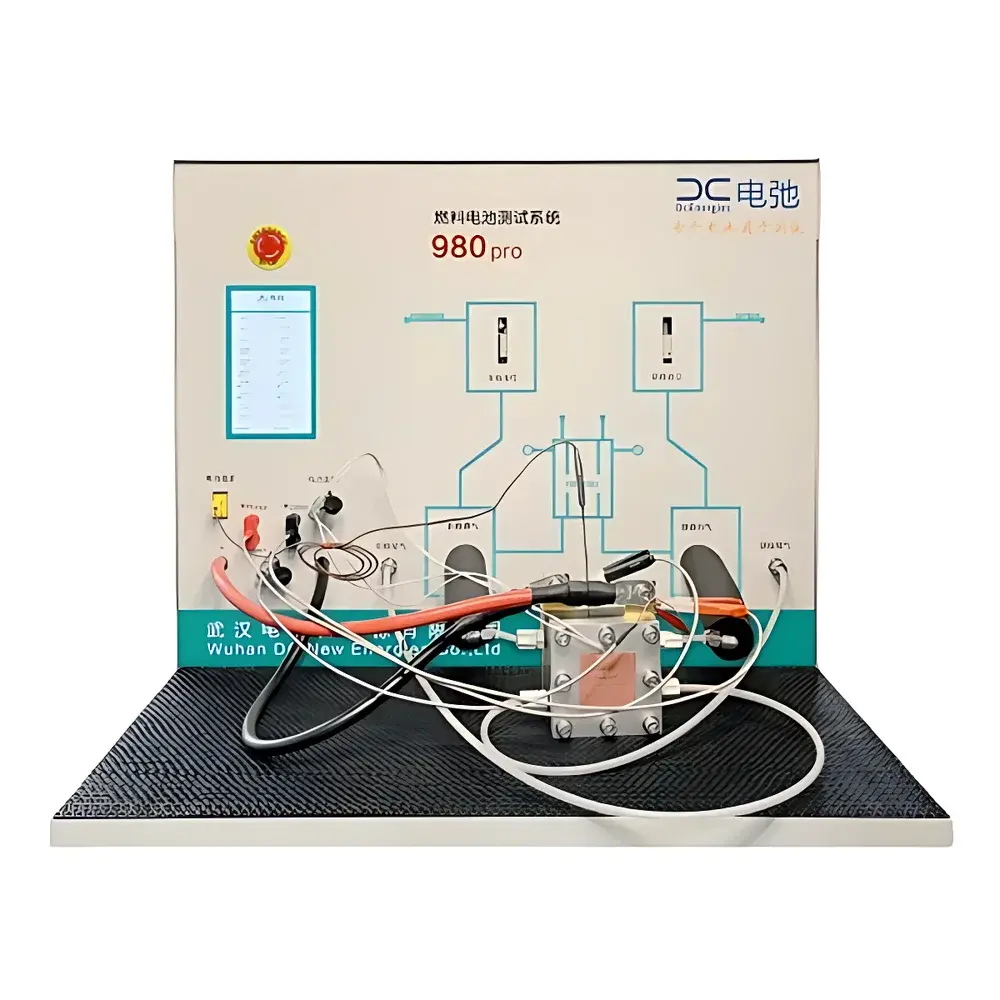
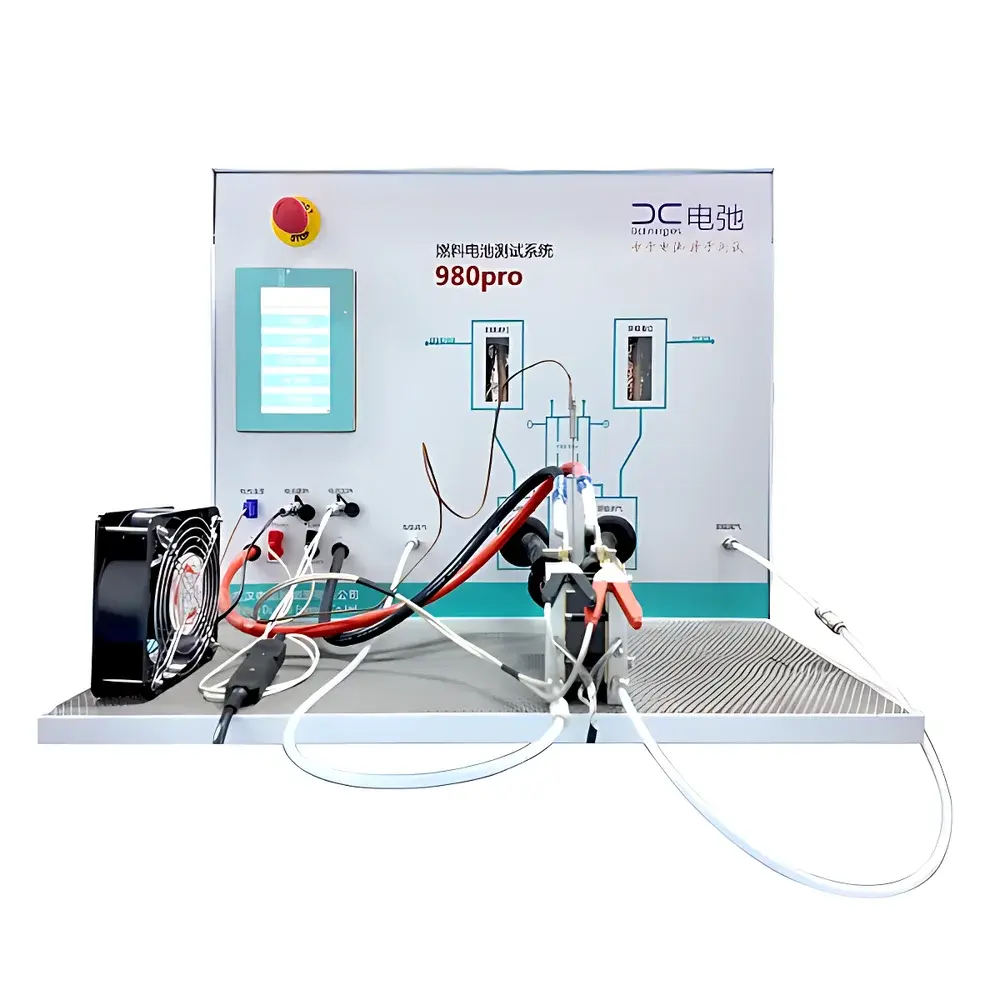
DC980 PEM Fuel Cell Testing System (Manual Backpressure Configuration)
| Brand | dc-energies |
|---|---|
| Model | DC980 |
| Origin | Hubei, China |
| Manufacturer Type | Authorized Distributor |
| Country of Origin | China |
| Quotation | Upon Request |
Overview
The DC980 PEM Fuel Cell Testing System (Manual Backpressure Configuration) is a compact, research-grade benchtop platform engineered for rigorous characterization and durability evaluation of proton exchange membrane (PEM) fuel cells. Developed by dc-energies (Wuhan DcEnergies New Energy Co., Ltd.), the system implements a Couette-type gas flow architecture with integrated thermal management, precise electrochemical load control, and fully synchronized gas delivery—enabling high-fidelity polarization curve acquisition, accelerated stress testing (AST), membrane electrode assembly (MEA) screening, and dynamic operational protocol execution. Its sub-0.5 m³ footprint meets stringent spatial constraints typical of university teaching laboratories and small-scale R&D facilities, while maintaining full compliance with core experimental requirements defined in ASTM D6866, ISO 14687-2 (hydrogen purity), and IEC 62282-2 (fuel cell performance testing). The system operates on a dual-loop control principle: real-time current/voltage regulation via programmable electronic load, coupled with independent PID-controlled anode/cathode humidification and temperature stabilization—ensuring thermodynamic consistency across variable stoichiometry and pressure conditions.
Key Features
- High-accuracy mass flow controllers (MFCs) with ±0.5% F.S. repeatability for both anode (up to 5 SLPM) and cathode (up to 10 SLPM) gas streams
- Manual backpressure configuration with calibrated precision valves enabling controlled differential pressure operation (0–3 bar(g) range)
- Dual-channel bubbling humidification system with T-type thermocouple feedback and PID-regulated heating (ambient +10°C to 90°C)
- Integrated automatic N₂ purging sequence triggered by safety events or user command, including pre-start and post-shutdown protocols
- Real-time liquid-level monitoring in humidifiers with auto-refill and overflow drainage functions
- Dual-display interface supporting simultaneous visualization of polarization data, gas parameters, thermal profiles, and safety status
- Hardware-enforced safety layer: hydrogen leakage detection (0–40,000 ppm range, configurable alarm thresholds), emergency stop circuit, overcurrent/undervoltage/fuel cutoff interlocks
- Software-configurable dry/wet mode switching for anode and cathode independently, supporting comparative hydration studies
- Modular electrical architecture accommodating custom current ranges (standard: 0–24 A; optional: 0–120 A) and voltage ranges (–0.7 V to 2 V / –3.3 V to 10 V)
- Thermal insulation package including heated anode/cathode tubing and dual-zone heater jackets for uniform stack temperature distribution
Sample Compatibility & Compliance
The DC980 supports single-cell PEM fuel cells with active areas ranging from 5 cm² to 100 cm², compatible with standard graphite or metallic bipolar plates and industry-standard gasket configurations. It accommodates MEAs fabricated with Nafion®-based membranes (e.g., N115, N212, N117), hydrocarbon alternatives, and thin-film catalyst layers (0.05–0.4 mgₚₜ/cm²). All gas handling components meet ISO 8573-1 Class 2 purity requirements for compressed air/hydrogen supply. The system’s firmware and software architecture are designed to support GLP-compliant data integrity practices—including electronic signatures, audit trails, and 21 CFR Part 11–ready user access controls (available via optional license). Mechanical design adheres to IEC 61000-6-2 (immunity) and IEC 61000-6-4 (emission) standards; structural enclosure conforms to IP20 environmental protection rating.
Software & Data Management
dc-energies’ proprietary FC-Studio v4.x software provides a unified interface for test sequencing, real-time parameter monitoring, and post-acquisition analysis. It supports script-based automation of multi-step protocols—including startup conditioning, hold-and-ramp polarization sweeps, cyclic load testing, and poisoning simulations (CO, SO₂). Raw data streams (voltage, current, temperature, pressure, humidity, flow rates) are timestamped at 5 Hz and stored in HDF5 format with embedded metadata (user ID, test ID, calibration stamps). Offline analysis tools include Tafel slope extraction, ohmic resistance calculation (via high-frequency resistance, HFR), and degradation rate quantification per DOE Fuel Cell Tech Team metrics. Export options include CSV, MATLAB .mat, and PDF report generation with customizable templates. The software SDK enables Python/C++ integration for advanced algorithm development and third-party instrument synchronization.
Applications
- MEA performance benchmarking under standardized operating conditions (e.g., 80°C, 100% RH, 150 kPa abs, H₂/air)
- Accelerated stress testing (AST) per DOE protocols: relative humidity cycling, open-circuit voltage holds, start-stop cycling
- Fuel impurity tolerance assessment (e.g., CO ≤ 10 ppm, NH₃ ≤ 0.1 ppm)
- Mass transport limitation analysis via concentration polarization experiments
- Thermal management validation across low-to-high power density regimes (0.05–1.2 W/cm²)
- Electrochemical impedance spectroscopy (EIS) readiness—hardware timing synchronization supports external potentiostat integration
- Teaching laboratory modules covering Faraday efficiency, activation/ohmic/concentration losses, and water balance modeling
FAQ
What is the maximum allowable operating temperature for single-cell testing?
The system supports single-cell operation up to 160°C with appropriate MEA and sealing materials; standard configuration is rated for continuous operation at ≤90°C.
Does the DC980 support automated backpressure control?
The base model features manual backpressure regulation; automatic backpressure control is available as an optional upgrade with integrated pressure transducers and servo-valve actuation.
Can the system perform EIS measurements?
While the DC980 does not include a built-in frequency response analyzer, its analog output interfaces and precise voltage/current control enable seamless integration with external commercial potentiostats for EIS acquisition.
Is remote monitoring and control supported?
Yes—FC-Studio supports secure TCP/IP communication over LAN/WAN; authenticated web-based dashboard access is available via optional remote server module.
What safety certifications does the system comply with?
The DC980 meets CE marking requirements per Machinery Directive 2006/42/EC and Low Voltage Directive 2014/35/EU; hydrogen sensor calibration follows EN 60079-29-1:2016 for explosive atmospheres.






