
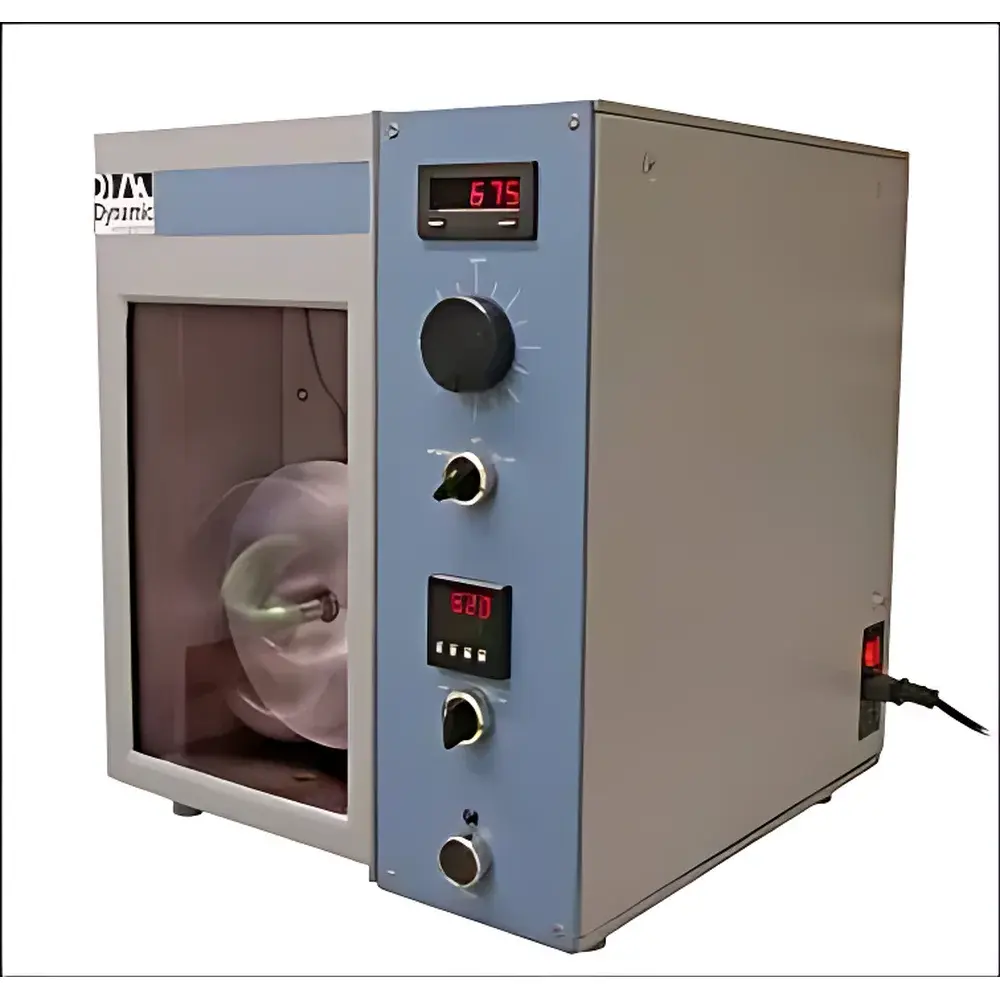
DE Spectrum HPCCC High-Speed Counter-Current Chromatography System
| Brand | DE |
|---|---|
| Origin | United Kingdom |
| Model | DE Spectrum HPCCC |
| Configuration | Analytical to Semi-Preparative |
| Column Volume | 20–125 mL |
| Sample Load per Run | 50–1250 mg |
| Mobile Phase Flow Rate | 1–10 mL/min |
| Rotational Speed | 1600 rpm |
| Phase System | Liquid–Liquid Biphasic Solvent System |
| Solvent Consumption | ~10% w/w relative to crude sample mass |
Overview
The DE Spectrum HPCCC is a high-performance High-Speed Counter-Current Chromatography (HPCCC) system engineered for scalable, solvent-efficient, and lossless liquid–liquid partition chromatography. Unlike conventional solid-phase chromatographic methods—such as HPLC or flash chromatography—HPCCC operates without a solid stationary phase. Instead, it utilizes a precisely controlled biphasic solvent system in which both the stationary and mobile phases are immiscible liquids. The stationary phase is retained within a coiled column via centrifugal force generated by planetary rotation (1600 rpm), while the mobile phase is pumped through the column under low backpressure (<5 bar). This fundamental design eliminates irreversible adsorption, silanol interactions, and column fouling—enabling quantitative recovery of labile, polar, or strongly adsorbing compounds that are often degraded or irreversibly retained on silica-based media.
Key Features
- Zero Sample Loss Recovery: Since no solid support is involved, all injected material remains chemically intact and fully recoverable—critical for precious natural product isolates, unstable metabolites, or early-stage synthetic intermediates.
- High Sample Loading Capacity: Capable of processing 50–1250 mg of crude extract per run, supported by a modular coil volume range (20–125 mL), making it suitable for analytical screening through semi-preparative purification.
- Low Solvent Demand: Typical solvent consumption is approximately 10% (w/w) relative to the mass of crude input material—significantly reducing operational costs, waste disposal burden, and environmental footprint compared to conventional preparative LC.
- Scalable & Reproducible Method Transfer: Separation conditions—including solvent ratio, flow rate, rotation speed, and temperature—are directly transferable across instrument scales due to the absence of column packing variability. No column conditioning or regeneration downtime is required between runs.
- Robust Planetary Mechanism: Precision-engineered dual-axis rotation ensures stable retention of the stationary phase across extended operation, even with highly polar or viscous solvent systems (e.g., aqueous–organic biphases like hexane–ethyl acetate–methanol–water).
Sample Compatibility & Compliance
The DE Spectrum HPCCC accommodates a broad spectrum of analytes—including alkaloids, flavonoids, terpenoids, peptides, glycosides, and organometallic complexes—that exhibit poor retention or decomposition on reversed-phase or normal-phase columns. Its inert fluidic path (PEEK, glass, and fluoropolymer components) prevents metal-catalyzed degradation and ensures compatibility with corrosive or pH-extreme solvent systems. The system supports compliance with GLP and GMP-aligned workflows: method parameters are digitally logged with timestamped audit trails; instrument control software maintains full traceability of run sequences, solvent batches, and operator credentials—facilitating alignment with FDA 21 CFR Part 11 requirements when deployed in regulated environments.
Software & Data Management
Control and data acquisition are managed via the proprietary Spectrum Control Suite, a Windows-based application offering real-time monitoring of rotation speed, flow rate, pressure (via optional sensor), UV absorbance (200–400 nm), and fraction collector triggers. All method files—including solvent gradient profiles, collection logic, and calibration curves—are stored in encrypted, version-controlled repositories. Raw chromatograms and fraction metadata export natively to CSV, ASCII, and CDF formats for integration with LIMS or third-party chemometric tools (e.g., MestReNova, Simca-P). Electronic signatures, user role management, and automated backup protocols support routine validation and requalification activities.
Applications
- Purification of natural products from plant, marine, or microbial extracts without derivatization or adsorption artifacts
- Isolation of enantiomers using chiral solvent systems (e.g., D-limonene–DMSO–buffer)
- Downstream processing of biologics—e.g., separation of monoclonal antibody fragments or PEGylated proteins
- Preparative isolation of reference standards for pharmacopeial compliance (USP, EP, JP)
- Rapid scouting of biphasic solvent systems via automated solvent selection modules
- Process development for continuous counter-current chromatography (cCCC) scale-up pathways
FAQ
How does HPCCC differ from traditional column chromatography?
HPCCC uses two immiscible liquid phases—no solid stationary phase—eliminating irreversible binding, peak tailing, and column degradation.
Can I use HPCCC for polar compounds that don’t retain on C18 columns?
Yes—by selecting appropriate biphasic systems (e.g., ethanol–water–hexane), HPCCC achieves high resolution for highly polar or ionic species.
Is method development time-intensive?
Not inherently—the system includes pre-validated solvent system libraries and partition coefficient (K) prediction tools to accelerate screening.
What maintenance is required?
No column replacement or cleaning; only routine inspection of tubing, seals, and UV flow cell—typically <1 hour per 200 hours of operation.
Does the system support regulatory documentation for quality-controlled labs?
Yes—full electronic records, audit trails, and 21 CFR Part 11–compliant user access controls are embedded in the control software architecture.





