
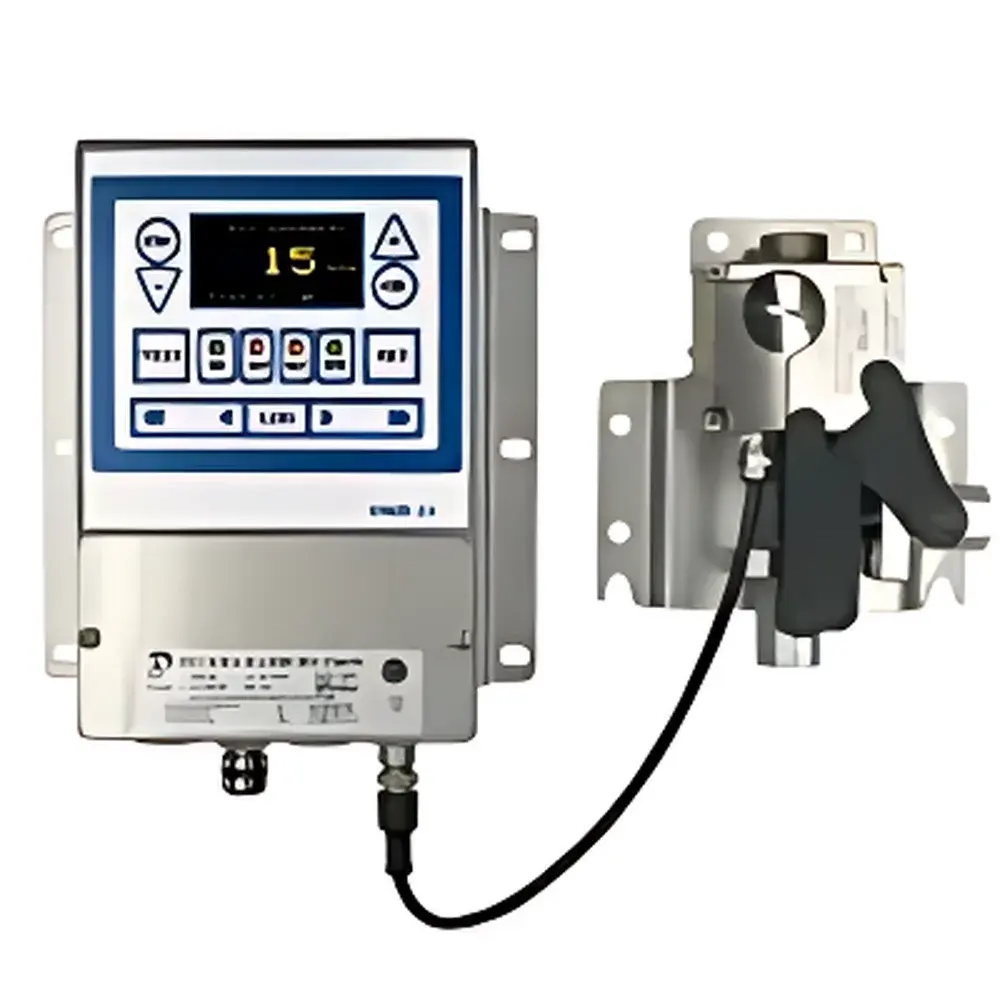
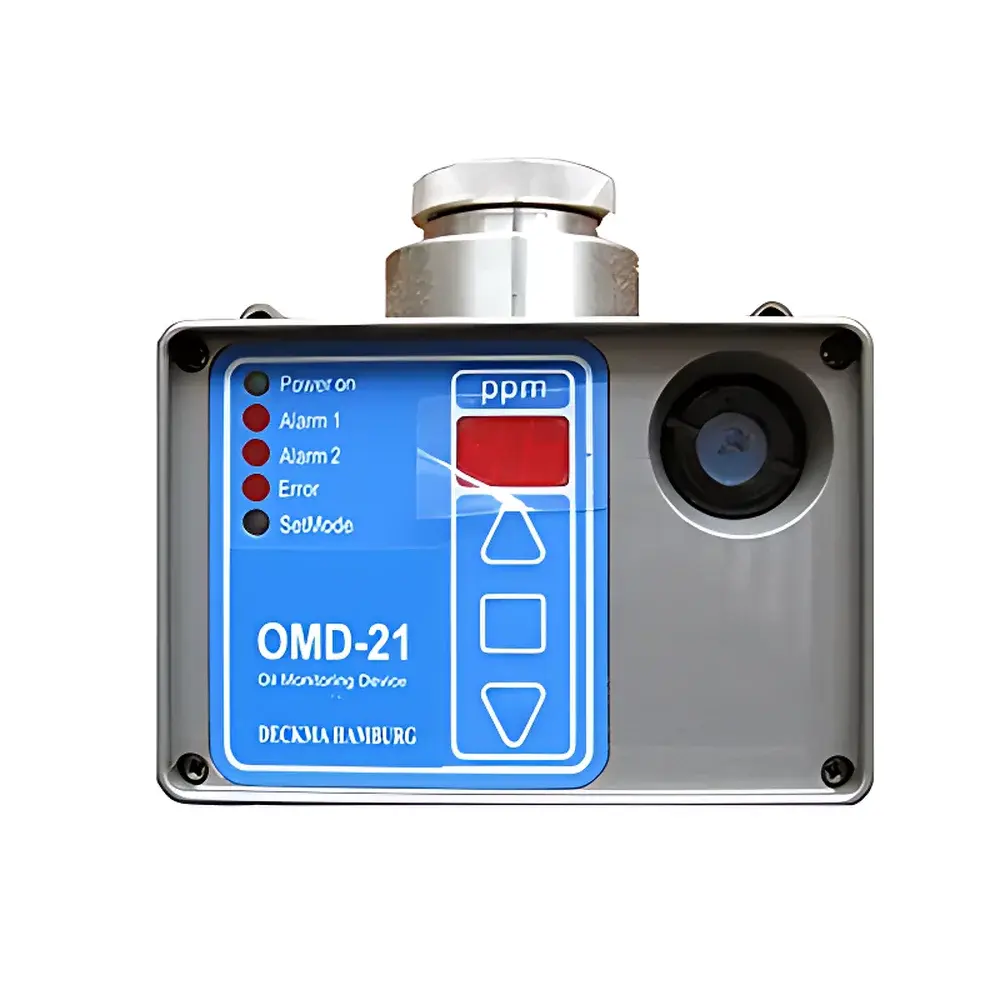
Deckma OMD-24 Marine Oil-in-Water Alarm Monitor
| Origin | Germany |
|---|---|
| Manufacturer Type | Authorized Distributor |
| Origin Category | Imported |
| Model | OMD-24 / OMD-15 |
| Instrument Type | Online |
| Measurement Principle | Fluorescence-based Optical Detection (IMO MEPC.107(49)-compliant) |
| Measurement Range | 0–30 ppm (trending up to 50 ppm), IMO-compliant range: 0–15 ppm |
| Detection Limit | < 2% of full scale |
| Accuracy | ±1% FS |
| Resolution | 0.1 ppm |
| Measurement Frequency | User-adjustable |
| Linearity | ±2% FS |
| Power Supply | 24 V AC/DC ±10% |
| Power Consumption | < 10 VA |
| Sample Flow Rate | 0.1–4 L/min |
| Sample Temperature Range | +1 °C to +65 °C |
| Process Connection | R ¼" internal thread |
| Alarm Setpoints | Two independent, adjustable within 1–15 ppm (default: 15 ppm) |
| Alarm Delay (Point 1) | 1–540 s (default: 2 s) |
| Control Delay (Point 2) | 1–20 s (default: 10 s) |
| Relay Output | Passive, 3 A / 240 V AC/DC |
| Analog Output | 4–20 mA, max. load < 150 Ω |
| Display | Graphical LCD |
| Ambient Operating Temperature | +1 °C to +55 °C |
| Enclosure Rating | IP65 |
| Dimensions (Control Unit) | 185 × 210 × 65 mm (W×H×D) |
| Dimensions (Measurement Cell) | 140 × 160 × 65 mm (W×H×D) |
| Weight | 2.5 kg |
Overview
The Deckma OMD-24 Marine Oil-in-Water Alarm Monitor is an IMO MEPC.107(49)-certified online optical analyzer engineered for continuous, real-time detection of hydrocarbon contamination in bilge water effluent from marine oil-water separators. It employs a robust fluorescence excitation and detection principle—optimized for diesel, lubricating oils, and residual fuel oils—enabling selective, interference-resistant measurement without reagents or consumables. Unlike generic “other method” instruments, the OMD-24 implements a calibrated, factory-traceable optical path with temperature-compensated photodiode detection, ensuring compliance with the stringent repeatability, linearity, and response time requirements defined in Resolution MEPC.107(49). Designed for integration into Class-approved oily water separator (OWS) systems, it delivers deterministic alarm triggering at precisely configured thresholds—critical for preventing non-compliant discharges and supporting Port State Control (PSC) audits.
Key Features
- Full compliance with IMO Resolution MEPC.107(49), including mandatory 15 ppm alarm threshold validation, response time verification (<60 s for 90% step change), and zero-drift stability testing over 72 hours
- Dual independent alarm outputs: Alarm Point 1 (audible/visual alarm) and Alarm Point 2 (interlock signal for OWS recirculation or shutdown), each with fully configurable setpoints (1–15 ppm) and programmable delay timers
- Integrated graphical LCD display with real-time concentration trend, status flags (e.g., flow fault, sensor fouling, calibration due), and event log (last 100 entries with timestamps)
- Passive relay output rated for 3 A / 240 V AC/DC, compatible with shipboard PLCs, alarm panels, and safety interlocks per IEC 60947-5-1
- 4–20 mA analog output with HART-compatible signaling capability (optional firmware upgrade), supporting integration into distributed control systems (DCS) and SCADA platforms
- IP65-rated enclosure with stainless-steel wetted parts and fluoropolymer-coated optical windows, resistant to salt fog (IEC 60068-2-52), vibration (IEC 60945), and thermal cycling
Sample Compatibility & Compliance
The OMD-24 is validated for use with clarified effluent from gravity-based and coalescing-type oil-water separators operating under MARPOL Annex I conditions. It accommodates variable flow rates (0.1–4 L/min) and temperatures (+1 °C to +65 °C), with automatic thermal compensation applied to both excitation source and detector gain. The measurement cell design minimizes bubble entrapment and sediment accumulation, reducing false positives during transient flow conditions. All calibration and verification procedures align with ISO 8573-1 (compressed air purity) and ISO 17025-accredited laboratory practices. Documentation includes EU Declaration of Conformity (2014/30/EU EMC Directive, 2014/35/EU LVD Directive), and type approval certificates issued by recognized classification societies (e.g., DNV, LR, ABS).
Software & Data Management
Configuration and diagnostics are performed via front-panel keypad navigation or optional USB-to-RS485 interface using Deckma’s OMD Configuration Suite (v3.2+). The embedded firmware supports audit-trail logging per GLP/GMP principles: all parameter changes, alarm activations, and maintenance events are timestamped and stored in non-volatile memory with write-protection. Calibration history—including date, operator ID, standard used (traceable to NIST SRM 2781), and post-calibration verification results—is retained for ≥12 months. No cloud connectivity or remote access functionality is included, preserving cybersecurity integrity in accordance with IMO MSC-FAL.1/Circ.3 guidelines on maritime cyber risk management.
Applications
- Continuous monitoring of OWS discharge streams on commercial vessels (tankers, bulk carriers, container ships) to ensure MARPOL Annex I compliance
- Alarm verification during PSC inspections and flag state audits
- Integration with automated bilge management systems for real-time decision support and regulatory reporting
- Performance validation of oil-water separator efficiency during commissioning and periodic maintenance
- Supporting environmental management systems (EMS) aligned with ISO 14001:2015 clause 8.2 (emergency preparedness and response)
FAQ
Does the OMD-24 require periodic calibration with certified standards?
Yes. Initial calibration is performed at the factory using traceable hydrocarbon standards. Field recalibration is recommended every 6 months or after maintenance, using Deckma-certified calibration kits (OMD-CAL-KIT-15) traceable to NIST SRM 2781.
Can the OMD-24 distinguish between mineral oil and bio-oil contaminants?
No. It responds to aromatic hydrocarbons common in petroleum-based oils. Non-aromatic biolubricants (e.g., vegetable esters) exhibit significantly lower fluorescence yield and may fall below detection sensitivity.
Is the measurement cell prone to fouling in high-suspended-solid environments?
The optical path incorporates self-cleaning geometry and optional ultrasonic assist (OMD-US-1 module) to mitigate fouling. Routine inspection and manual wipe-down of the quartz window are required per manufacturer’s maintenance schedule (every 3 months under normal operation).
What documentation is supplied for regulatory submission?
Each unit ships with a Factory Calibration Certificate, IMO MEPC.107(49) Test Report, EU DoC, installation manual, and maintenance logbook template compliant with ISO 55001 asset management requirements.







