
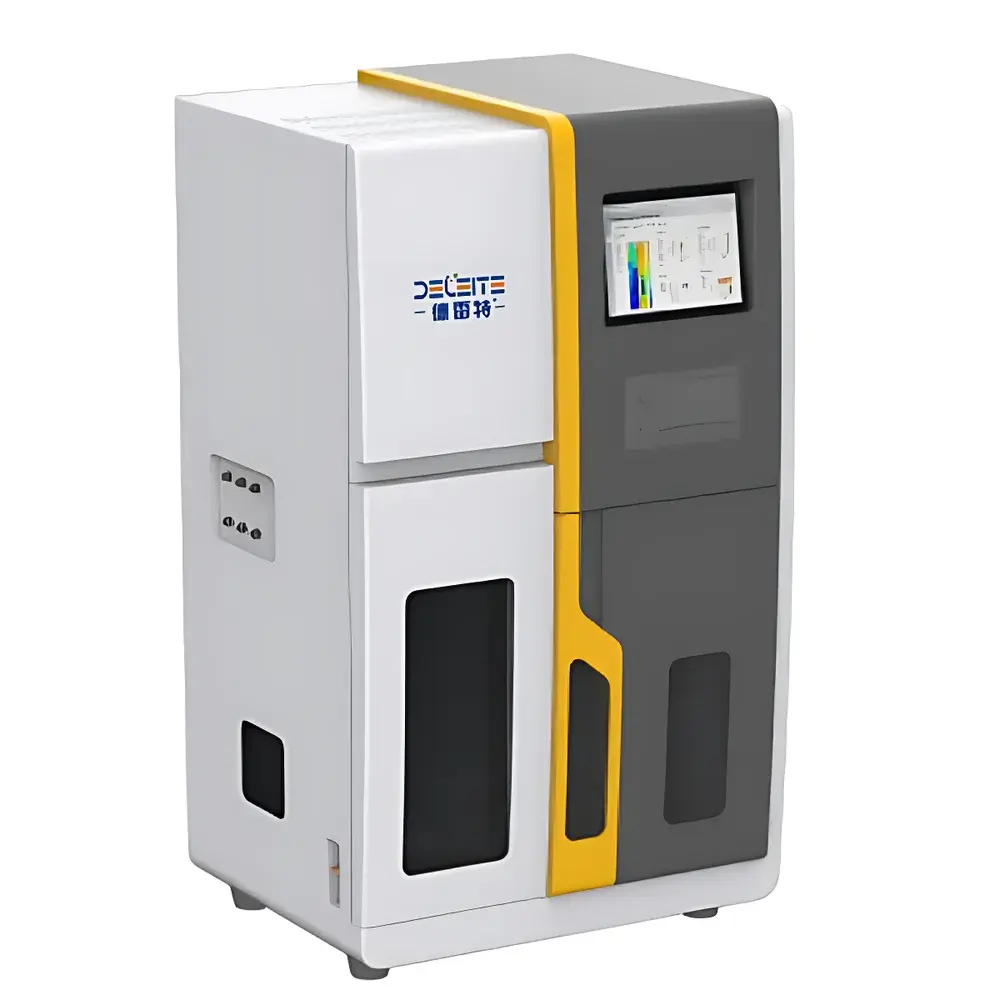
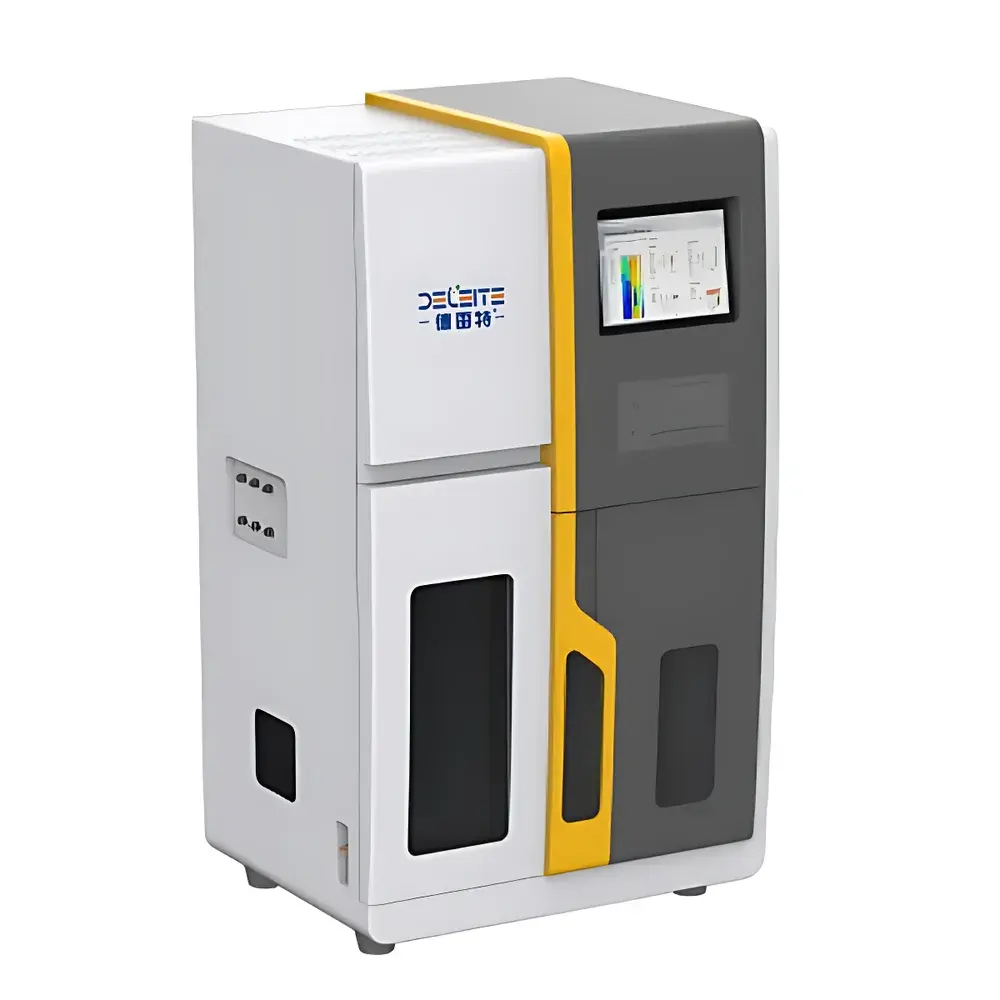
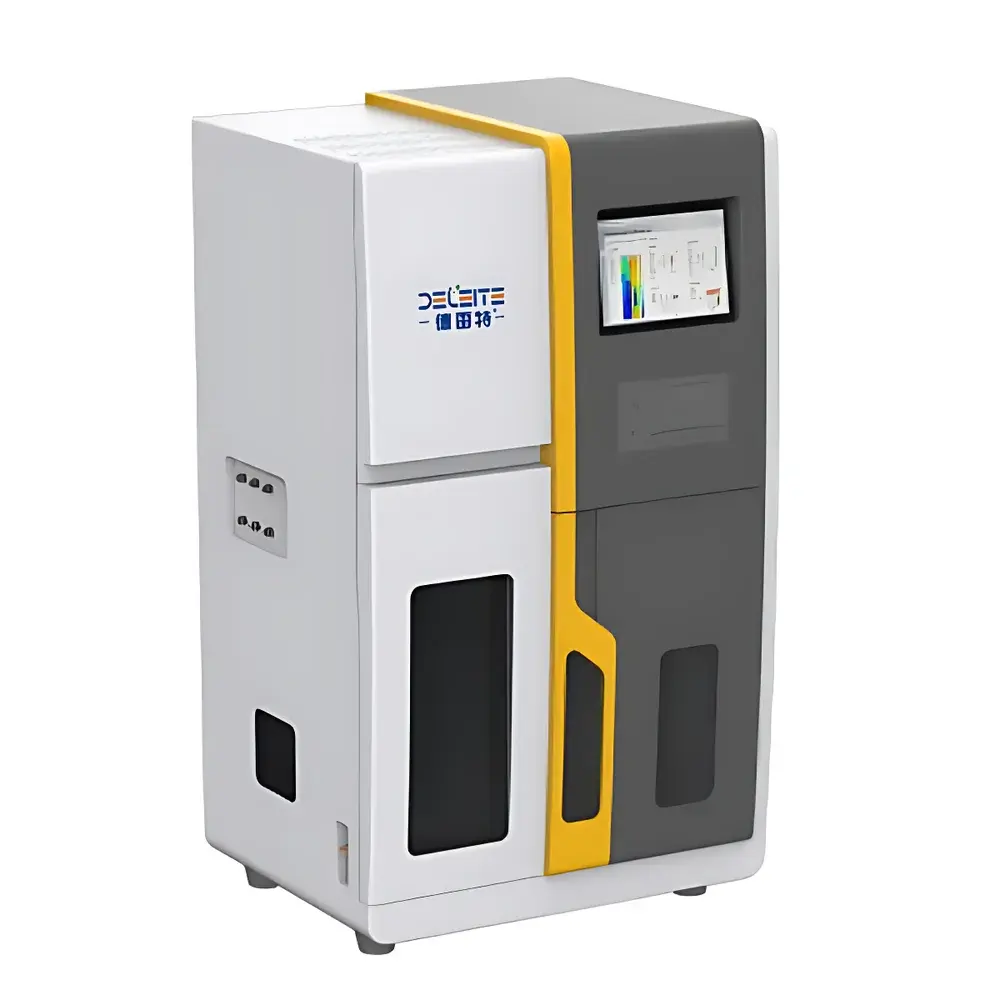
DELEITE AKN-3240 Fully Automated Kjeldahl Nitrogen Determinator
| Brand | DELEITE |
|---|---|
| Origin | Shanghai, China |
| Model | AKN-3240 |
| Automation Level | Fully Automated |
| Nitrogen Determination Range | 0.01–240 mg N per sample |
| Distillation Time | 0–9 min/sample |
| Titration Precision | RSD < 0.0012 µL/step |
| Minimum Titration Volume | 1–20 µL/step (auto-adjusted based on standard acid concentration) |
| Recovery Rate | >99.5% |
| Power Adjustment Range | 0–1500 W |
| Linearity | RSD <1.0% across 1× to 4× sample mass (same matrix) |
| Repeatability (RSD) | <0.5% |
| Digestion Tube Compatibility | Ø42 × 300 mm (supports both 300 mL and 650 mL tubes) |
| Data Storage Capacity | ≥200,000 sample records (≥7 years at typical lab throughput) |
| Compliance | Supports audit-trail-enabled operation per GLP/GMP requirements |
Overview
The DELEITE AKN-3240 Fully Automated Kjeldahl Nitrogen Determinator is engineered for high-throughput, regulatory-compliant nitrogen and protein quantification in food, feed, agricultural, environmental, and pharmaceutical laboratories. Based on the classical Kjeldahl digestion–distillation–titration principle, the system automates all critical steps—from alkaline distillation of ammonium ions liberated from digested samples to precise potentiometric or colorimetric endpoint detection during titration with standardized sulfuric or hydrochloric acid. The instrument implements simultaneous distillation and titration: distillation concludes within a user-defined window (0–9 minutes per sample), and titration terminates automatically within ≤15 seconds after distillate collection ceases—ensuring minimal ammonia loss and maximal analytical integrity. Colorimetric endpoint detection eliminates electrode drift and calibration dependency associated with traditional pH-based systems, delivering robust performance across diverse matrices without routine sensor maintenance.
Key Features
- Fully integrated automation: automatic reagent dispensing (acid, base, diluent), steam distillation, back-titration, calculation, result display, and thermal printing of nitrogen (%) and protein (%) values.
- Dynamic titration control: minimum dispensing volume auto-adjusts between 1–20 µL/step depending on standard acid molarity, ensuring optimal resolution across wide concentration ranges (e.g., 0.1 M to 0.5 M H2SO4).
- High-precision fluid handling: peristaltic reagent pumps with ≤0.0012 µL/step volumetric repeatability (RSD); 0–150 mL programmable reagent delivery range in 1 mL increments.
- Dual digestion tube support: accommodates standard Ø42 × 300 mm tubes (300 mL capacity) and extended-height 650 mL tubes for high-volume or low-concentration sample processing.
- Real-time safety monitoring: continuous optical detection of digestion chamber door status with audible/visual alerts and automatic process suspension if opened during operation.
- Self-maintaining titration cell: automated post-analysis rinse cycle prevents cross-contamination and preserves endpoint accuracy over extended runs.
- GLP-ready data architecture: immutable storage of ≥200,000 sample records—including raw titration curves, reagent lot IDs, operator ID, timestamp, and instrument parameters—with full traceability and no editable fields.
- Optional balance integration: RS-232 or USB interface enables direct acquisition of sample mass data, eliminating manual entry errors and supporting 21 CFR Part 11-compliant electronic signatures when paired with validated LIMS software.
Sample Compatibility & Compliance
The AKN-3240 is validated for use with solid, semi-solid, and liquid samples compliant with AOAC Official Method 981.10, ISO 8968-1:2014 (milk), ISO 1871:2020 (cereals), and USP <467> residual nitrogen testing protocols. Its adjustable distillation power (0–1500 W) enables optimization for volatile or thermally sensitive matrices, while the 0–3600 s programmable delay function supports nitrate/nitrite correction via cadmium reduction pretreatment. All operational parameters—including distillation time, base volume, acid concentration, and titration threshold—are fully configurable and stored per method, enabling seamless switching between food-grade protein assays and environmental total Kjeldahl nitrogen (TKN) workflows. The system meets mechanical and electrical safety requirements per IEC 61010-1 and supports laboratory quality systems aligned with ISO/IEC 17025 and FDA 21 CFR Part 11 when deployed with audit-trail-enabling software.
Software & Data Management
Embedded firmware provides intuitive touchscreen navigation with multilingual UI (English, Spanish, French, Chinese). All measurement data—including titration curves, endpoint voltages, blank corrections, and recovery calculations—are timestamped and stored locally in non-volatile memory. Export options include CSV and PDF formats via USB port or Ethernet connection. Data integrity safeguards include write-once storage logic, cryptographic hashing of record headers, and automatic generation of daily calibration logs. Optional PC-based software extends functionality with statistical process control (SPC) charts, method validation reporting (linearity, LOD/LOQ, intermediate precision), and integration into enterprise LIMS platforms via ASTM E1384-compliant HL7 or RESTful API interfaces.
Applications
- Food & Feed: Crude protein determination in grains, dairy products, meat meals, and pet food per AOAC 984.13 and ISO 14891.
- Agriculture: Soil and fertilizer TKN analysis under EPA Method 350.1 and ISO 13878.
- Pharmaceuticals: Nitrogen content verification in excipients and active pharmaceutical ingredients (APIs) per USP <467> and Ph. Eur. 2.5.27.
- Environmental: Wastewater and sludge TKN quantification per APHA Standard Methods 4500-Norg B and ISO 11261.
- Research: Method development for non-standard matrices requiring customized distillation kinetics or multi-step digestion protocols.
FAQ
Does the AKN-3240 require manual calibration before each analysis?
No. The system performs automatic zero-point and span calibration at startup using built-in reference solutions, eliminating daily manual standardization.
How is endpoint accuracy ensured during colorimetric titration?
A dual-wavelength photometric sensor continuously monitors indophenol blue formation kinetics; endpoint is determined by first-derivative inflection point detection, not fixed absorbance thresholds.
Can the instrument store and recall multiple analytical methods?
Yes—up to 100 user-defined methods can be saved, each with independent settings for distillation time, reagent volumes, acid concentration, and reporting units (N% or protein%).
Is remote monitoring or control supported?
Standard Ethernet connectivity enables real-time status viewing and basic job initiation via web browser; advanced remote diagnostics and firmware updates require optional service contract.
What documentation is provided for regulatory audits?
Factory-issued IQ/OQ documentation, electronic logbook export, and traceable calibration certificates for all critical sensors (photometer, temperature, pressure) are included with delivery.
Related Products





