
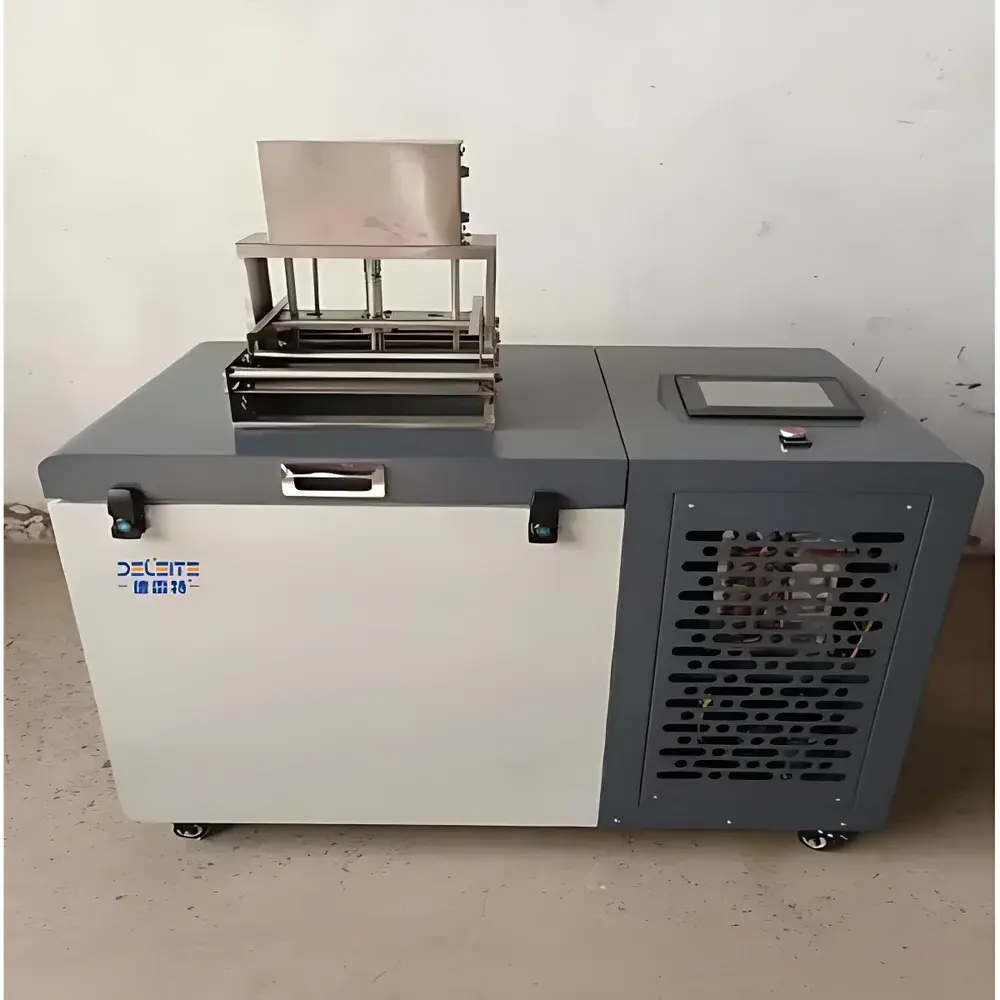
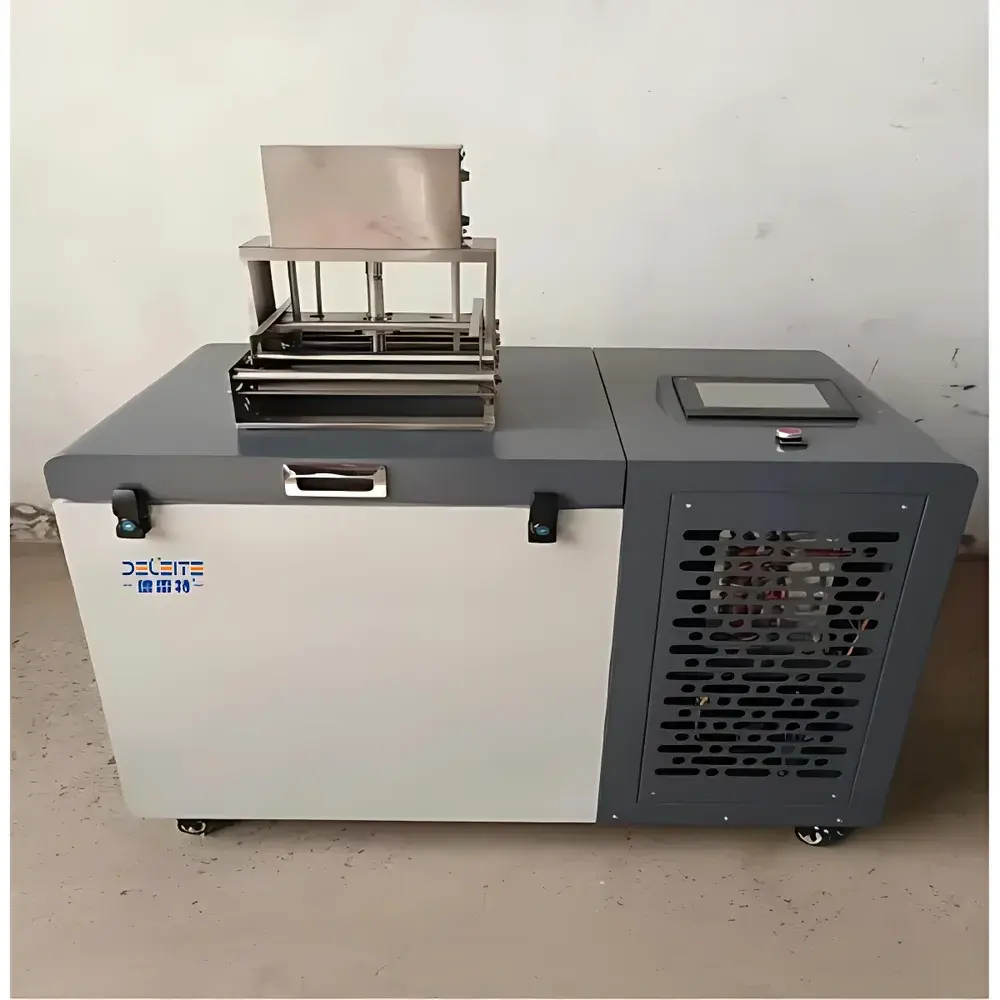
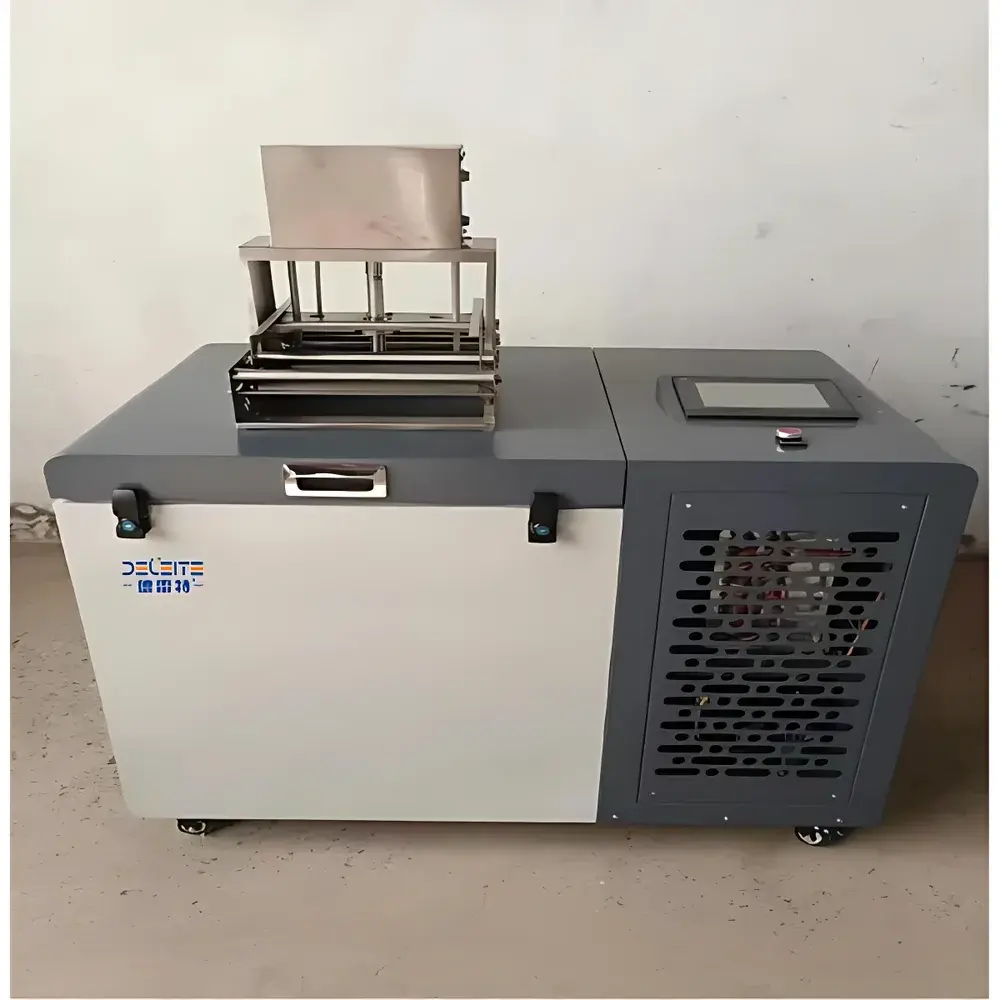
DELEITE ALTR-5000 Fully Automated Low-Temperature Flexibility Tester
| Brand | DELEITE |
|---|---|
| Origin | Shanghai, China |
| Manufacturer Type | Authorized Distributor |
| Country of Manufacture | China |
| Model | ALTR-5000 |
| Voltage | 220 V AC |
| Power Consumption | 1200 W |
| Net Weight | 145 kg |
| External Dimensions | 118 × 66 × 110 cm |
| Test Speed | 360 ± 40 mm/min |
| Temperature Range | –40 °C (adjustable in 1 °C increments) |
| Specimen Capacity | 10 or 20 specimens per cycle |
| Specimen Size | 150 × 25 mm |
| Timing Range | 0–99 min 59 sec (programmable) |
| Mandrel Diameters | Φ20 mm, Φ30 mm, Φ50 mm |
| Cooling System | Dual-compressor refrigeration unit |
| Control Interface | 7-inch capacitive touchscreen with embedded PLC logic |
| Compliance | GB/T 328.14–2007 (Method 14: Low-Temperature Flexibility of Bituminous Waterproofing Membranes) |
Overview
The DELEITE ALTR-5000 Fully Automated Low-Temperature Flexibility Tester is an electromechanical test system engineered for standardized evaluation of low-temperature ductility and bending resistance in bituminous and polymer-modified waterproofing membranes. It operates on the principle of controlled mechanical bending under precisely stabilized sub-zero thermal conditions, directly implementing the test sequence defined in GB/T 328.14–2007 — the Chinese national standard equivalent to ISO 4627:2017 and aligned with ASTM D3462 and EN 1107-1 requirements for flexibility assessment at low temperatures. Unlike manual or semi-automated alternatives, the ALTR-5000 eliminates operator-dependent variables—such as inconsistent bending speed, timing deviation, or temperature fluctuation during specimen loading—by integrating closed-loop PID temperature control, synchronized linear actuation, and programmable mandrel positioning. The system maintains thermal stability within ±0.5 °C across the full test chamber volume during continuous operation at –40 °C, ensuring measurement repeatability essential for quality control laboratories operating under GLP or internal audit frameworks.
Key Features
- Fully automated test cycle: automatic specimen loading/unloading simulation (via programmable carriage), temperature ramping, dwell stabilization, bending execution, and pass/fail recording—all initiated from a single touchscreen command.
- Dual-compressor cascade refrigeration architecture enables rapid cooldown to –40 °C (≤90 minutes from ambient) and sustained thermal uniformity across the 300 × 200 × 250 mm test chamber.
- High-precision linear motion stage with servo-controlled actuator delivers consistent bending speed of 360 ± 40 mm/min, traceable to NIST-traceable calibration protocols.
- Modular mandrel set (Φ20 mm, Φ30 mm, Φ50 mm) complies with GB/T 328.14–2007 Annex A specifications; each mandrel is hardened stainless steel with surface roughness Ra ≤ 0.8 µm to prevent specimen slippage.
- Embedded industrial PLC with real-time data logging records temperature, position, time, and status flags at 10 Hz resolution; raw logs exportable via USB 2.0 in CSV format.
- Touchscreen HMI supports multi-language UI (English, Chinese, Spanish), user-level access control (admin/operator modes), and configurable test templates for routine QC batches.
Sample Compatibility & Compliance
The ALTR-5000 accommodates standard flat-sheet specimens measuring 150 mm × 25 mm, cut perpendicular to the machine direction per GB/T 328.14–2007 Section 6.1. It accepts bituminous membranes (SBS/APP-modified), PVC, TPO, EPDM, and other elastomeric or plastomeric roofing and waterproofing materials. Specimen clamping uses pneumatic dual-point fixation to eliminate edge deformation during bending. The instrument satisfies mandatory verification requirements for CNAS-accredited testing labs in China and supports documentation packages compliant with ISO/IEC 17025:2017 clause 6.4 (equipment validation). Its thermal performance profile has been verified against JJF 1101–2019 (Calibration Specification for Environmental Test Chambers) and meets the temperature uniformity criteria (<±1.0 °C) required for GB/T 328.14–2007 conformance.
Software & Data Management
No external PC software is required—the ALTR-5000 runs a deterministic real-time OS with onboard firmware v3.2. All test parameters, results, and environmental metadata are stored internally on a 4 GB industrial-grade SD card with wear-leveling and error-correction. Each test record includes timestamp, operator ID, specimen ID, target temperature, actual chamber temperature (averaged over last 60 s pre-bend), bending duration, mandrel diameter, and visual pass/fail annotation (manually entered post-test). Audit trails are immutable and support FDA 21 CFR Part 11–compatible electronic signatures when integrated with enterprise LIMS via optional RS-485 Modbus RTU interface. Exported CSV files contain column headers compatible with Minitab, JMP, and Excel for SPC charting and statistical process review.
Applications
- Quality assurance of roll-based waterproofing membranes prior to factory release or construction site delivery.
- R&D evaluation of new polymer formulations’ cold-weather performance, including comparative studies across curing conditions or plasticizer types.
- Third-party certification testing for CCC mark applications in China’s building materials regulatory regime.
- Supplier qualification audits requiring documented evidence of low-temperature flexibility compliance per project specifications (e.g., subway tunnel linings, green roof assemblies).
- Interlaboratory comparison exercises coordinated under CNAS proficiency testing programs.
FAQ
Does the ALTR-5000 meet international standards beyond GB/T 328.14–2007?
Yes—it is functionally compatible with ISO 4627:2017, ASTM D3462–18 (Section 8), and EN 1107-1:2003, provided mandrel diameters and specimen dimensions align with those standards’ requirements.
Can test data be exported in PDF format with digital signature?
Raw data exports exclusively as CSV. PDF reporting requires integration with external LIMS or QA software; however, the system timestamps and logs all actions for forensic traceability.
What maintenance intervals are recommended for the dual-compressor cooling system?
Compressor oil and refrigerant levels require inspection every 12 months by certified HVAC-R technicians; condenser coil cleaning is advised quarterly in high-dust environments.
Is calibration certificate included with shipment?
A factory-issued calibration report (covering temperature uniformity, bending speed, and timer accuracy) is supplied. Full ISO/IEC 17025 calibration must be performed on-site by an accredited provider.
How is specimen failure defined during the bending test?
Per GB/T 328.14–2007 Section 8.2, failure occurs if any visible crack, split, or delamination appears on the tension surface after bending and visual inspection under 2× magnification.



