
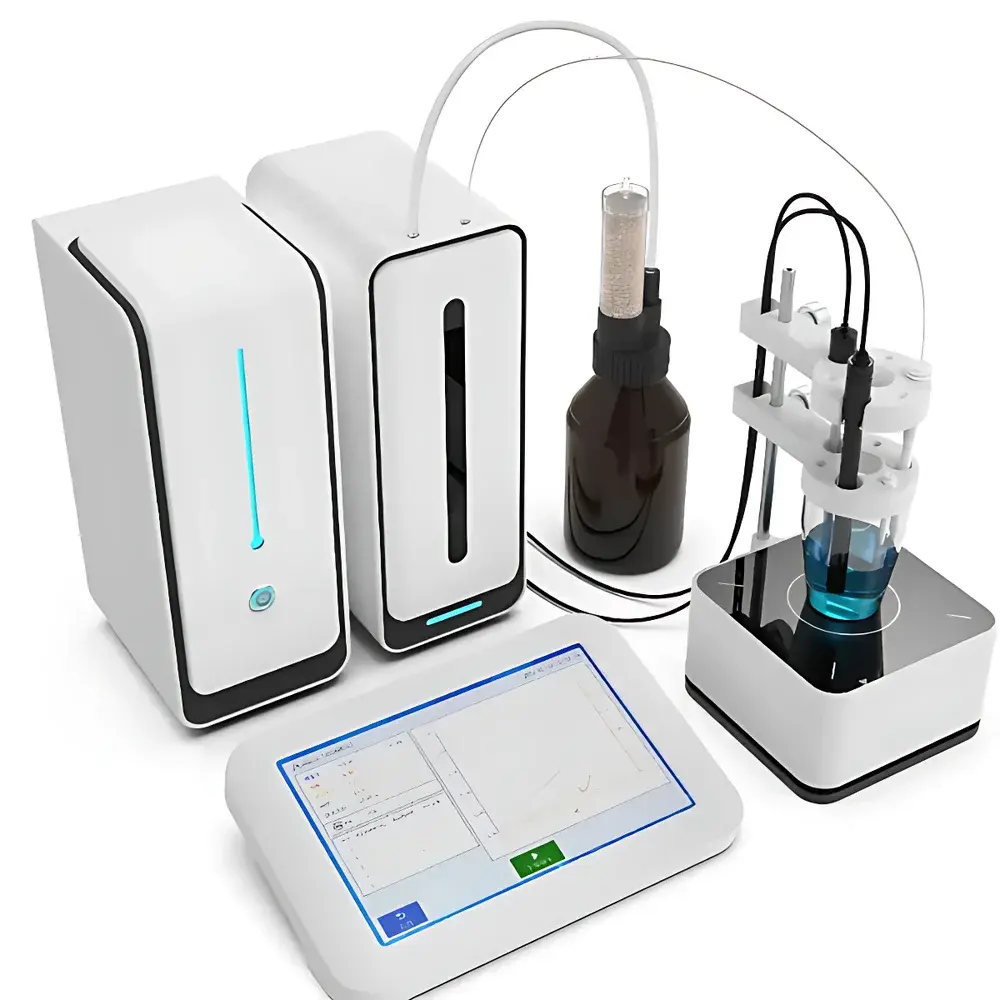
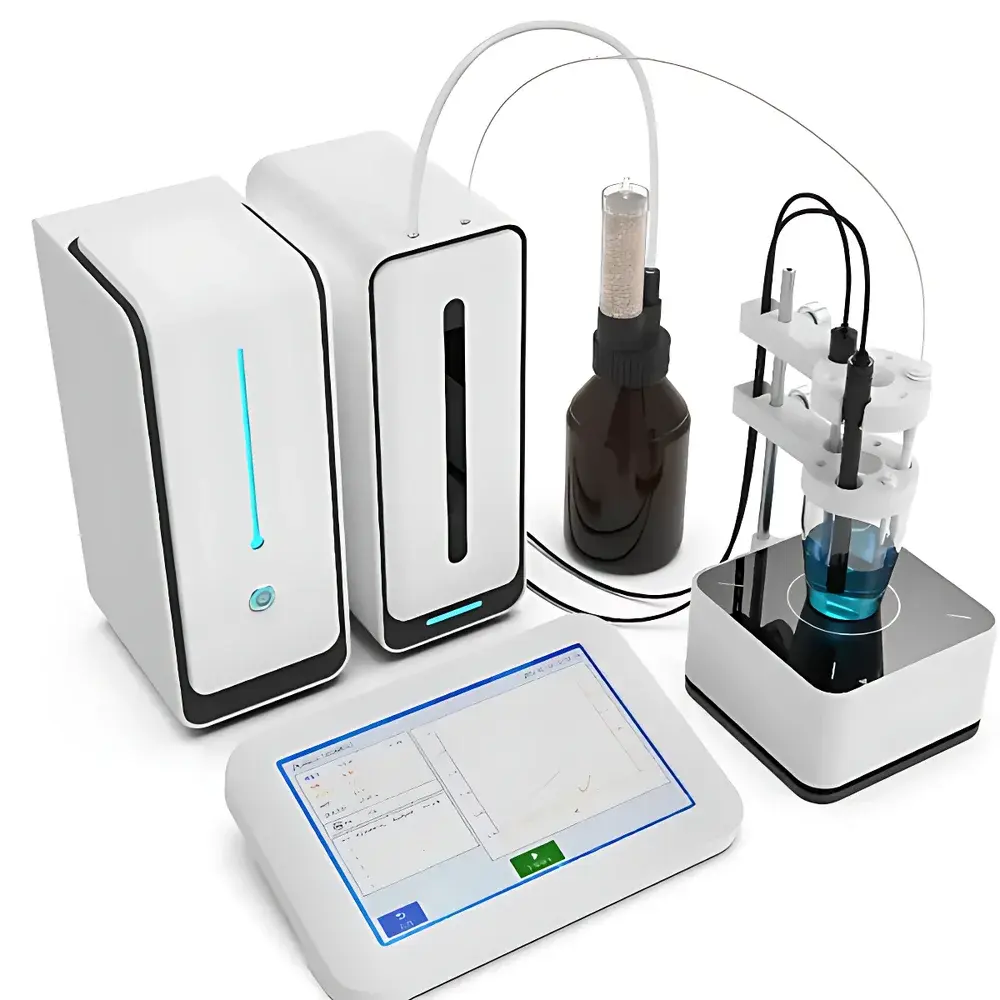
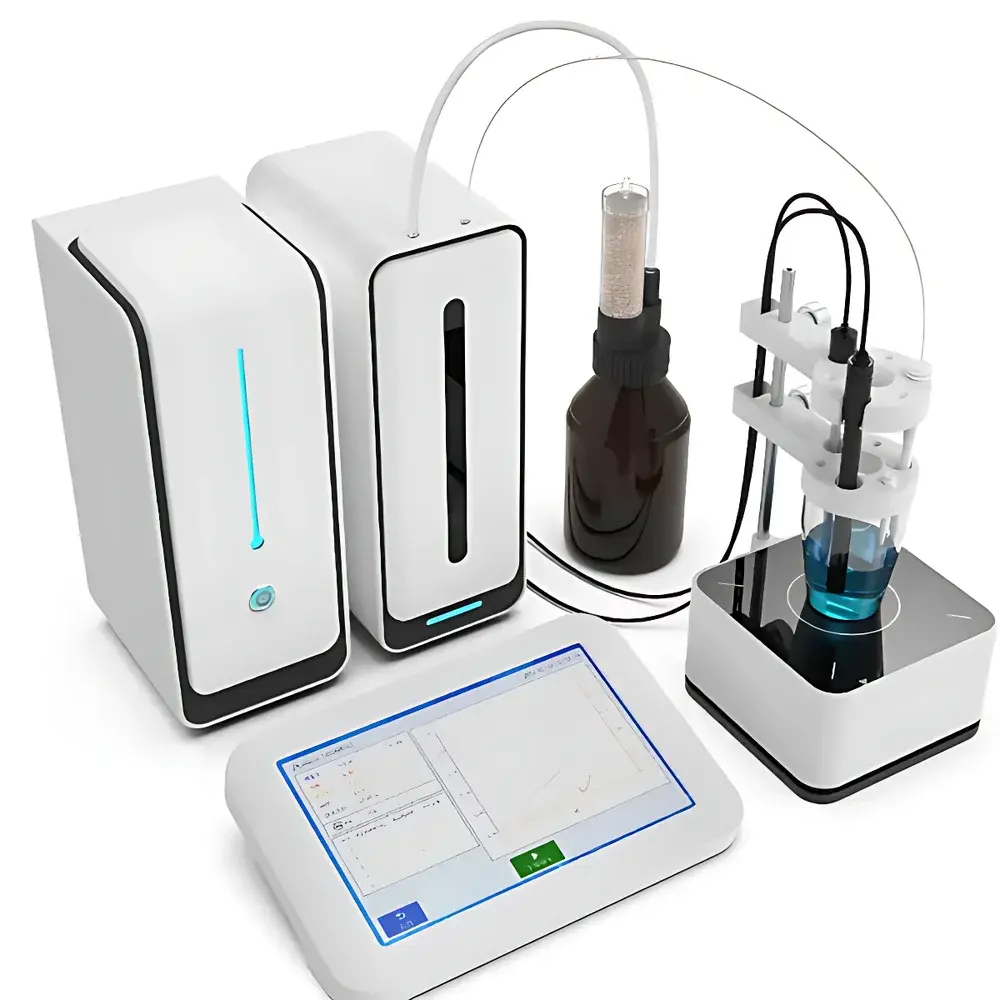
DELEITE APT-1000 Fully Automated Potentiometric Titrator
| Brand | DELEITE |
|---|---|
| Origin | Shanghai, China |
| Model | APT-1000 |
| Display | 10-inch capacitive color touchscreen |
| Titration Modes | Dynamic, Endpoint, Equivalence-Point, Manual |
| Measurement Range | mV: −2000.0 to +2000.0 mV |
| pH | −2.000 to +20.000 pH |
| Temperature | −5 to 120 °C |
| Resolution | mV: 0.1 mV |
| pH | 0.001 pH |
| Temp | 0.1 °C |
| Accuracy | mV: ±0.1 mV or ±0.03% FS |
| pH | ±0.01 pH |
| Temp | ±0.1 °C |
| Repeatability (Titration) | ≤0.2% RSD |
| Electronic Unit Repeatability | ≤0.2 mV |
| Drift Stability | ±0.3 mV / 3 h |
| Burette Capacity | 10 mL |
| Burette Resolution | 1/96,000 steps |
| Material Compatibility | Acid-/alkali-resistant fluidic path (PP, PTFE, FEP, ceramic valves) |
| Compliance | Designed for GLP/GMP-aligned workflows |
Overview
The DELEITE APT-1000 Fully Automated Potentiometric Titrator is an engineered solution for high-precision, traceable volumetric analysis in regulated and research-intensive laboratory environments. It operates on the fundamental principle of potentiometric endpoint detection—measuring the potential difference between a reference electrode and an indicator electrode as titrant is incrementally added to the analyte. This electrochemical signal shift, governed by the Nernst equation, enables accurate identification of stoichiometric equivalence points across diverse reaction types—including acid-base, redox, complexometric, precipitation, non-aqueous, and constant-pH (potentiometric) titrations. Its modular architecture separates the titration unit, electrode module, reagent handling station, and control interface—reducing electromagnetic coupling and enabling independent thermal and mechanical stability. Designed for reproducibility under ISO 8655 (volumetric equipment) and ASTM E202 (standard practices for titrimetry), the APT-1000 delivers sub-0.2% RSD repeatability in routine operation when calibrated per manufacturer protocol.
Key Features
- Modular, decoupled hardware design minimizes cross-talk between electronic subsystems—each signal path (electrode input, burette drive, temperature sensing) uses shielded, isolated cabling to suppress noise and ensure <0.2 mV electronic repeatability.
- 10-inch capacitive touchscreen with intuitive, menu-driven navigation supports real-time visualization of titration curves (E vs. V, dE/dV vs. V, second derivative), method parameters, and live endpoint calculation.
- Integrated 10 mL precision burette with 1/96,000-step microstepping motor ensures volumetric resolution down to 0.104 µL per step and flow-rate stability across 0.01–20 mL/min range.
- Automated fluidic management includes multi-cycle rinse protocols (up to 5 pre-wash cycles per titration), air-gap aspiration, and closed-loop reagent replenishment—eliminating carryover and enabling unattended sequential analysis of up to 99 samples.
- Onboard self-diagnostic suite validates electrode response (pH/mV calibration verification), burette linearity (gravimetric volume verification), and temperature sensor drift—generating diagnostic logs traceable to ISO/IEC 17025 calibration requirements.
- Chemically inert fluid path constructed from polypropylene (PP), PTFE, FEP, and ceramic components withstands prolonged exposure to concentrated HCl, NaOH, perchloric acid, acetic anhydride, and chloroform-based solvents without degradation.
Sample Compatibility & Compliance
The APT-1000 accommodates aqueous and non-aqueous matrices ranging from highly acidic (pH −2.000) to strongly alkaline (pH +20.000), with temperature-controlled titration capability from −5 °C to 120 °C—enabling applications such as Karl Fischer water determination, iodometric copper assay in HNO₃ media, and EDTA titration of Ca²⁺ in cement extracts. Its measurement electronics meet IEC 61326-1 (EMC for laboratory equipment) and IEC 61010-1 (safety). While the instrument itself does not hold formal FDA 21 CFR Part 11 certification, its data export structure (CSV, PDF, XML), timestamped audit logs, and user-access controls align with Part 11 implementation prerequisites when deployed within validated IT infrastructure. It supports GLP-compliant record retention through encrypted local storage (≥10,000 titration records) and optional network backup.
Software & Data Management
The embedded firmware provides full method scripting—including conditional branching (e.g., “if ΔpH > 0.5, pause and stir 30 s”), multi-step titration sequences, and dynamic endpoint algorithms (first-derivative threshold, inflection point interpolation, Gran plot). All raw sensor data (mV, pH, temp, volume), intermediate calculations, and final reports are stored with immutable timestamps, operator ID, and instrument serial number. Export formats include CSV (for LIMS integration), PDF (with digital signature fields), and XML (compatible with ELN platforms). Optional PC-based software extends functionality with statistical process control (SPC) charting, method validation templates (per USP ), and automated report generation aligned with ISO 17025 clause 7.8.2.
Applications
- Pharmaceutical QC: Assay of active pharmaceutical ingredients (APIs) via non-aqueous acidimetry (e.g., amine hydrochlorides in glacial acetic acid).
- Food & Beverage: Total acidity (TA) in wines, free fatty acids in edible oils, chloride content in dairy products using argentometric titration.
- Environmental Testing: Alkalinity profiling in wastewater, cyanide determination by pyridine-barbituric acid titration, fluoride analysis via lanthanum nitrate back-titration.
- Materials Science: Hydroxyl number in polyols, acid number in resins, saponification value in biodiesel—per ASTM D974, D465, D93.
- Academic Research: Kinetic titration studies, pKa determination via half-neutralization method, redox potential mapping in battery electrolyte formulations.
FAQ
Does the APT-1000 support GLP-compliant audit trails?
Yes—every titration event records operator ID, timestamp, method version, raw sensor values, calibration history, and system diagnostics. Audit logs are write-once and exportable in tamper-evident formats.
Can it perform thermometric or photometric titrations?
No—the APT-1000 is dedicated to potentiometric and pH-metric detection only. It does not integrate thermistors or photodiodes for alternative endpoint detection modes.
What is the maximum number of titrations possible in unattended operation?
Up to 99 sample positions can be programmed; automatic rinsing, electrode conditioning, and reagent refilling enable continuous overnight runs without manual intervention.
Is the 10 mL burette user-replaceable?
Yes—burettes are field-swappable modular units with factory-calibrated encoder alignment; replacement requires no recalibration if performed per service manual procedure.
How is compliance with ISO 8655 verified during installation qualification (IQ)?
Gravimetric verification kits (certified weights, Class A volumetric flasks) and NIST-traceable pH/mV standards are recommended for IQ/OQ; full qualification documentation templates are provided in the Installation & Operation Qualification (IOQ) package.



