
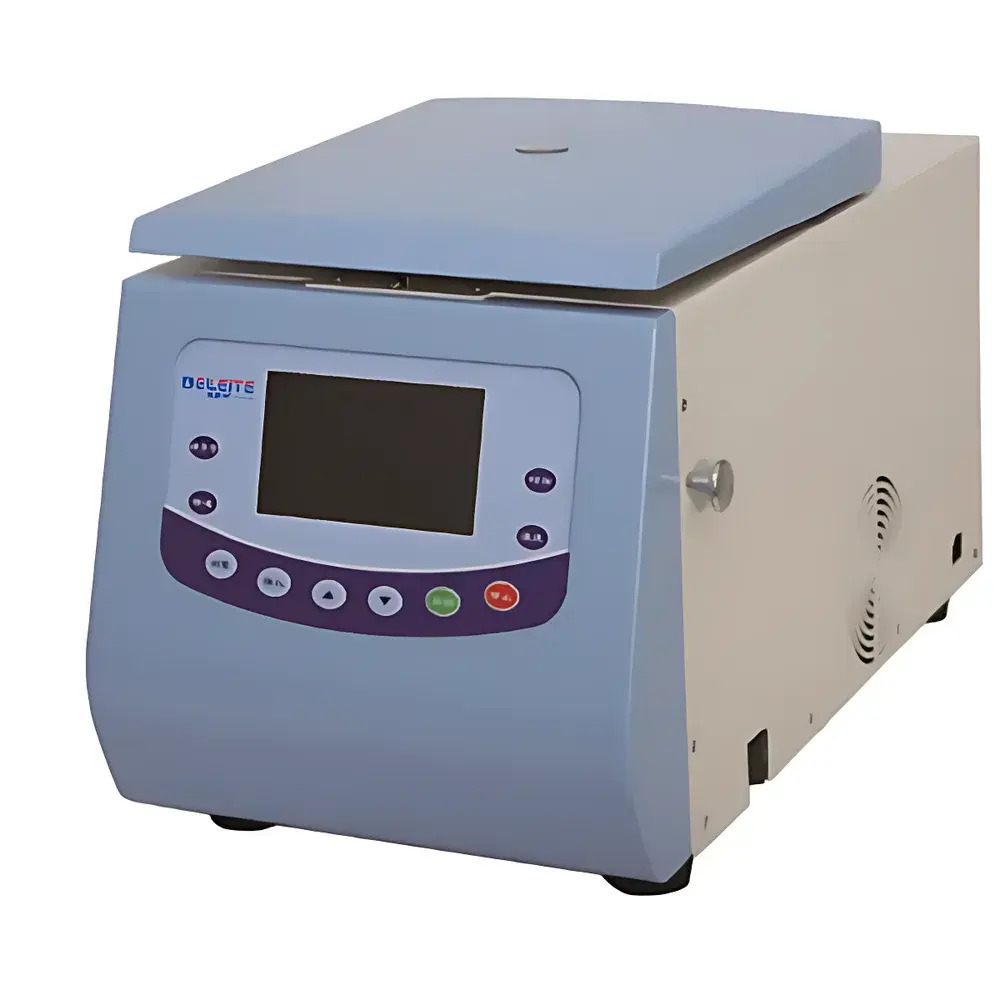
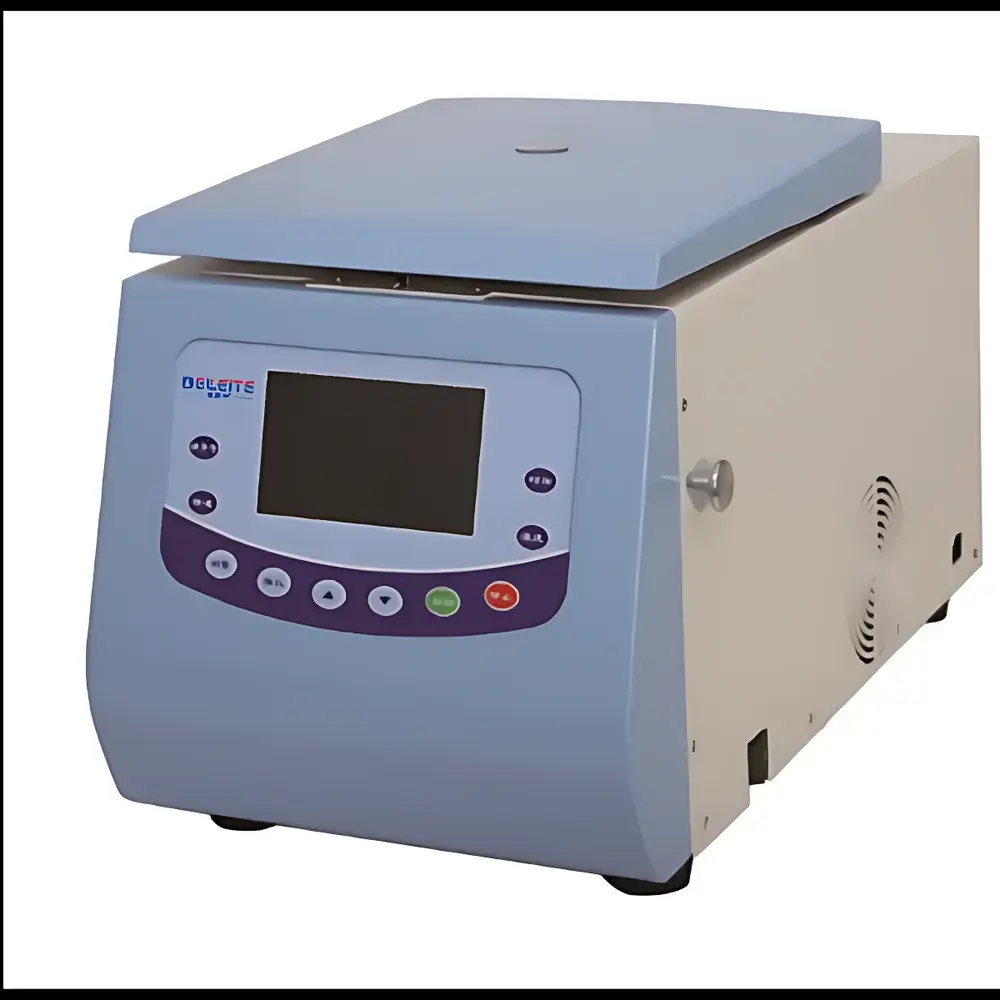
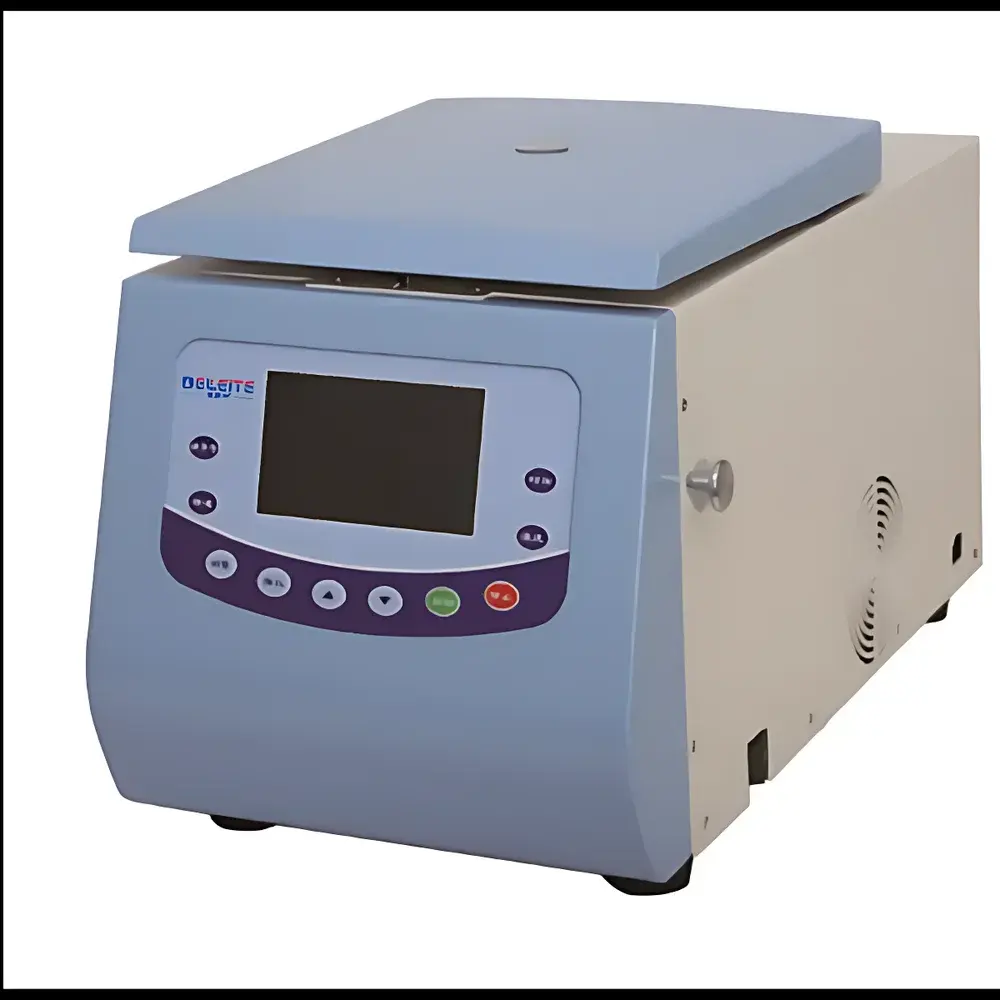
DELEITE DLG-R165AT Benchtop High-Speed Refrigerated Centrifuge
| Brand | DELEITE |
|---|---|
| Origin | Shanghai, China |
| Model | DLG-R165AT |
| Instrument Type | Benchtop Centrifuge |
| Speed Range | High-Speed (10,000–30,000 rpm) |
| Cooling Function | Refrigerated |
| Rotor Type | Fixed-Angle |
| Maximum Capacity | 36 × 1.5 mL tubes |
| Maximum Speed | 16,500 rpm |
| Maximum RCF | 21,532 × g |
| Dimensions (L×W×H) | 280 mm × 540 mm × 300 mm |
| Speed Accuracy | ±30 rpm |
| Time Range | 1 min – 9 h 59 min (or 1–99 min in short-mode) |
| Noise Level | <65 dB(A) |
| Power Supply | AC 220 V, 50 Hz, 10 A |
| Sealing Material | Food-Grade Silicone Rubber Gasket |
| Safety Features | Electronic Door Lock, Lid Interlock, Overspeed Protection, Overtemperature Protection, Automatic Fault Alarm |
Overview
The DELEITE DLG-R165AT is a compact, high-performance benchtop refrigerated centrifuge engineered for precision separation of biological samples in resource-constrained or space-limited laboratory environments. Utilizing a high-torque AC frequency-controlled motor and microprocessor-based control architecture, the system delivers stable rotational dynamics across its full speed range—up to 16,500 rpm—with exceptional speed reproducibility (±30 rpm) and low acoustic emission (<65 dB[A]). Its integrated refrigeration system maintains sample temperature between –20 °C and +40 °C during operation, ensuring thermal integrity for heat-sensitive nucleic acids, proteins, organelles, and cell lysates. Designed for routine use in clinical diagnostics, academic research, and quality control laboratories, the DLG-R165AT complies with fundamental mechanical and electrical safety standards applicable to Class II medical laboratory equipment under IEC 61010-1 and meets structural requirements for GLP-compliant sample preparation workflows.
Key Features
- AC frequency-controlled motor with high torque output ensures smooth acceleration/deceleration and minimal vibration at high speeds.
- Intuitive touch-panel interface with large backlit LCD display enables real-time switching between rpm and RCF values, programmable parameter recall, and automatic storage of up to 9 user-defined protocols.
- Electronic door lock with lid interlock mechanism prevents accidental opening during operation; integrated safety cutoffs respond to overspeed, overtemperature, imbalance, and rotor recognition failure.
- Nine programmable acceleration/deceleration profiles allow optimization of pelleting efficiency and sample integrity—critical for fragile subcellular fractions or PCR-ready nucleic acid preparations.
- Food-grade silicone rubber sealing gasket provides reliable chamber integrity and corrosion resistance against common laboratory reagents and condensate buildup.
- Compact footprint (280 × 540 × 300 mm) facilitates placement on standard lab benches without requiring dedicated cold-room integration.
Sample Compatibility & Compliance
The DLG-R165AT supports fixed-angle rotors optimized for microcentrifuge tubes (1.5 mL × 36), including compatibility with standard PCR strip carriers and low-retention tubes. Its maximum RCF of 21,532 × g enables efficient pelleting of mammalian cells, bacterial cultures, exosomes, and precipitated DNA/RNA. The unit operates within ISO 13485-aligned manufacturing practices and conforms to essential performance criteria outlined in ASTM F2621 (Standard Guide for Centrifuge Use in Biomedical Applications). While not FDA-cleared as a medical device, its design supports 21 CFR Part 11–compatible data logging when paired with external validated software solutions. Temperature uniformity across the rotor chamber is maintained within ±2 °C during continuous operation—a specification aligned with CLSI EP17-A2 guidance for centrifugal separation validation.
Software & Data Management
The onboard controller stores operational parameters—including speed, time, temperature, and acceleration/deceleration ramp settings—for each run. All settings are retained after power cycling, supporting repeatable method execution without reconfiguration. Though the instrument does not feature built-in Ethernet or USB data export, its protocol memory and fault-event logging (e.g., “Overtemp Alert,” “Lid Open During Run”) provide auditable traceability suitable for internal QC documentation. When deployed in regulated environments, users may integrate the DLG-R165AT into broader LIMS or ELN ecosystems via manual entry or third-party middleware that captures displayed parameters through serial communication (RS-232 optional interface available upon request).
Applications
- Preparative isolation of plasmid DNA, genomic DNA, and total RNA from bacterial and eukaryotic lysates.
- Clarification of cell culture supernatants prior to chromatography or mass spectrometry analysis.
- Concentration and purification of extracellular vesicles (exosomes) using differential ultracentrifugation protocols.
- Routine serum/plasma separation in clinical chemistry and immunoassay workflows.
- High-yield recovery of PCR products and enzymatic reaction mixtures prior to downstream sequencing or cloning.
- Stabilization of thermolabile enzymes and co-factors during buffer exchange steps.
FAQ
What is the minimum and maximum operating temperature range?
The refrigeration system maintains chamber temperatures from –20 °C to +40 °C, adjustable in 1 °C increments.
Is rotor auto-recognition supported?
No—the DLG-R165AT requires manual rotor selection via the touchscreen interface prior to run initiation.
Can this centrifuge accommodate 0.2 mL PCR tubes?
Yes, when used with compatible PCR strip carriers designed for the 1.5 mL fixed-angle rotor configuration.
Does the unit include a calibration certificate?
Factory calibration verification is performed per internal QA protocol; NIST-traceable calibration services are available through authorized DELEITE service partners.
What maintenance intervals are recommended?
Routine cleaning of the rotor chamber and gasket is advised after each use; full preventive maintenance—including bearing inspection and refrigerant pressure check—is recommended every 12 months or after 1,000 operating hours, whichever occurs first.



