
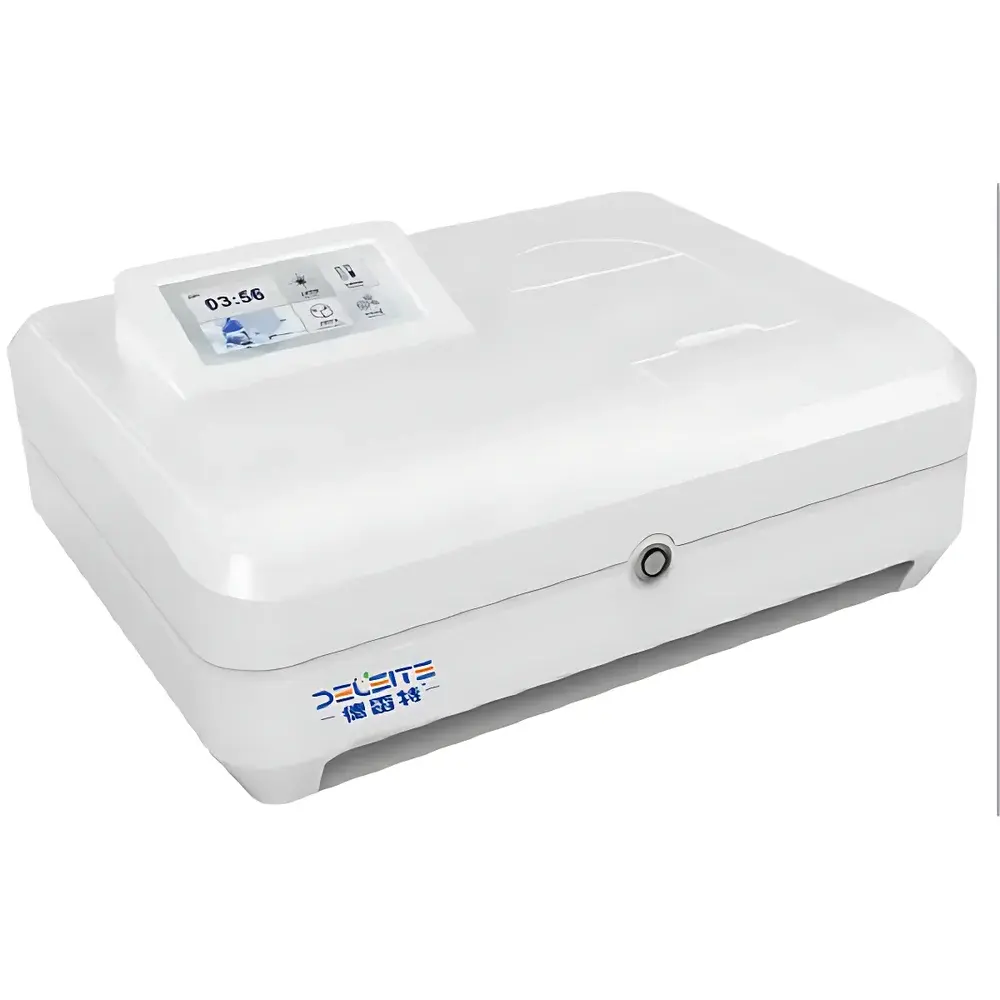
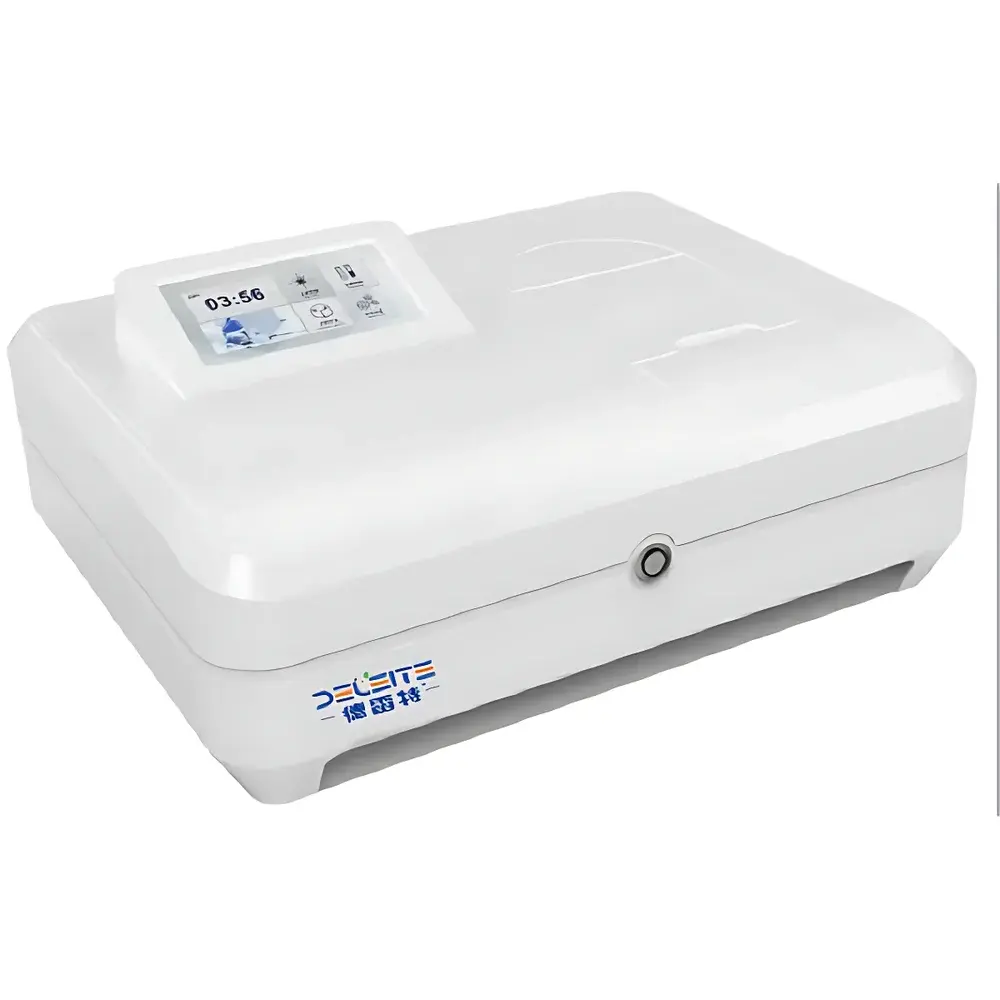
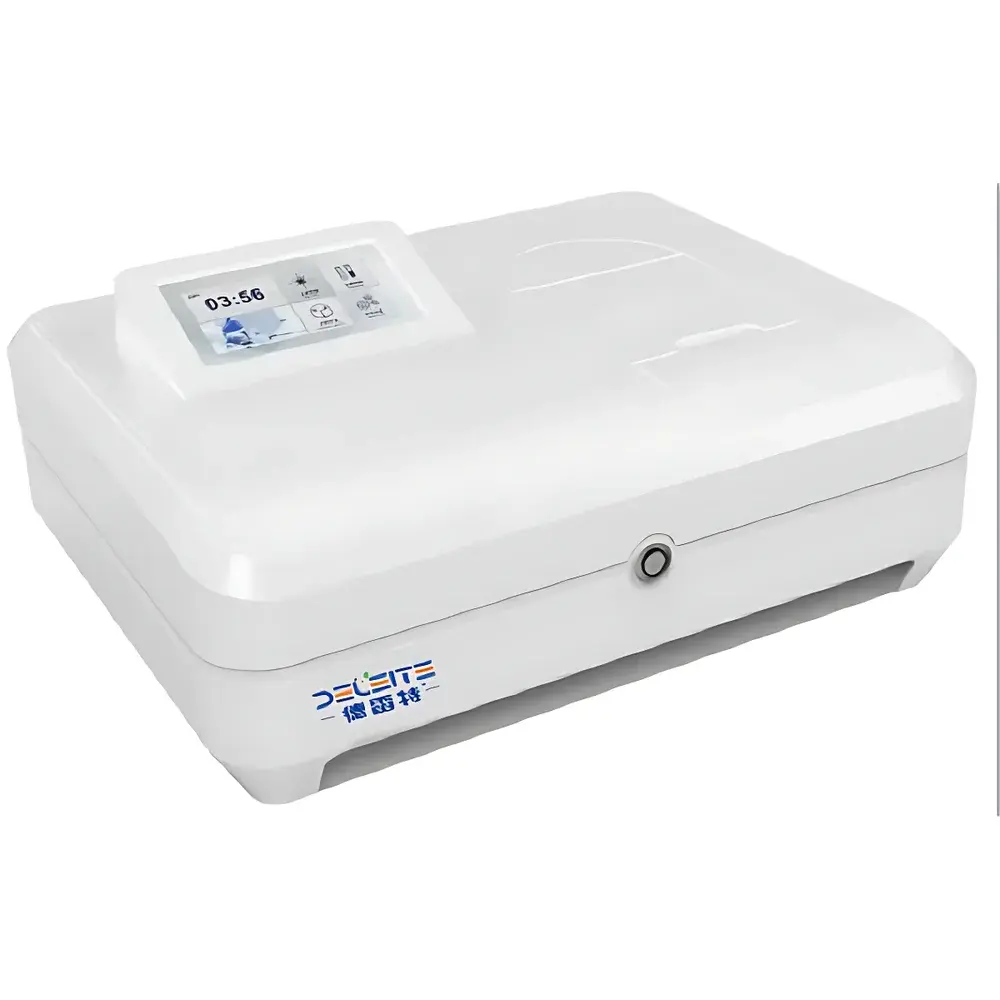
DELEITE DLT-6500 Dual-Beam UV-Vis Spectrophotometer
| Brand | DELEITE |
|---|---|
| Origin | Shanghai, China |
| Model | DLT-6500 |
| Optical System | Dual-beam |
| Detector | Photodiode Array (PDA) |
| Wavelength Range | 190–1100 nm |
| Spectral Bandwidth | 2 nm |
| Wavelength Accuracy | ±0.3 nm |
| Wavelength Repeatability | ±0.1 nm |
| Stray Light | ≤0.05%T |
| Photometric Range | 0–200%T, –0.3–3 A |
| Photometric Accuracy | ±0.5%T, ±0.004 A (0–0.5 A), ±0.008 A (0.5–1 A) |
| Photometric Repeatability | ±0.5%T, ±0.004 A (0–0.5 A), ±0.008 A (0.5–1 A) |
| Baseline Stability | ±0.002 A (500 nm, 3 min) |
| Display | 7-inch TFT-LCD touchscreen (1024 × 768) |
| Interfaces | USB 2.0, Bluetooth 4.2, Wi-Fi 802.11 b/g/n |
| Software Compatibility | PC-based spectral analysis suite (optional), cloud-enabled IoT firmware (standard) |
Overview
The DELEITE DLT-6500 is a dual-beam UV-Vis spectrophotometer engineered for precision quantitative and qualitative analysis across academic research laboratories, quality control environments, and routine pharmaceutical and environmental testing workflows. It operates on the principle of Beer–Lambert law-based absorbance measurement, utilizing a Czerny–Turner monochromator equipped with a holographic blazed grating (1200 lines/mm) to deliver high-resolution spectral separation across the full 190–1100 nm range. The instrument’s dual-beam architecture continuously corrects for source drift and detector fluctuations by splitting the optical path into reference and sample beams—ensuring long-term photometric stability and minimizing baseline drift during extended kinetic or scanning protocols. Its photodiode array (PDA) detector enables rapid, simultaneous acquisition across the entire spectral window without mechanical scanning, supporting high-throughput applications such as nucleic acid quantification, enzyme kinetics, and multicomponent assay development.
Key Features
- 7-inch high-resolution (1024 × 768) capacitive touchscreen interface with intuitive icon-driven navigation—designed for glove-compatible operation in controlled laboratory environments.
- Dual-beam optical design with automatic wavelength calibration and lamp switching (deuterium/tungsten) at user-defined thresholds (default: 340 nm), ensuring seamless transition across UV and visible regions.
- Low-stray-light performance (<0.05%T at 220 nm), achieved through optimized optical baffling, high-efficiency blazed grating, and precision-aligned beam path—critical for accurate low-transmittance measurements in turbid or highly absorbing samples.
- Integrated connectivity stack: standard USB 2.0 port, Bluetooth 4.2 module, and IEEE 802.11 b/g/n Wi-Fi—enabling direct wireless printing, remote firmware updates, and secure data synchronization with local network servers or cloud-based LIMS platforms.
- Onboard storage capacity for up to 500 spectra and 30 calibration curves; all data exportable via USB flash drive in native CSV format—fully compatible with Microsoft Excel, OriginLab, and MATLAB for downstream statistical modeling and reporting.
- Firmware-level IoT support: real-time instrument status monitoring, usage logging, and audit-ready event tracking—aligned with GLP/GMP documentation requirements for regulated environments.
Sample Compatibility & Compliance
The DLT-6500 accommodates standard 10-mm pathlength cuvettes (glass and quartz), with optional accessories including an 8-position automated cuvette changer, 5-cm/10-cm long-path cuvette holders, film sample stages, and micro-volume adapters. Its optical design supports liquid, suspension, and thin-film specimens—provided they meet minimum transmittance thresholds (>0.1%T) and do not exceed the maximum optical density limit (OD < 3.0). The system complies with ISO 9001 manufacturing standards and meets core performance criteria outlined in ASTM E275, ISO 6059, and USP for spectrophotometric instrumentation. While not pre-certified for FDA 21 CFR Part 11, its software architecture supports integration with validated third-party electronic lab notebook (ELN) systems that provide full audit trail, electronic signature, and role-based access control capabilities.
Software & Data Management
A dedicated PC-based spectral analysis software suite (optional) extends the instrument’s functionality to include wavelength scanning, time-resolved kinetics, multi-wavelength quantitative analysis, derivative spectroscopy, spectral overlay, and DNA/RNA concentration calculation using built-in extinction coefficients. All acquired data are timestamped and tagged with instrument ID, operator login (if network-authenticated), and environmental metadata (e.g., ambient temperature, humidity if sensor-equipped). Raw spectral files (.csv) retain full 1-nm resolution and photometric accuracy—no lossy compression or proprietary binary encoding. Firmware updates are delivered over-the-air (OTA) via encrypted HTTPS channels, with version rollback capability and SHA-256 integrity verification. Audit logs record every configuration change, calibration event, and data export action—retained for ≥18 months unless manually purged under documented SOP.
Applications
- Pharmaceutical QC: Active pharmaceutical ingredient (API) assay, dissolution testing, excipient compatibility screening per ICH Q5C guidelines.
- Clinical biochemistry: Total protein, albumin, bilirubin, and enzymatic activity assays (e.g., LDH, ALT) using standardized colorimetric methods.
- Environmental monitoring: Nitrate, phosphate, and heavy metal ion quantification in water samples via EPA-approved spectrophotometric protocols.
- Academic research: Ligand-binding studies, redox reaction kinetics, nanoparticle surface plasmon resonance characterization.
- Food & beverage: Color index (L*a*b*), anthocyanin content, and preservative (e.g., sulfite) determination in compliance with AOAC International methods.
FAQ
Does the DLT-6500 support GLP-compliant data integrity?
Yes—its firmware implements immutable event logging, user authentication (via optional LDAP integration), and tamper-evident data export. When paired with validated ELN software, it satisfies ALCOA+ principles (Attributable, Legible, Contemporaneous, Original, Accurate).
Can the instrument perform nucleic acid quantification without external software?
Yes—the onboard firmware includes preloaded A260/A280 and A260/A230 ratio calculations, molar extinction coefficient tables for dsDNA, ssDNA, RNA, and oligos, and automatic dilution factor compensation.
What is the maximum sampling rate for kinetic measurements?
Up to 10 spectra per second in fixed-wavelength mode; 1 spectrum per 0.5 s across 190–1100 nm in full-scan mode (1-nm step, PDA readout).
Is the Wi-Fi module certified for use in hospital or GMP cleanroom networks?
The module complies with FCC Part 15B and CE RED Directive 2014/53/EU. Network deployment requires site-specific IT security review—WPA2-Enterprise authentication and VLAN segmentation are supported.
Are calibration certificates traceable to NIST or equivalent national standards?
Factory calibration uses NIST-traceable holmium oxide and didymium filters. Optional on-site calibration services include ISO/IEC 17025-accredited certification with uncertainty budgets.





