
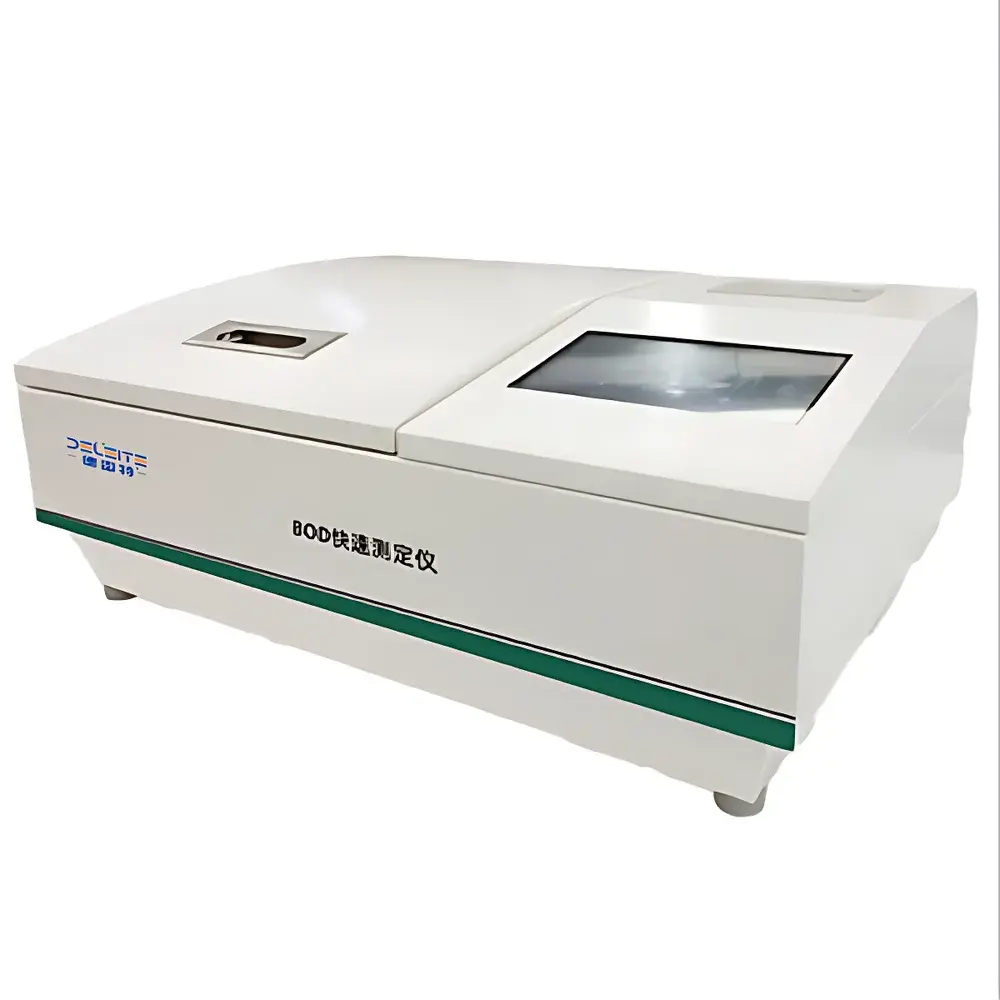
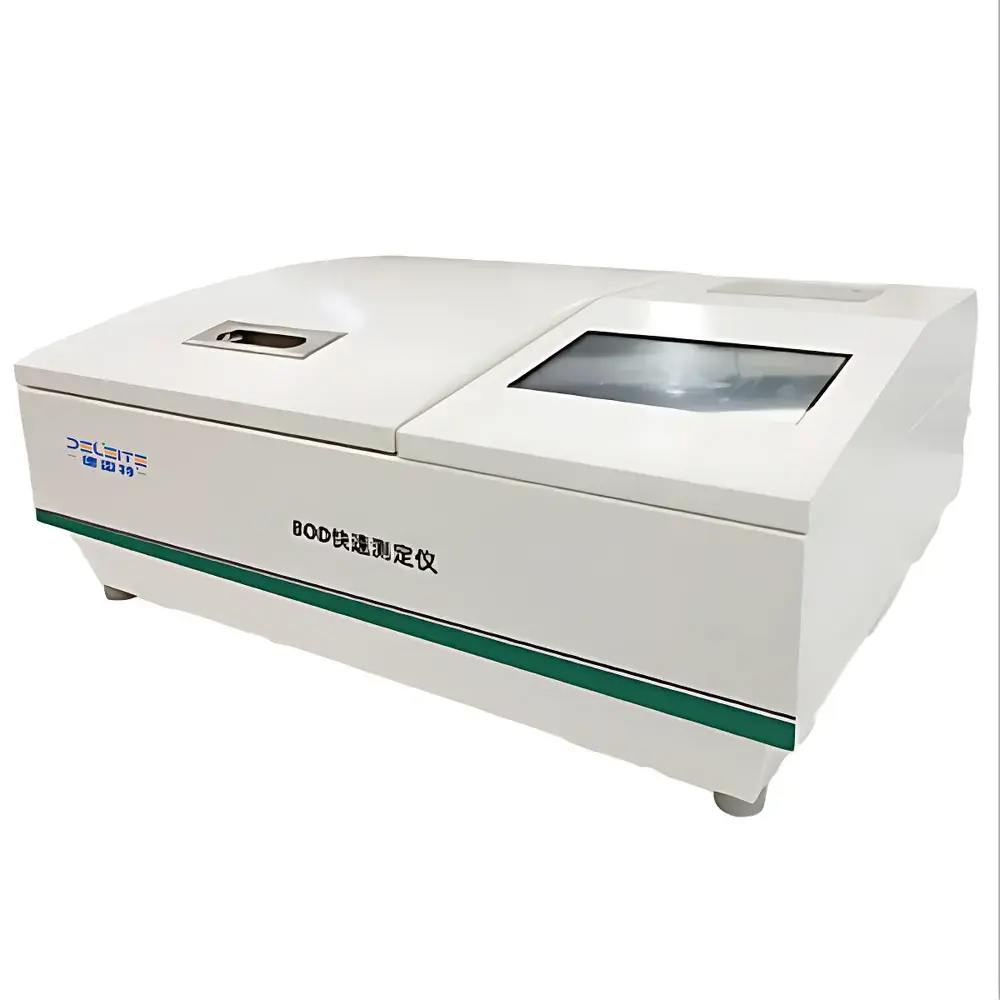
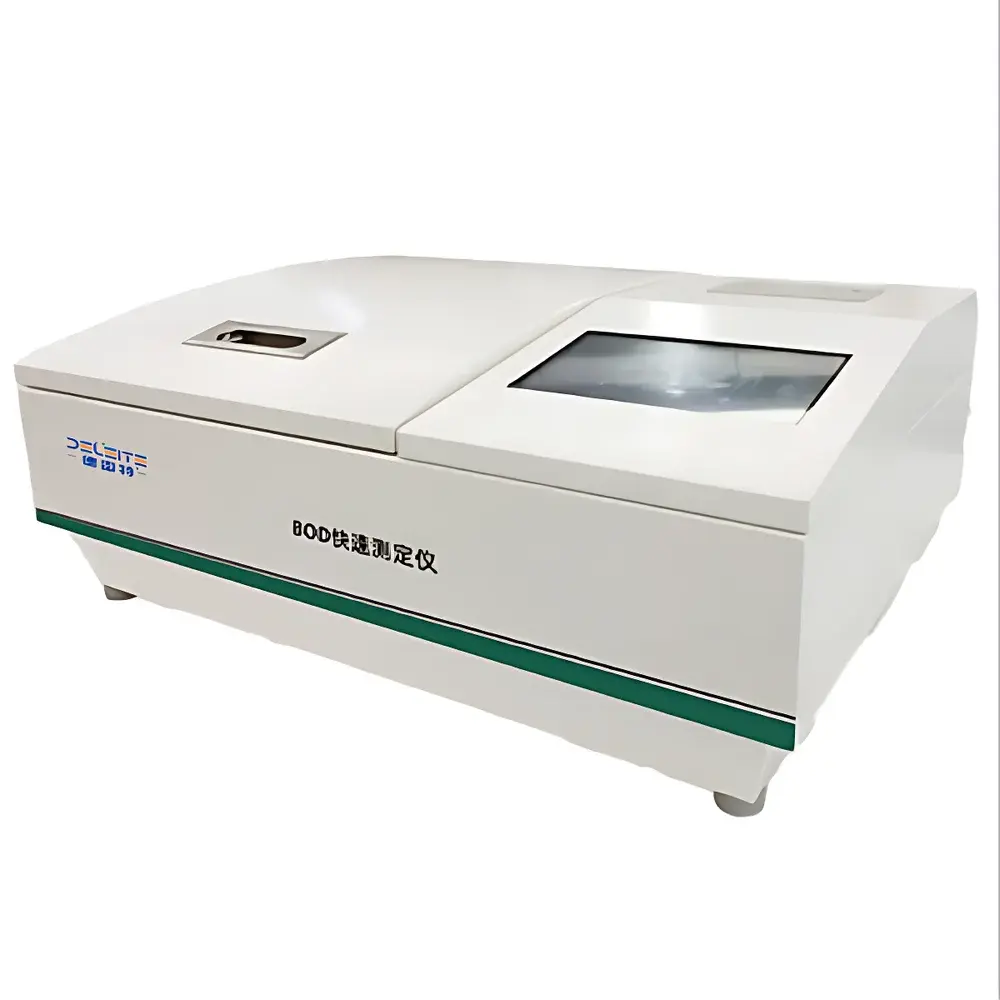
Deleite DR-506 Microbial Electrode-Based BOD Analyzer
| Brand | Deleite |
|---|---|
| Origin | Shanghai, China |
| Model | DR-506 |
| Measurement Principle | Microbial Electrode Method |
| Standard Compliance | HJ/T 86–2002 |
| Measuring Range | 2–50 mg/L (up to 4000 mg/L with dilution) |
| Repeatability | ≤10% RSD |
| Accuracy | ±5% of reading |
| Resolution | 0.1 mg/L |
| Sample Throughput Time | 5–8 min per sample |
| Sample Volume Required | 50 mL per assay |
| Flow Rate | Constant-flow continuous injection (5 mL/min buffer consumption) |
| Operating Temperature | 5–40 °C |
| Relative Humidity | ≤90% RH |
| Power Supply | AC 220 V, 50 Hz |
| Power Consumption | 100 W |
| Dimensions (W×D×H) | 560 × 360 × 210 mm |
| Net Weight | 16 kg (shipping weight ~20 kg) |
| Sample Handling | No pretreatment required |
| Microbial Sensor | Non-pathogenic, immobilized nitrifying bacteria strain |
| Data Output | Integrated thermal printer |
Overview
The Deleite DR-506 Microbial Electrode-Based BOD Analyzer is a dedicated benchtop instrument engineered for rapid, reliable quantification of biochemical oxygen demand (BOD) in aqueous environmental samples. Unlike conventional 5-day BOD5 methods—labor-intensive, time-sensitive, and subject to inter-laboratory variability—the DR-506 implements the microbial electrode principle defined in China’s national standard HJ/T 86–2002. This method employs a fixed-film biosensor containing viable, non-pathogenic nitrifying microorganisms housed within an oxygen-permeable membrane. As organic substrates in the sample diffuse into the biofilm, microbial respiration consumes dissolved oxygen; the resulting change in oxygen partial pressure at the cathode surface is linearly transduced into an electrical current, which is calibrated against BOD concentration. The system operates under constant-flow hydrodynamic conditions, eliminating manual injection artifacts and enabling true kinetic measurement. Designed for routine monitoring rather than research-grade trace analysis, the DR-506 delivers field-deployable performance in laboratories where throughput, operational simplicity, and regulatory alignment with domestic water quality protocols are primary requirements.
Key Features
- Microbial electrode sensor with immobilized, non-hazardous bacterial culture—fully compliant with biosafety Level 1 handling requirements
- Constant-flow continuous sample introduction—eliminates air bubble interference and improves measurement reproducibility
- Integrated microprocessor control with real-time signal conditioning and automatic zero/span verification
- No sample prefiltration, centrifugation, or dilution required for most municipal and industrial effluents
- Thermal printer module provides immediate hardcopy output with timestamp, sample ID, and measured BOD value
- Low-maintenance architecture: sensor membrane replacement every 30–45 days under normal use; peristaltic tubing replaced quarterly
- Robust mechanical design with vibration-damped chassis and sealed electronics enclosure for stable operation in shared lab environments
- Self-diagnostic firmware alerts for low buffer level, flow interruption, or sensor response decay
Sample Compatibility & Compliance
The DR-506 is validated for direct analysis of raw and treated wastewater, surface water, groundwater, and industrial discharges exhibiting moderate turbidity (<100 NTU) and chloride concentrations below 2,000 mg/L. It demonstrates high tolerance to common interferents including nitrate, sulfate, and low-molecular-weight alcohols—conditions frequently encountered in municipal influent and food-processing effluents. While not intended for seawater or highly chlorinated samples without prior dechlorination, its performance meets the precision and accuracy criteria specified in HJ/T 86–2002 for Class I–III water quality assessment. The instrument supports audit-ready documentation: printed reports include operator ID, calibration date, sensor lot number, and ambient lab conditions—facilitating GLP-aligned recordkeeping. Though not certified to ISO/IEC 17025 or EPA Method 405.1, its operational logic aligns with the fundamental microbiological kinetics underlying standardized BOD determination.
Software & Data Management
The DR-506 operates via embedded firmware with no external PC dependency. All calibration parameters—including slope, intercept, temperature compensation coefficient, and sensor response half-life—are stored in non-volatile memory with write-protection. Each assay generates a discrete data packet containing raw current signal trace (sampled at 2 Hz), integrated response area, calculated BOD value, and QC flags. Thermal printouts serve as primary data records; optional RS-232 serial interface permits passive logging to external terminals or LIMS-compatible systems using ASCII-based protocol (no proprietary drivers required). Firmware updates are performed via USB flash drive—ensuring long-term maintainability without vendor lock-in. Audit trails are retained for ≥1000 assays; older entries auto-rotate upon buffer full condition. No cloud connectivity or remote access functionality is implemented—consistent with institutional IT security policies governing analytical instrumentation.
Applications
- Routine BOD screening in municipal wastewater treatment plants for process control and discharge compliance verification
- Environmental monitoring labs conducting statutory reporting under China’s “Surface Water Environmental Quality Standards” (GB 3838–2002)
- Academic teaching laboratories requiring safe, repeatable BOD demonstrations for undergraduate environmental science curricula
- Industrial QA/QC departments evaluating biodegradability of process streams or cleaning agents
- Field mobile labs equipped with portable power inverters (220 V AC output) for on-site river basin surveys
- Regulatory inspection units performing rapid verification testing during environmental audits
FAQ
What is the recommended frequency for microbial membrane replacement?
Under typical usage (≤20 samples/day), replace the sensor membrane every 30–45 days. Extended intervals may compromise response linearity and increase detection limit.
Can the DR-506 measure BOD in seawater or brackish samples?
Not directly—high chloride concentrations (>2,000 mg/L) inhibit nitrifier activity. Dilution with deionized water or use of chloride-tolerant sensor variants (not supplied with base model) is required.
Is the instrument compatible with international standards such as ISO 5815 or ASTM D5210?
The DR-506 implements HJ/T 86–2002, which shares conceptual equivalence with ISO 5815-1:2019 (microbial electrode method), though formal cross-validation studies are not published. It is not validated against ASTM D5210 (dilution method).
Does the system support multi-point calibration?
Yes—up to five standard points (0, 5, 10, 20, 40 mg/L BOD) can be entered manually; calibration curves are stored per sensor lot and recalled automatically.
What maintenance documentation is provided with the instrument?
A bilingual (Chinese/English) maintenance logbook, sensor replacement checklist, buffer preparation SOP, and HJ/T 86–2002 excerpt are included in the shipment package.




