
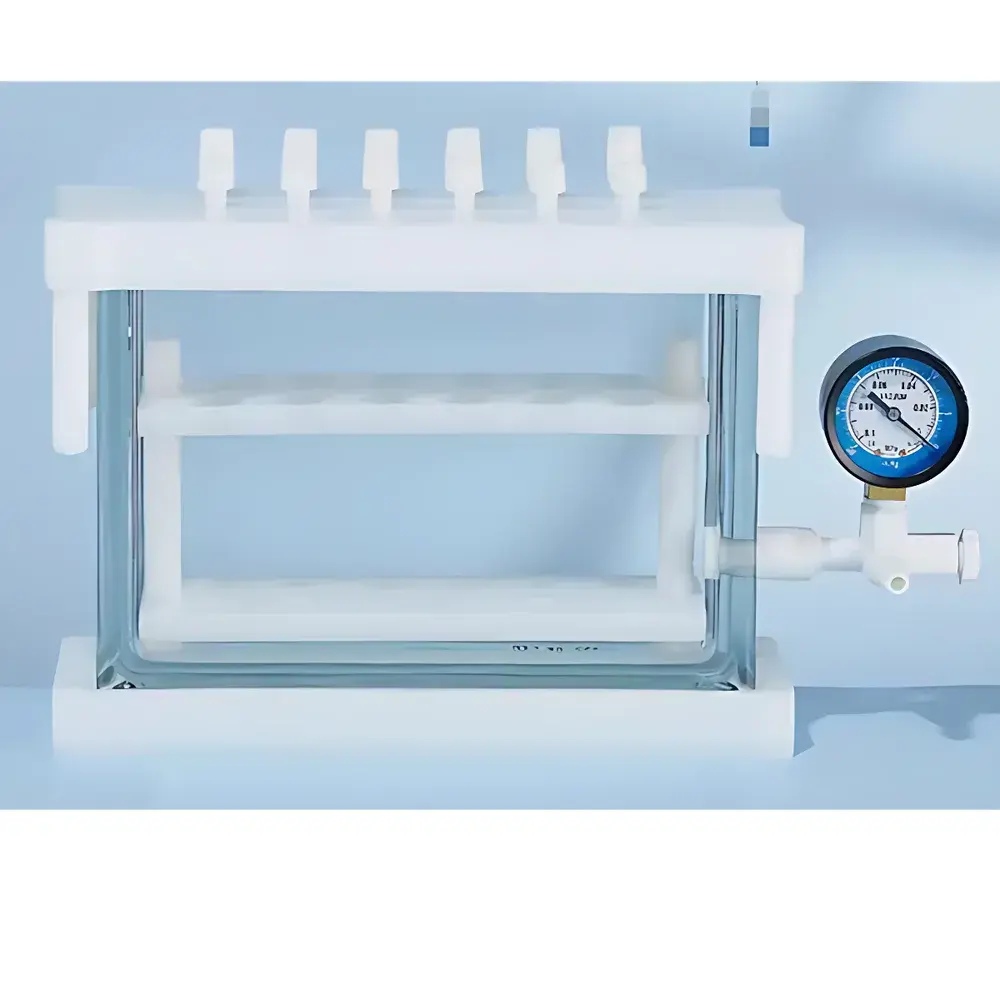
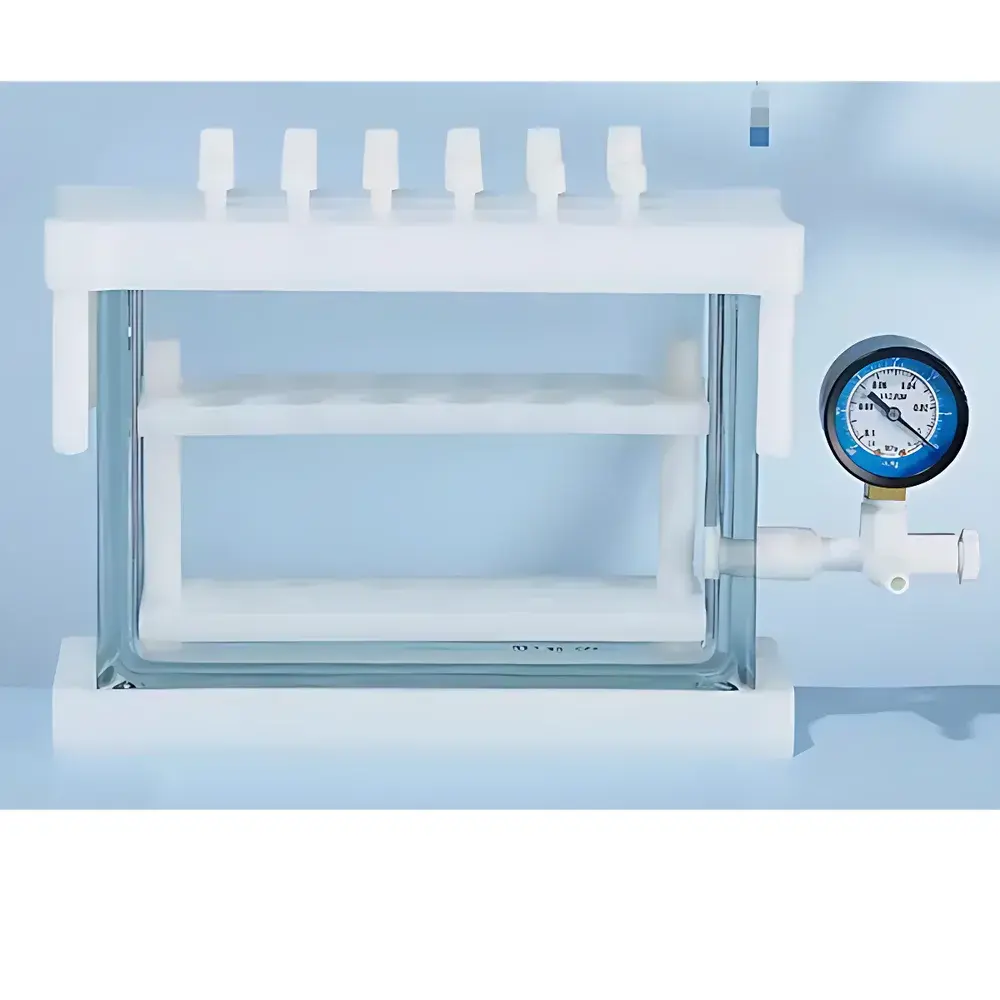
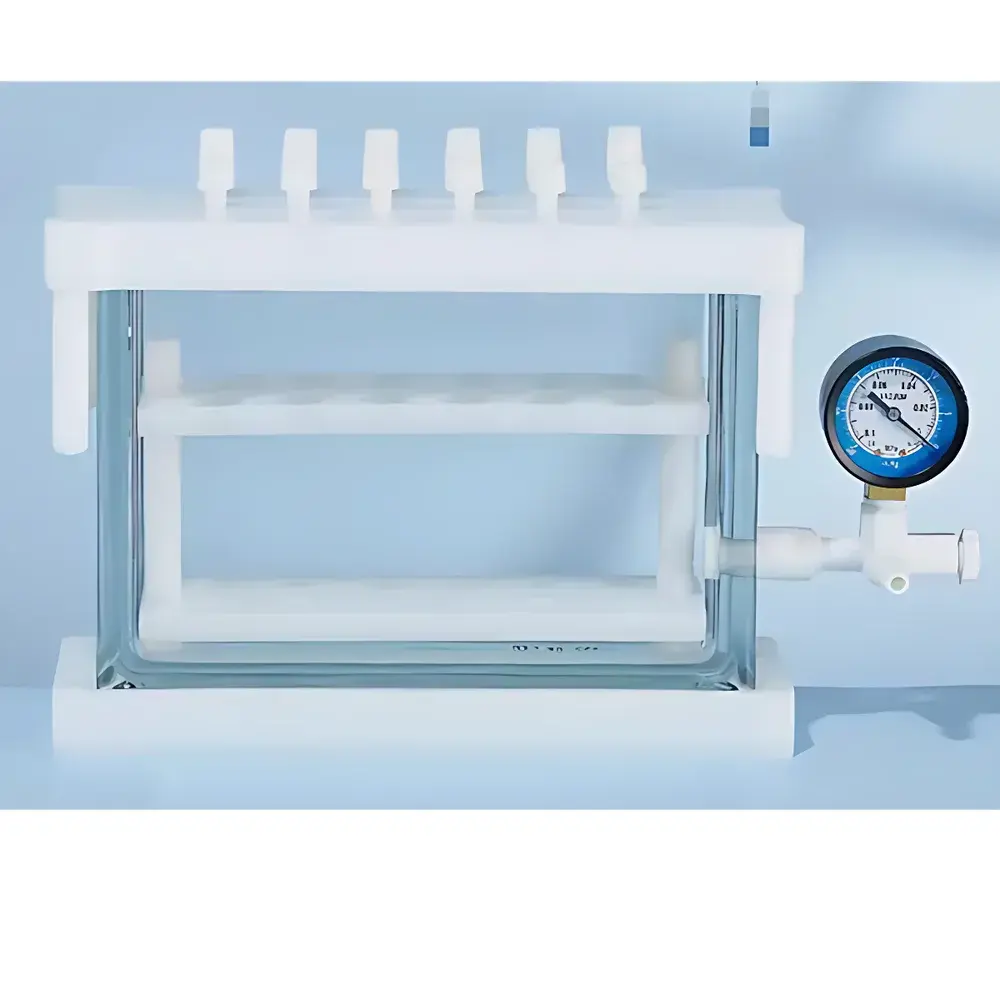
DELEITE FB-12 / FB-24 Manual Solid Phase Extraction Manifold System
| Brand | DELEITE |
|---|---|
| Origin | Shanghai, China |
| Model | FB-12 / FB-24 |
| Automation Level | Manual |
| Channel Count | 12 or 24 parallel ports |
| Extraction Format | Cartridge-based (SPE column) |
| Flow Control | Individual manual valve per channel |
| Solvent Compatibility | Multi-solvent (polar to non-polar, including methanol, acetonitrile, ethyl acetate, hexane, dichloromethane) |
| Sample Capacity | 12 samples (FB-12) or 24 samples (FB-24) simultaneously |
| Sample Loading Volume | 1–50 mL (dependent on SPE cartridge specifications) |
| Wetted Materials | Borosilicate glass (vacuum chamber, solvent reservoir, collection tray), PTFE (valves, sealing gaskets), chemically resistant polypropylene (support frame and adjustable tube rack) |
| Vacuum Source | External diaphragm vacuum pump (optional, not included) |
Overview
The DELEITE FB-12 and FB-24 are manually operated, multi-channel solid phase extraction (SPE) manifold systems engineered for reproducible, high-throughput sample preparation in analytical laboratories. These systems implement classical vacuum-assisted SPE methodology—where liquid samples are sequentially loaded, washed, and eluted through sorbent-packed cartridges under controlled negative pressure—to isolate, concentrate, and purify analytes from complex matrices. Designed for compatibility with standard 1 mL, 3 mL, 6 mL, and 12 mL SPE cartridges, the manifolds support method development and routine applications requiring precise flow regulation, minimal cross-contamination risk, and full operator control over solvent selection and timing. Their modular architecture enables seamless integration into existing workflows for LC-MS, GC-MS, HPLC, and ICP-MS sample preparation pipelines.
Key Features
- Independent manual flow control valves per channel—enabling consistent, repeatable flow rates across all SPE columns during conditioning, loading, washing, and elution steps
- Reinforced borosilicate glass vacuum chamber with integrated bottom-mounted pressure gauge for real-time vacuum level monitoring and stable pressure maintenance
- Adjustable height tube rack accommodates collection tubes ranging from 12 × 75 mm to 18 × 150 mm, supporting diverse vial formats used in evaporation, derivatization, or direct instrument injection
- Chemically inert wetted path: vacuum chamber, solvent reservoir, and collection tray constructed from high-purity borosilicate glass; valves, seals, and structural components fabricated from virgin PTFE and UV-stabilized polypropylene
- Anti-misting vacuum seal design prevents aerosol formation during high-flow elution, reducing solvent loss and minimizing exposure risk
- Modular platform compatible with optional accessories—including large-capacity solvent reservoirs (up to 2 L), rapid-drying nitrogen blow-down modules, and vacuum-controlled fraction collectors—for expanded workflow scalability
Sample Compatibility & Compliance
The FB-12/FB-24 supports a broad range of sample types including aqueous environmental extracts (e.g., wastewater, surface water), biological fluids (urine, plasma, serum), food homogenates, pesticide-spiked agricultural commodities, and pharmaceutical formulations. It is routinely deployed in laboratories adhering to EPA Method 508.1, 525.3, 8270D, ISO 17025-accredited testing protocols, and internal SOPs aligned with GLP principles. While the manifold itself does not require regulatory certification, its material composition and mechanical design ensure full compliance with USP , ASTM D4291, and EU Directive 2002/72/EC for extractables and leachables when used with certified SPE cartridges and solvents. No electrical or electronic components are present—eliminating electromagnetic interference concerns and simplifying validation documentation.
Software & Data Management
As a fully manual, non-electronic platform, the FB-12/FB-24 requires no embedded firmware, driver installation, or proprietary software. All operational parameters—including vacuum level, dwell time per step, solvent sequence, and collection vessel assignment—are documented externally via laboratory notebooks, LIMS entries, or electronic batch records. This analog architecture inherently satisfies FDA 21 CFR Part 11 requirements for audit-trail simplicity: every procedural decision and physical action is directly attributable to the analyst and traceable through handwritten or digitally signed records. For labs implementing paperless workflows, the system integrates natively with validated ELN platforms (e.g., LabArchives, Benchling) without configuration overhead.
Applications
- Residue analysis: Multi-class pesticide extraction from fruits, vegetables, and cereals prior to GC-MS/MS quantification
- Environmental monitoring: Isolation of PAHs, PCBs, and brominated flame retardants from drinking water and sediment extracts
- Clinical toxicology: Cleanup of urine and blood samples for amphetamine, opioid, and benzodiazepine screening by LC-MS/MS
- Pharmaceutical quality control: Removal of excipients and degradation products from tablet dissolution media prior to HPLC assay
- Food safety: Mycotoxin enrichment (aflatoxins, ochratoxin A) from grain and nut extracts using immunoaffinity or C18 cartridges
- Forensic chemistry: Selective isolation of synthetic cannabinoids and novel psychoactive substances from seized materials
FAQ
What vacuum pump specifications are recommended for optimal performance?
A diaphragm vacuum pump delivering ≥60 kPa (≥450 mmHg) ultimate vacuum and ≥25 L/min free air displacement is advised. Oil-free operation is strongly preferred to avoid hydrocarbon contamination of SPE cartridges and eluates.
Can the FB-12/FB-24 accommodate 20 mL or larger SPE cartridges?
Yes—when used with optional extended-height support rods and reinforced glass adapters, both models accept 20 mL and 60 mL cartridges. Column stability must be verified empirically for each cartridge brand and sorbent density.
Is the glass vacuum chamber autoclavable?
No—the borosilicate chamber is designed for solvent resistance and thermal shock tolerance up to 120 °C, but repeated autoclaving may compromise vacuum seal integrity and cause microfracture propagation over time. Cleaning is performed using sequential rinses with methanol, acetone, and ultrapure water.
Are replacement PTFE valves and glass components available as spare parts?
Yes—DELEITE supplies OEM-certified replacement kits including full valve assemblies, glass reservoirs, collection trays, and custom-machined PTFE gaskets under part numbers FB-SV-12, FB-GK-24, and FB-GT-UNI.
Does the system support positive-pressure SPE?
No—this is a vacuum-driven manifold only. Positive-pressure SPE requires dedicated instrumentation such as pneumatic or syringe-driven systems (e.g., Gilson Aspec, J2 Scientific Hydra).



