
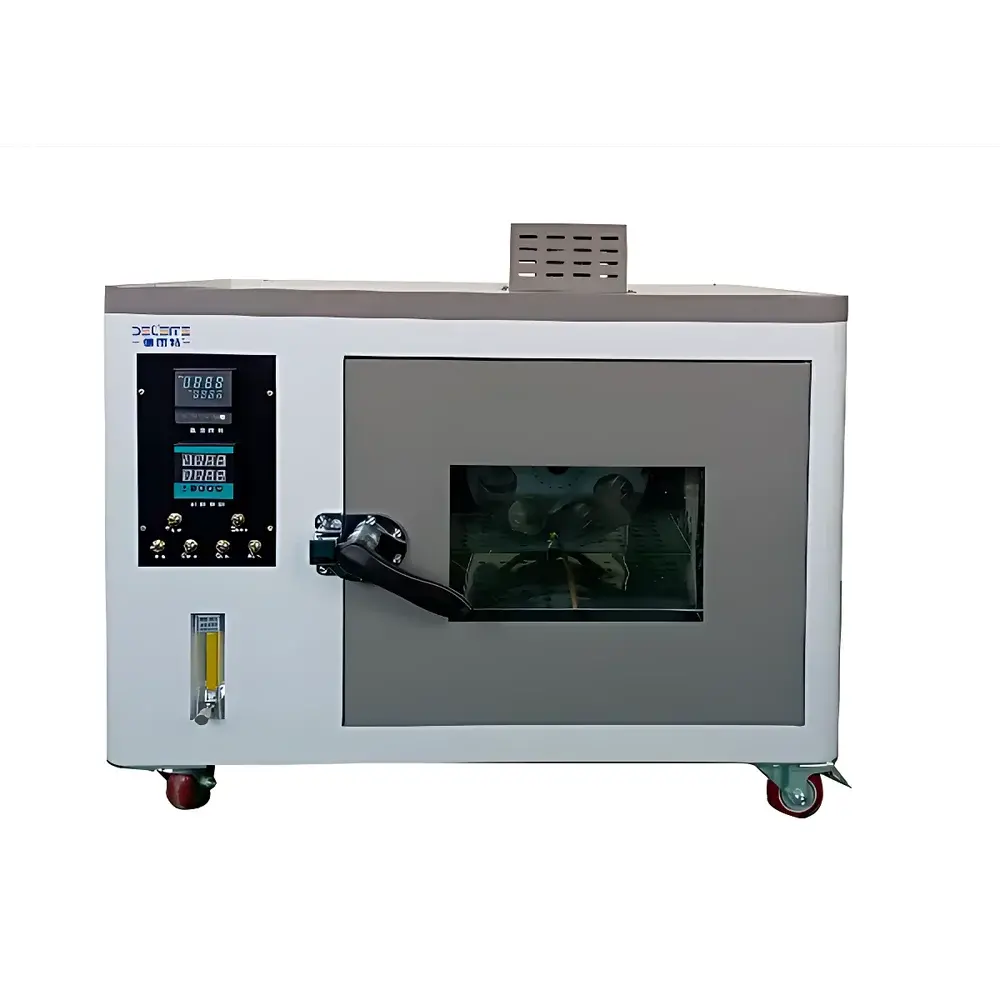
Deleite RTF-8500 Rotating Thin-Film Oven
| [Brand | Deleite |
|---|---|
| Origin | Shanghai, China |
| Model | RTF-8500 |
| Voltage | 220 V AC, 50 Hz |
| Total Power | 3 kW |
| Air Flow Rate | 4000 mL/min |
| Turntable Speed | 15 rpm |
| Sample Capacity | 8 x asphalt sample bottles |
| Temperature Control Range | 163 °C ± 0.5 °C |
| Chamber Dimensions | 485 × 445 × 380 mm (W × D × H) |
| Construction | Dual-layer stainless steel chamber with forced-air circulation system |
| Integrated Miniature Air Compressor | Yes] |
Overview
The Deleite RTF-8500 Rotating Thin-Film Oven is an ASTM D2872-22 and JTG E20–2025 (T0610-2025) compliant instrument engineered for the controlled thermal aging of asphalt binders under standardized oxidative conditions. It implements the rotating thin-film principle—where asphalt samples are uniformly distributed as thin films inside rotating glass bottles exposed to heated, conditioned air—to simulate short-term aging during hot-mix asphalt production. The oven’s design follows the technical framework of Japanese Industrial Standard JIS K 2207 and aligns with key requirements for binder rheological stability assessment in pavement material qualification protocols.
Key Features
- Stainless steel dual-door chamber with reinforced observation window and interior LED lighting—designed for corrosion resistance, thermal stability, and visual monitoring without compromising temperature uniformity.
- Integrated forced-air circulation system featuring a squirrel-cage fan and directional airflow ducting, ensuring consistent thermal distribution and laminar air movement across all eight sample positions.
- Precision digital temperature controller with ±0.5 °C accuracy at 163 °C, meeting strict repeatability criteria for binder aging studies required by AASHTO MP19 and EN 12607-1.
- Motor-driven turntable operating at a fixed 15 rpm, enabling reproducible centrifugal film formation and minimizing inter-bottle variability in oxidation kinetics.
- Built-in miniature air compressor delivering regulated 4000 mL/min airflow through preheated copper tubing and calibrated flowmeter—eliminating external gas supply dependencies while maintaining traceable volumetric delivery.
- Robust electrical architecture with overcurrent protection, grounding compliance, and thermal cut-off safeguards—certified for continuous-duty laboratory operation per IEC 61010-1 safety standards.
Sample Compatibility & Compliance
The RTF-8500 accommodates standard 50 mL tapered-neck glass sample bottles (ASTM D2872 specification), with eight positions arranged symmetrically on the turntable. Empty bottle balancing is supported to preserve rotational inertia and thermal equilibrium when fewer than eight samples are loaded. All wetted components—including air delivery tubing, nozzle manifolds, and chamber lining—are constructed from inert, high-temperature-resistant materials to prevent catalytic interference or contamination. The system satisfies method validation requirements for GLP-compliant asphalt testing laboratories and supports audit-ready documentation when paired with external data loggers. It is routinely deployed in conformity with national highway agency specifications (e.g., FHWA, NCHRP Report 511) and international pavement engineering guidelines including ISO 10147 and EN 13589.
Software & Data Management
The RTF-8500 operates as a standalone analog-digital hybrid system with no embedded software interface. Temperature setpoint, runtime tracking, and airflow regulation are performed manually via front-panel controls and calibrated mechanical meters. For regulatory traceability, users integrate external Class I or II temperature data loggers (e.g., Omega OM-DAQPRO or Testo 176 T4) connected to thermocouple inputs at designated chamber monitoring ports. When used within a validated QC/QA environment, the unit supports 21 CFR Part 11–compliant electronic records when paired with validated third-party acquisition software and audit-trail-enabled hardware. All operational parameters—including actual chamber temperature profiles, airflow verification logs, and turntable rotation confirmation—must be recorded manually or via synchronized external instrumentation per ASTM D2872 Annex A1.
Applications
- Short-term aging simulation of asphalt binders prior to dynamic shear rheometer (DSR) or bending beam rheometer (BBR) testing per AASHTO T315 and T313.
- Performance grading (PG) binder characterization according to SHRP specifications and subsequent rutting/fatigue prediction modeling.
- Quality assurance of polymer-modified asphalt (PMA) formulations under oxidative stress conditions.
- Comparative evaluation of antioxidant additives and bio-based rejuvenators in aged binder recovery studies.
- Research-grade thermal degradation kinetics analysis for bitumen molecular weight distribution shifts using GPC or FTIR post-RTF treatment.
FAQ
What standards does the RTF-8500 comply with?
It conforms to JTG E20–2025 (T0610-2025), ASTM D2872-22, JIS K 2207, and EN 12607-1 for rotating thin-film oven testing of asphalt binders.
Is the built-in air compressor mandatory for operation?
No—it is optional; users may connect an external compressed air source directly to the flowmeter inlet, provided it delivers clean, oil-free air at stable 4000 mL/min flow rate.
Can the RTF-8500 be used for non-asphalt materials?
Not recommended—the chamber geometry, airflow dynamics, and thermal profile are specifically optimized for asphalt binder film thickness, volatility, and oxidation behavior per standardized test methods.
How often should calibration verification be performed?
Temperature uniformity and airflow rate must be verified prior to each test series using NIST-traceable probes and calibrated rotameters, in accordance with ISO/IEC 17025 internal quality control procedures.
What maintenance is required for long-term reliability?
Monthly inspection of heating elements, electrical contacts, and fan motor bearings is advised; chamber gaskets and glass observation windows should be checked for seal integrity and thermal stress cracking every 6 months.



