
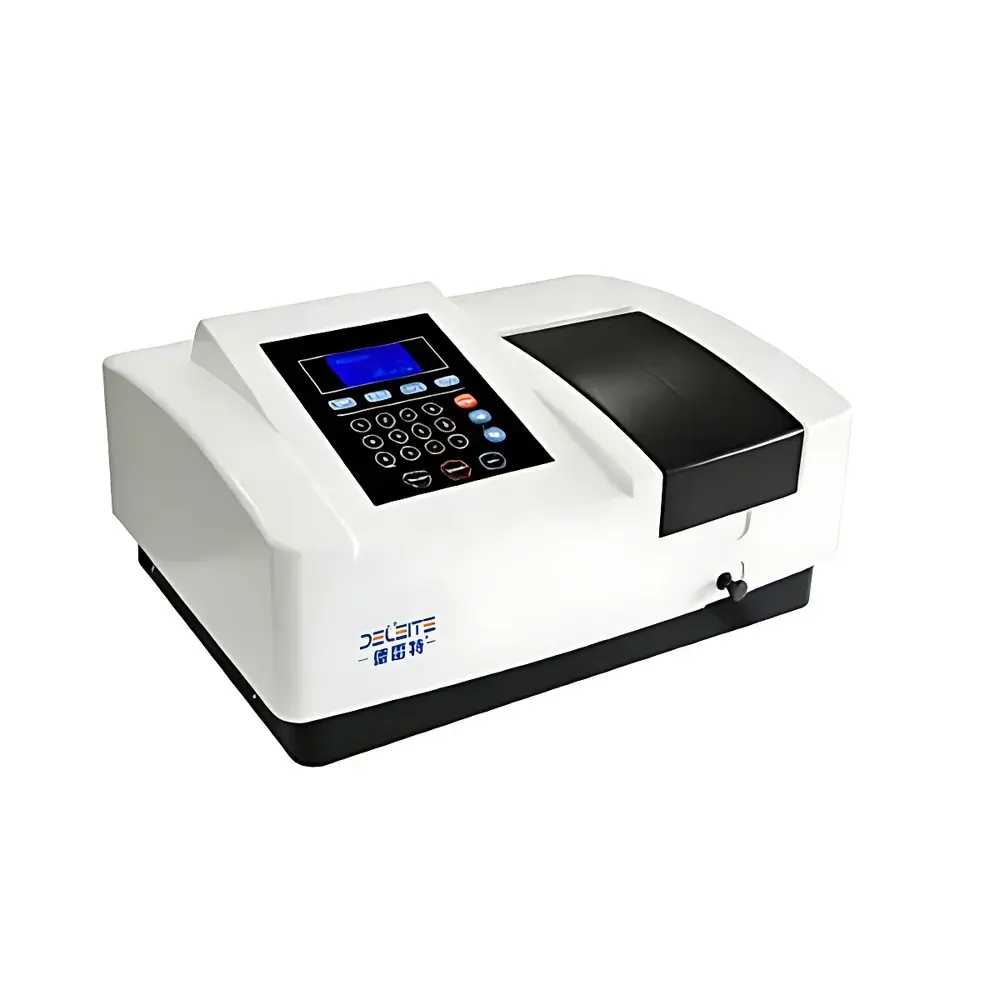
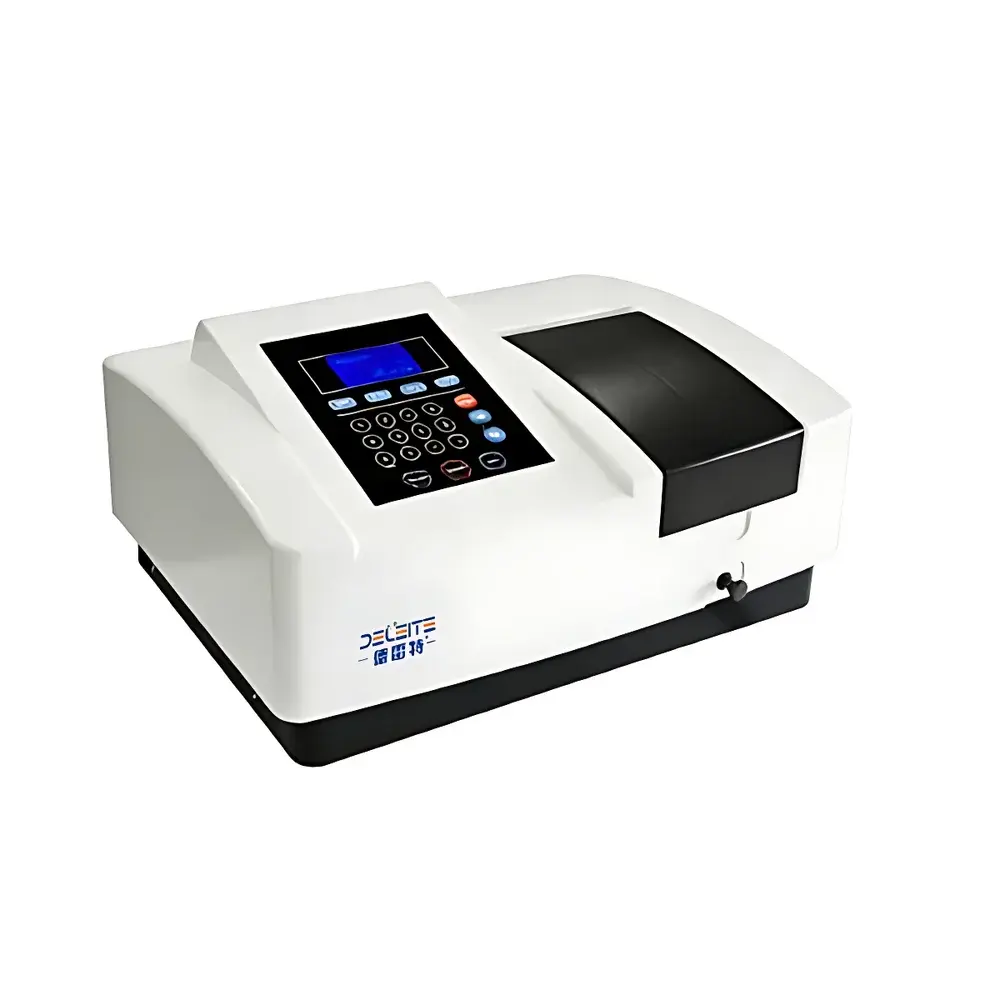
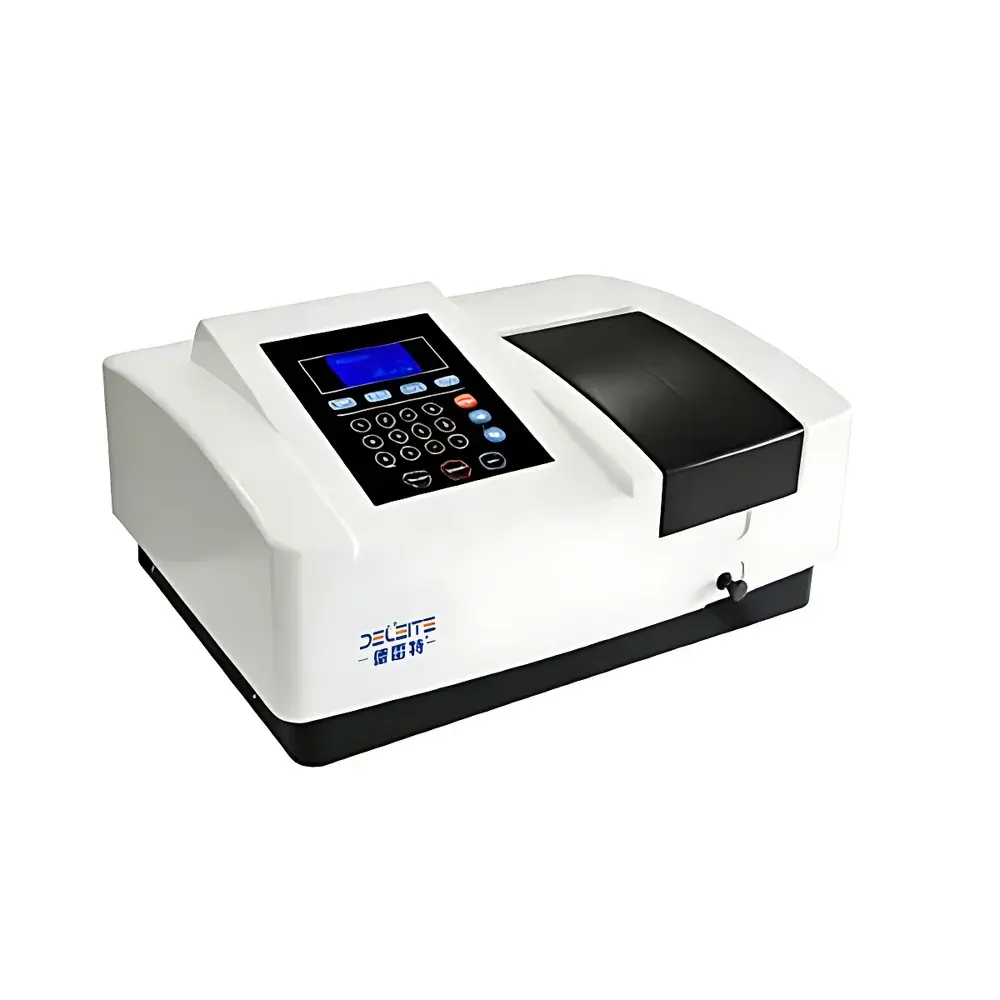
DELEITE VIS-7000S Dual-Beam Visible Spectrophotometer
| Brand | DELEITE |
|---|---|
| Origin | Shanghai, China |
| Manufacturer Type | Authorized Distributor |
| Product Origin | Domestic (China) |
| Model | VIS-7000S |
| Instrument Architecture | Dual-Beam |
| Detector Type | Photomultiplier Tube (PMT) |
| Wavelength Range | 325–1100 nm |
| Wavelength Accuracy | ±0.5 nm |
| Wavelength Repeatability | ±0.2 nm |
| Spectral Bandwidth | 2.0 nm (nominal) |
| Stray Light | ≤0.05% T at 360 nm |
| Automatic Wavelength Scanning | Yes |
| Sample Compartment Dimensions | Accommodates Cuvettes from 5 mm to 100 mm Pathlength |
| Data Storage Capacity | 200 Sample Measurements + 100 User-Named Calibration Curves |
| Interface | USB 2.0 |
| Optional Software | YOKE 3.0 Spectral Analysis Suite |
Overview
The DELEITE VIS-7000S is a precision-engineered dual-beam visible spectrophotometer designed for routine quantitative and qualitative analysis in academic laboratories, quality control environments, and industrial R&D settings. Operating across a spectral range of 325–1100 nm, the instrument employs classical absorption spectroscopy based on Beer–Lambert law principles, utilizing a high-efficiency optical path with a 1200 lines/mm holographic grating and a low-noise photomultiplier tube (PMT) detector. Its dual-beam architecture continuously balances reference and sample beam intensities in real time, minimizing drift caused by source instability or environmental fluctuations—critical for extended measurement sessions and high reproducibility in compliance-driven workflows.
Key Features
- Dual-beam optical design with real-time reference compensation for enhanced baseline stability and measurement repeatability.
- High-resolution wavelength scanning with ±0.2 nm repeatability and ±0.5 nm absolute accuracy, certified against traceable NIST-traceable standards.
- Fixed 2.0 nm spectral bandwidth optimized for resolution/sensitivity balance in visible-region applications (e.g., dye concentration, enzyme kinetics, colorimetric assays).
- Large-capacity sample compartment accommodating standard cuvettes from 5 mm to 100 mm pathlength—including square, rectangular, and micro-volume cells—without mechanical adaptation.
- Integrated 128×64 dot-matrix LCD display supporting direct visualization of absorbance/transmittance spectra, calibration curves, and numerical results without external software.
- Onboard data management: stores up to 200 measurement sets and 100 user-named calibration curves with alphanumeric identifiers for rapid recall and audit-ready documentation.
- Optional rotating 8-position auto-sampler with centered beam alignment—eliminating lateral intensity variation observed in linear dual-row configurations and improving inter-cuvette comparability.
Sample Compatibility & Compliance
The VIS-7000S supports a broad spectrum of liquid-phase samples in quartz, glass, or plastic cuvettes compliant with ISO 3664 and ASTM E275. Its wide sample chamber enables use of specialized cells—including thermostatted, flow-through, or long-path cuvettes—facilitating method transfer from research to production QC. The instrument’s optical performance meets key specifications outlined in USP , ISO/IEC 17025:2017 (for testing laboratories), and general GLP/GMP documentation requirements when operated with validated protocols. While not FDA 21 CFR Part 11–certified out-of-the-box, audit trails and electronic records generated via YOKE 3.0 software can be configured to support ALCOA+ data integrity principles under supervised IT governance.
Software & Data Management
The VIS-7000S communicates via USB 2.0 interface with YOKE 3.0—a Windows-based spectral acquisition and analysis platform supporting full wavelength scanning, kinetic mode, multi-point calibration, and derivative spectroscopy. YOKE 3.0 provides customizable report templates, CSV/Excel export, and metadata tagging (operator ID, timestamp, instrument serial number). Raw spectral data are stored in vendor-neutral ASCII format, enabling third-party integration with LIMS or ELN systems. Internal memory retains all calibration parameters and measurement history even during power cycles—ensuring continuity in regulated environments where session restarts must preserve traceability.
Applications
- Quantitative determination of analytes in pharmaceutical excipients, food dyes, and water quality indicators (e.g., nitrate, phosphate, iron) using established colorimetric methods.
- Enzyme activity monitoring via NADH/NADPH absorbance at 340 nm under controlled kinetic conditions.
- Verification of optical density (OD600) in microbial culture growth studies.
- Color matching and spectral reflectance analysis in pigment and coating development.
- Educational labs for teaching fundamental spectroscopic concepts including absorbance linearity, molar absorptivity calculation, and spectral deconvolution.
FAQ
Does the VIS-7000S support UV-range measurements?
No—the VIS-7000S is optimized for the visible spectrum (325–1100 nm) and does not include a deuterium lamp or UV-optimized optics; for full UV-Vis capability, consider the DELEITE UV-7000 series.
Is the PMT detector replaceable by the user?
Detector replacement requires factory recalibration and alignment; it is not a field-serviceable component per IEC 61000-4-3 EMC and optical safety standards.
Can YOKE 3.0 generate 21 CFR Part 11–compliant electronic signatures?
YOKE 3.0 supports role-based user accounts and password-protected method locking, but full Part 11 compliance requires additional infrastructure (e.g., digital certificate authority, audit trail archiving)—consult your QA team for validation protocol development.
What is the warm-up time required before measurement?
Optimal photometric stability is achieved after 20 minutes of continuous operation following power-on, as verified by internal wavelength and photometric self-check routines.
Are cuvette holders compatible with industry-standard dimensions?
Yes—the sample stage accepts ANSI/SLAS-compliant 12.5 × 12.5 mm footprint cuvettes with pathlengths from 5 mm to 100 mm, including Hellma, Starna, and PG Instruments formats.
Related Products





