
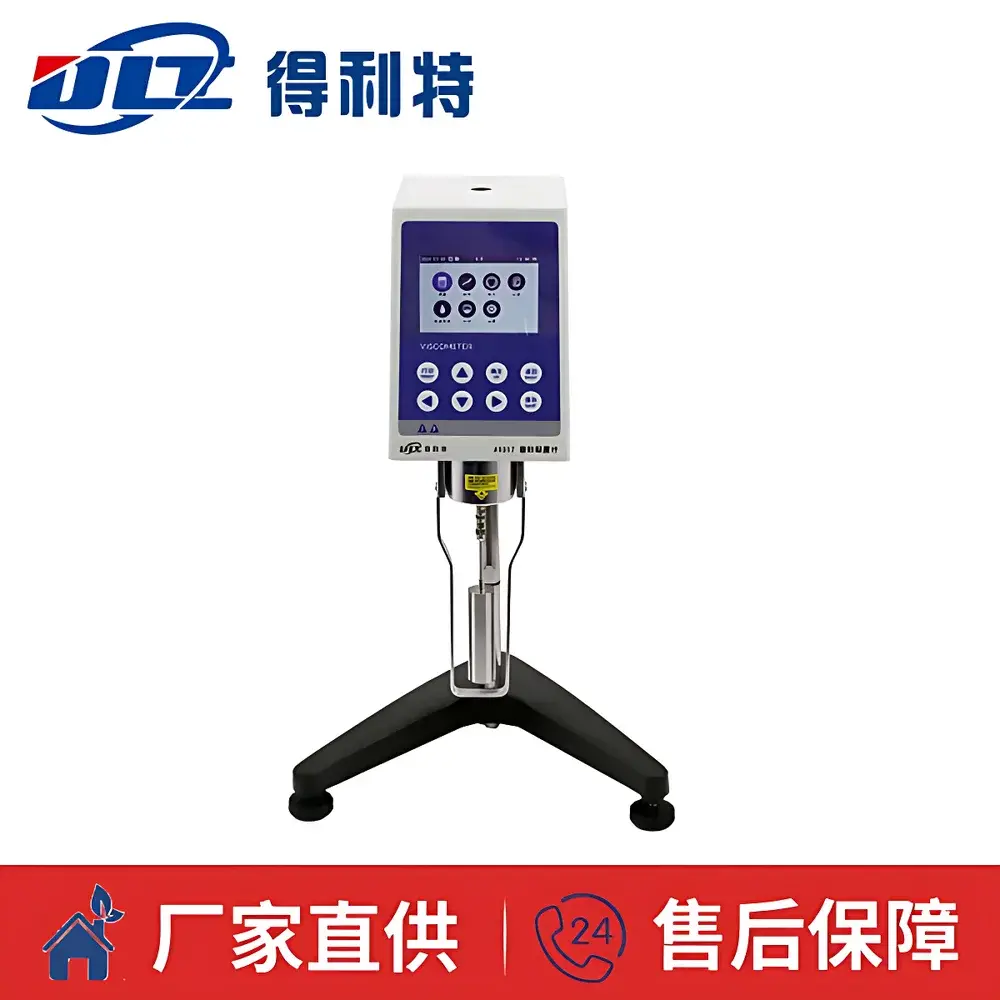
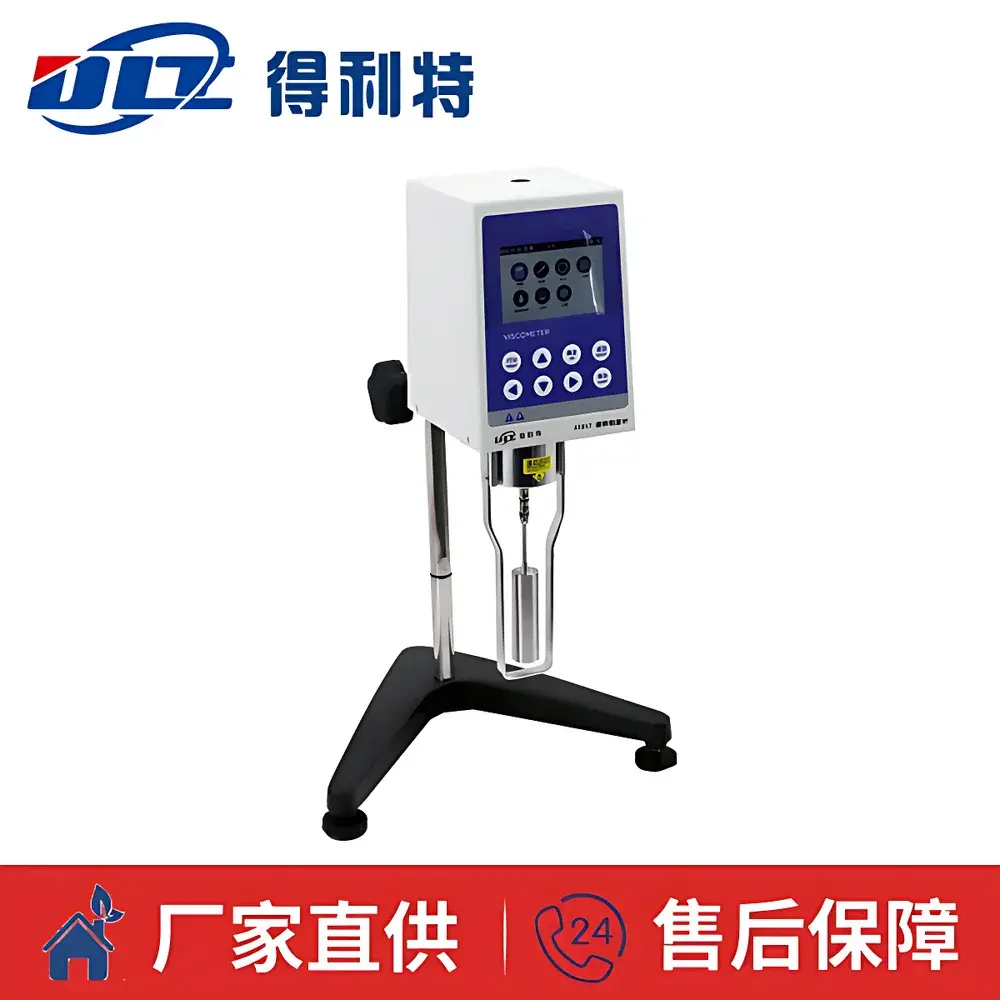
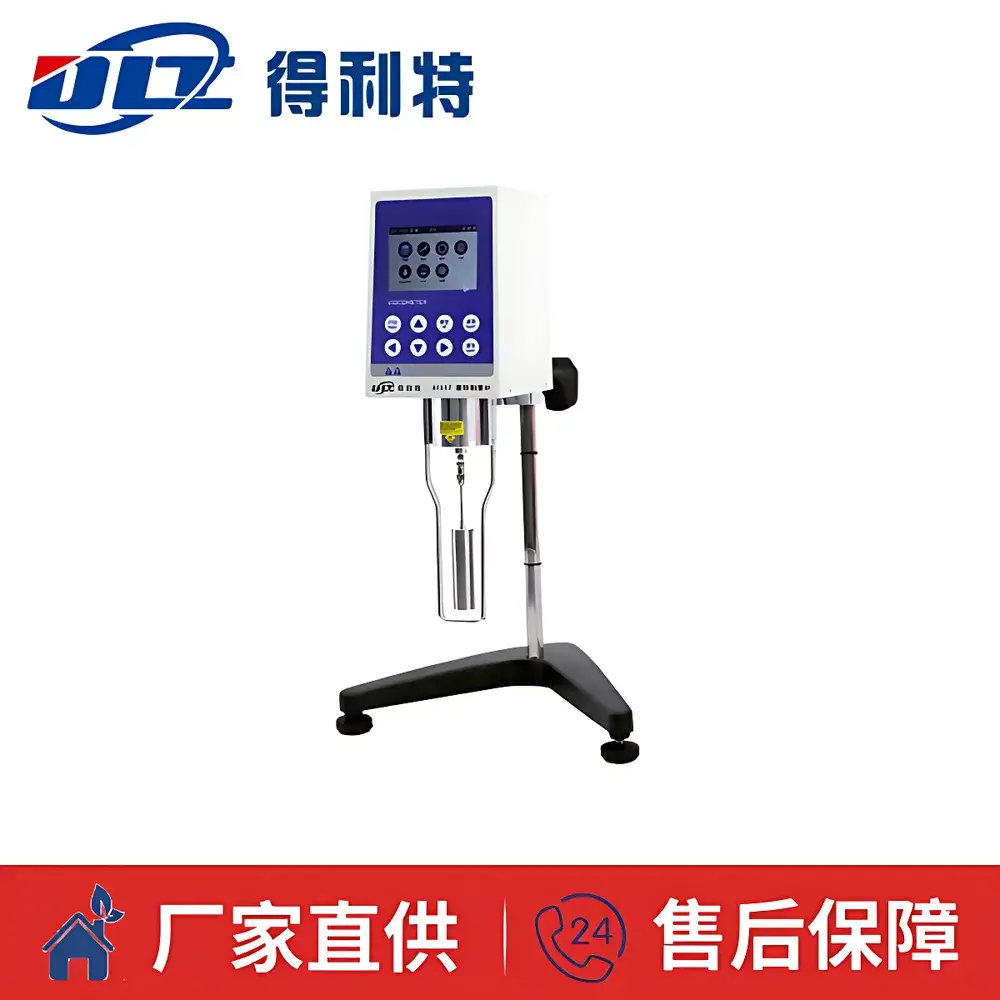
Delite A1017 Rotational Viscometer
| Brand | Delite |
|---|---|
| Origin | Beijing, China |
| Manufacturer Type | Manufacturer |
| Model | A1017 |
| Measurement Range | 10–2,000,000 mPa·s |
| Rotor Set | Four standard spindles (No. 1–4) |
| Speed Settings | 0.3, 0.6, 1.5, 3, 6, 12, 30, 60 rpm (stepped, not continuously variable) |
| Accuracy | ±1% of full scale (F.S.) |
| Display | Backlit high-contrast LCD showing viscosity, spindle number, rotational speed, sample temperature, % torque, and maximum measurable viscosity at selected speed |
| Data Output | RS232 serial interface for PC connectivity |
| Printing | Integrated thermal or impact dot-matrix printer support (via parallel/RS232) |
| Power Supply | AC 220 V ±10%, 50 Hz ±10% |
| Optional DC Input | 12 V / 1 A adapter |
| Operating Environment | 5–45 °C, ≤85% RH |
| Net Weight | 16 kg |
Overview
The Delite A1017 Rotational Viscometer is a precision-engineered instrument designed for the reliable measurement of absolute viscosity in Newtonian fluids and apparent viscosity in non-Newtonian fluids. Based on the principle of rotational viscometry—where torque required to rotate a spindle immersed in a fluid at a defined angular velocity is measured—the A1017 implements Couette flow geometry with interchangeable cylindrical spindles (spindle numbers 1–4) to accommodate a broad dynamic viscosity range from 10 to 2,000,000 mPa·s. Its mechanical architecture integrates high-resolution stepper motor control with microprocessor-based signal conditioning, ensuring stable rotational motion and repeatable torque transduction. The instrument complies with foundational metrological practices outlined in ASTM D2196, ISO 2555, and GB/T 265–2010 (Chinese national standard for kinematic and dynamic viscosity testing), making it suitable for routine quality control and process validation in petroleum, coatings, polymer, and pharmaceutical manufacturing environments.
Key Features
- Eight discrete rotational speeds (0.3, 0.6, 1.5, 3, 6, 12, 30, and 60 rpm) optimized for shear-rate-dependent characterization across diverse fluid classes.
- Four standardized spindles enabling method flexibility and extended range coverage without recalibration between configurations.
- Backlit monochrome LCD display providing real-time readouts of viscosity (mPa·s), spindle identification, rotational speed, % torque, sample temperature (via optional external probe), and maximum measurable viscosity at the current speed setting.
- Dual data output capability: direct thermal or impact dot-matrix printing via built-in port; bidirectional communication with laboratory PCs via RS232 serial interface.
- Robust power architecture featuring dual-input compatibility—standard AC mains (220 V ±10%, 50 Hz ±10%) and isolated 12 V DC input—enhancing electromagnetic noise immunity in industrial lab settings.
- Compliance-ready design supporting traceable calibration workflows and audit documentation under GLP and GMP-aligned quality systems.
Sample Compatibility & Compliance
The A1017 is validated for use with low-to-high-viscosity liquid samples including lubricating oils, crude oil fractions, bitumen emulsions, solvent-based paints, thermoplastic melts, topical pharmaceutical gels, and detergent formulations. It supports both single-point and multi-speed viscosity profiling per ASTM D1200 (for automotive and industrial coatings) and ISO 3219 (for polymer solutions). While not inherently compliant with FDA 21 CFR Part 11, its RS232 interface allows integration into validated LIMS or ELN platforms where electronic records, user authentication, and audit trails are externally managed. All spindle geometries conform to DIN 53019-1 dimensional tolerances, ensuring interchangeability with certified reference oils traceable to NIST SRM 2363 series.
Software & Data Management
The A1017 operates as a standalone viscometer but supports ASCII-formatted data export over RS232 at configurable baud rates (default: 9600 bps, 8N1). No proprietary software is bundled; however, raw output is compatible with common laboratory data acquisition tools (e.g., LabVIEW, MATLAB Serial Interface Toolboxes, or custom Python scripts using pySerial). Each transmitted line includes timestamp (if enabled via external clock sync), spindle ID, speed, viscosity value, temperature (when sensor connected), and torque percentage. Exported datasets retain full metrological context for inclusion in IQ/OQ/PQ protocols during equipment qualification.
Applications
- Petroleum refining: Monitoring viscosity stability of base oils, fuel blends, and residual fuels per ASTM D445 and D7042.
- Coatings & inks: Assessing shear-thinning behavior and sag resistance during formulation development.
- Pharmaceutical excipients: Quantifying consistency of ointments, suspensions, and hydrogels under controlled shear conditions.
- Adhesives & sealants: Evaluating open time, tack development, and thixotropic recovery profiles.
- Academic rheology education: Demonstrating fundamental concepts including Newtonian deviation, yield stress estimation (via extrapolation), and temperature-viscosity relationships (with optional Peltier bath).
FAQ
Is the A1017 compliant with ISO/IEC 17025 calibration requirements?
Yes—when used with NIST-traceable calibration oils and documented spindle verification procedures, the A1017 meets technical competence criteria for viscosity measurement under ISO/IEC 17025:2017 Clause 6.4. Calibration certificates may be issued by accredited third-party labs.
Can spindle No. 1 be used at 60 rpm for low-viscosity solvents?
Spindle No. 1 is rated for optimal accuracy between 10–200 mPa·s at 60 rpm; operation outside this window increases relative uncertainty beyond ±1% F.S. Refer to the included viscosity–speed–spindle matrix before selection.
Does the instrument support automatic temperature compensation?
No—temperature compensation is manual. An external Pt100 or thermistor probe (sold separately) must be connected and referenced in calculations per ASTM D445 Annex A1.
What is the minimum sample volume required for valid measurement?
Standard spindles require ≥20 mL in a 60 mm diameter sample container (e.g., ASTM D2196 cup); reduced-volume adapters are not supported.
Is firmware upgrade capability available?
Firmware updates are performed exclusively by Delite service centers using JTAG programming; no field-upgradable bootloader is provided.






