
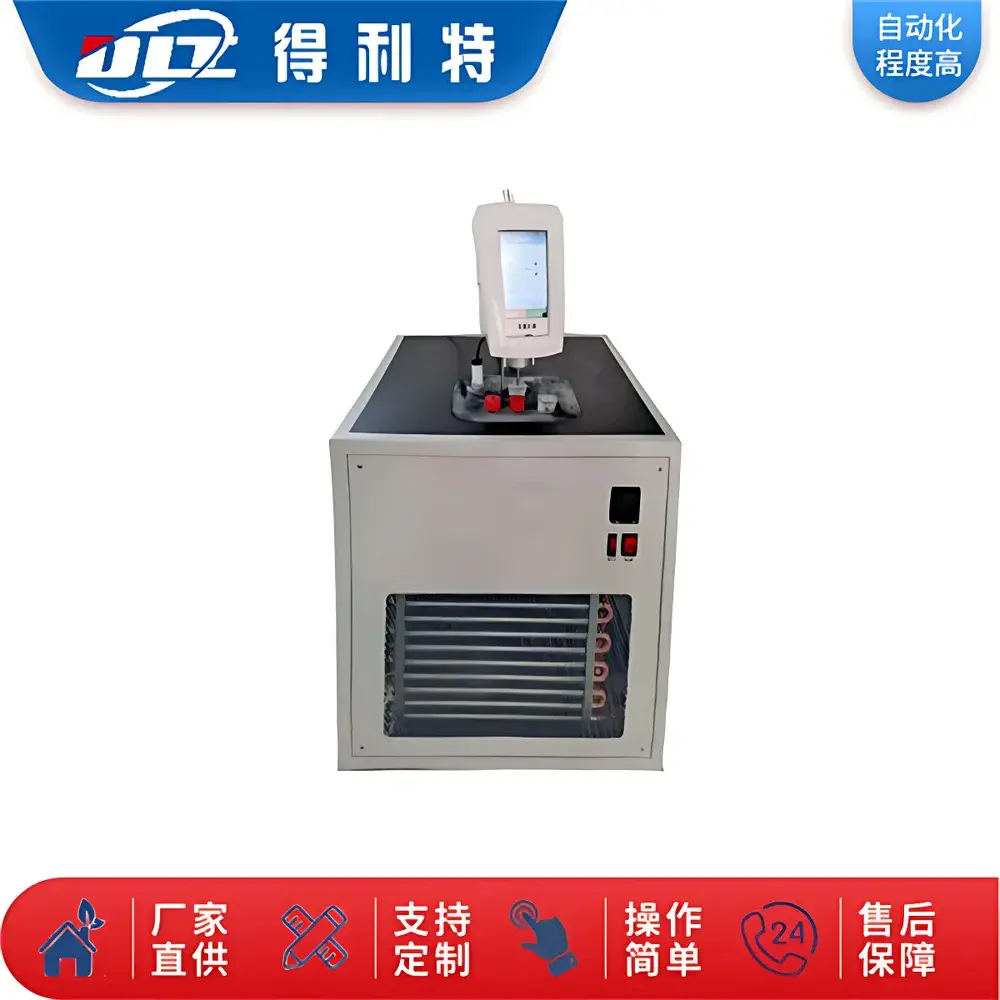
Delite A1018 Low-Temperature Kinematic Viscosity Tester for Lubricants
| Brand | Delite |
|---|---|
| Origin | Beijing, China |
| Manufacturer Type | Direct Manufacturer |
| Country of Origin | China |
| Model | Delite A1018 |
| Price | USD 13,800 (FOB Beijing) |
| Viscosity Range | 1000–1,000,000 mPa·s |
| Temperature Control Range (Bath) | −60 °C to +25 °C |
| Sample Temp Accuracy | ±0.1 °C |
| Bath Temp Stability | ±0.1 °C |
| Rotational Speeds | 0.3, 0.6, 1.5, 3, 6, 12, 30, 60 rpm |
| Included Rotors | LV-1, LV-2, LV-3, LV-4 (4 total) |
| Power Supply | AC 220 V ±10%, ≤1500 W |
| Interface | RS-232C, PT100 temperature probe port |
| Cooling Method | Imported hermetic compressor |
| Calibration | Certified reference oils (ASTM D2983, ISO 3104 compliant) |
| Dimensions | 480 × 580 × 610 mm |
| Weight | 85 kg |
Overview
The Delite A1018 Low-Temperature Kinematic Viscosity Tester is a precision-engineered rotational viscometer designed specifically for the rheological characterization of lubricants under sub-ambient conditions. It operates on the principle of controlled-shear-rate rotational viscometry—measuring torque required to rotate a calibrated spindle (rotor) at defined angular velocities within a thermally stabilized sample. Unlike capillary-based kinematic viscosity instruments, the A1018 delivers dynamic viscosity (η, in mPa·s) directly under shear, making it suitable for non-Newtonian and high-viscosity automotive fluids where flow behavior deviates significantly from ideal laminar flow assumptions. The system complies with key international standards including GB/T 11145 (Chinese national standard equivalent to ASTM D2983 for low-temperature viscosity of gear oils), as well as ISO 3104 and ASTM D445 methodologies for comparative validation. Its primary application domain spans quality control laboratories in OEM lubricant formulation facilities, Tier-1 automotive fluid suppliers, and independent testing labs performing GLP-compliant batch release testing.
Key Features
- Integrated cryogenic cooling bath with imported hermetic compressor, enabling stable thermal control from −60 °C to ambient (±0.1 °C bath stability and ±0.1 °C sample temperature accuracy)
- 16-bit microprocessor-controlled stepper motor drive with high-subdivision stepping—ensuring precise, jitter-free rotation across eight programmable speeds (0.3–60 rpm)
- LCD interface with intuitive menu navigation; real-time display of viscosity (mPa·s), rotational speed (rpm), % torque, rotor identification, and temperature
- Four standard LV-series rotors (No. 1–4) included, optimized for high-viscosity range coverage (1000–1,000,000 mPa·s) without manual recalibration
- Surface-mount technology (SMT) PCB architecture with dedicated细分 driver board and main control board—enhancing electromagnetic compatibility and long-term signal integrity
- Full-scale linearity verification via PC-based calibration routine using NIST-traceable reference oils per ASTM D2983 Annex A1
Sample Compatibility & Compliance
The A1018 is validated for use with mineral-, synthetic-, and semi-synthetic-based lubricants exhibiting pronounced shear-thinning or thixotropic behavior at low temperatures—including SAE 75W–90 and 80W–140 gear oils, ATF fluids, industrial hydraulic oils (ISO VG 32–220), and greases after solvent dilution. All measurement protocols align with regulatory expectations for automotive fluid certification: GB/T 11145 mandates viscosity determination at −18 °C, −26 °C, and −40 °C for multi-grade gear oils; the A1018’s cold-bath capability supports these test points with traceable temperature control. The instrument’s mechanical design conforms to IEC 61010-1 safety requirements for laboratory equipment. While not intrinsically certified for hazardous area use, its sealed refrigeration circuit and grounded chassis meet general-purpose lab installation criteria per EN 61326-1 (EMC for measurement equipment).
Software & Data Management
Data acquisition and reporting are supported through optional RS-232C serial communication to Windows-based host systems. The native protocol enables automated logging of time-stamped viscosity readings, temperature profiles, rotor ID, and torque history—exportable in CSV format for LIMS integration. Audit trail functionality (user login, method selection, calibration event timestamps) satisfies basic GLP documentation requirements. Though the base unit does not include FDA 21 CFR Part 11-compliant electronic signature modules, firmware version 2.3+ supports external authentication hooks for third-party compliance middleware. All calibration records—including reference oil lot numbers, date stamps, and deviation logs—are retained in non-volatile memory and accessible via diagnostic mode.
Applications
- Low-temperature pumpability assessment of automotive gear oils per SAE J300 and GB/T 11145
- Viscosity index improver (VII) performance evaluation under thermal cycling
- Batch-to-batch consistency verification during lubricant manufacturing
- Failure analysis of cold-start viscosity degradation in field-used oils
- Supporting OEM specification development for EV transmission fluids requiring extended low-T rheology windows
- Research into wax crystallization kinetics in paraffinic base stocks via controlled-cool ramp profiling
FAQ
What standards does the A1018 comply with?
It meets GB/T 11145, and its operational methodology is compatible with ASTM D2983, ISO 3104, and ASTM D445 for comparative low-shear viscosity assessment.
Can the A1018 measure kinematic viscosity directly?
No—it measures dynamic viscosity (mPa·s); kinematic viscosity (mm²/s) requires density input and subsequent calculation per ISO 2715.
Is external chiller required?
No—the integrated compressor-based cold bath eliminates dependency on external glycol chillers or liquid nitrogen.
How often must calibration be performed?
Initial factory calibration is valid for 12 months; users should verify annually using certified reference oils traceable to NIST or equivalent NMIs.
Does the system support automated temperature ramping?
Manual setpoint control only; programmable ramp profiles require external PID controller integration via analog output (not standard-equipped).







