
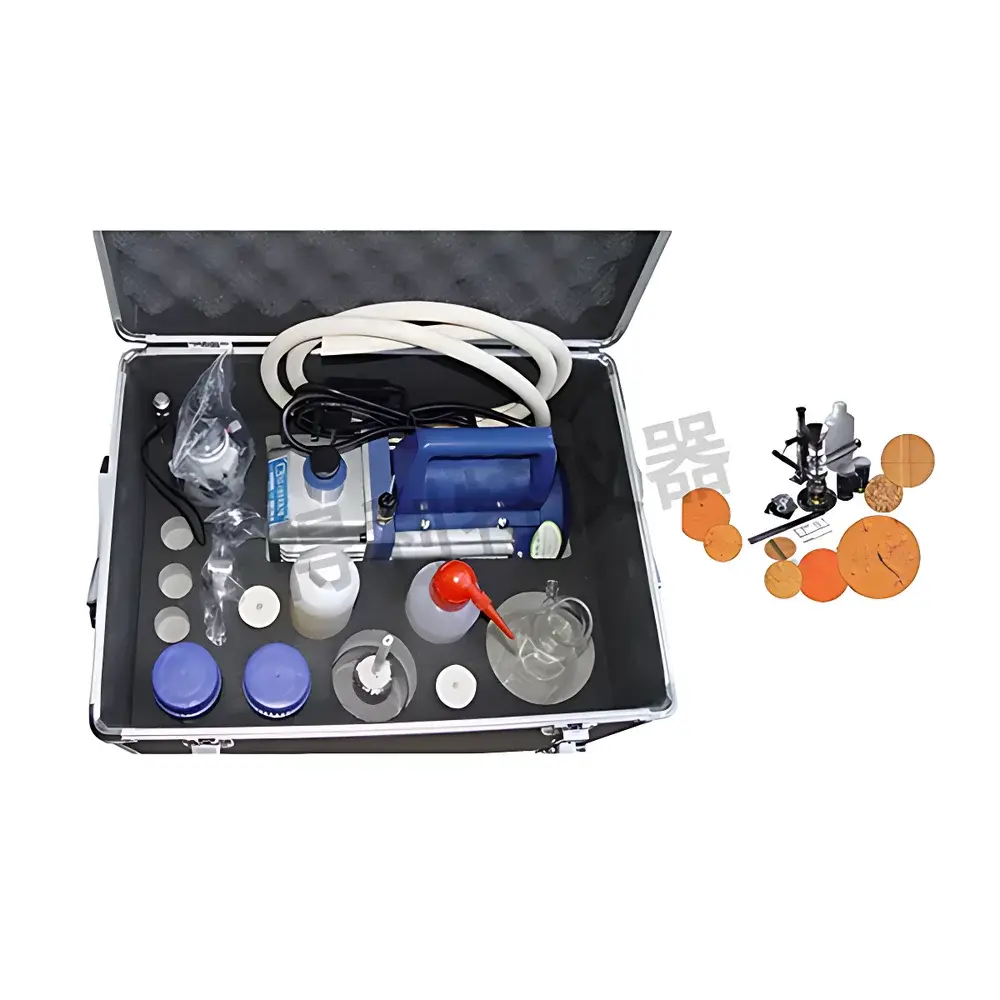
Delite A1030 Portable Oil Contamination Analyzer
| Brand | Delite |
|---|---|
| Origin | Beijing, China |
| Manufacturer Type | Direct Manufacturer |
| Product Type | Portable Instrument |
| Model | A1030 |
| Detection Target | Particulate Contaminants in Hydraulic & Lubricating Oils |
| Microscope Magnification | 100× |
| Particle Size Range | 5–150 µm |
| Cleanliness Rating Scales | NAS 1638 (Classes 00–12) and ISO 4406:2021 (Codes 1–24) |
| Filter Membrane Pore Sizes | 1.2 µm and 5 µm |
| Compliance Standard | DL/T 432–1992 |
Overview
The Delite A1030 Portable Oil Contamination Analyzer is an engineered field-deployable instrument designed for rapid, on-site assessment of particulate contamination in hydraulic fluids, turbine oils, gear oils, and water-glycol fire-resistant fluids. It operates on the principle of membrane filtration followed by microscopic particle enumeration and classification—aligned with standardized gravimetric and optical methodologies defined in DL/T 432–1992, the Chinese electric power industry specification for oil cleanliness testing. Unlike automated laser-based counters, the A1030 employs a manual filtration–microscopy workflow that enables visual morphological analysis of captured particles, supporting root-cause diagnostics such as wear debris identification (e.g., ferrous splinters vs. non-metallic fibers), oxidation byproducts, or external ingress (e.g., sand, rust, sealant fragments). Its compact footprint, battery-compatible operation, and minimal peripheral requirements make it suitable for use in turbine halls, hydraulic power units, mobile maintenance vans, and offshore platform engine rooms where laboratory access is impractical.
Key Features
- Field-ready portable architecture: Integrated carrying case, lightweight aluminum housing, and optional rechargeable power module enable operation without AC mains for ≥4 hours.
- Dual-pore membrane support: Accommodates standard 47-mm diameter filters with 1.2 µm and 5 µm pore sizes—enabling selective retention of fine silt vs. coarse wear debris per application need.
- Calibrated 100× optical microscope: Equipped with coaxial LED illumination, precision stage micrometer, and reticle graticule for consistent particle sizing across the 5–150 µm range.
- Standardized reporting capability: Direct mapping to NAS 1638 (Class 00–12) and ISO 4406:2021 (Code 1–24) cleanliness scales using pre-validated counting grids and reference charts.
- No consumable reagents or calibration fluids required: Eliminates dependency on proprietary consumables, reducing total cost of ownership and logistical complexity in remote deployments.
Sample Compatibility & Compliance
The A1030 is validated for use with mineral-based, synthetic, and semi-synthetic lubricants; phosphate ester and water-glycol hydraulic fluids; and turbine oils conforming to ASTM D4378 and IEC 60296 specifications. It supports sampling volumes from 5 mL to 100 mL, with vacuum-assisted filtration optimized for viscosities up to 220 cSt at 40 °C. All test procedures adhere to DL/T 432–1992, which references core principles of ISO 4022 and ASTM D2276 for particulate extraction and quantification. While not certified for GLP/GMP environments requiring full 21 CFR Part 11 audit trails, its manual documentation workflow is compatible with internal maintenance SOPs and ISO 55001 asset management frameworks.
Software & Data Management
The A1030 operates as a standalone hardware system with no embedded firmware or cloud connectivity. Data recording follows paper-based or spreadsheet-integrated protocols: users log sample ID, date/time, fluid type, filter pore size, observed particle counts per size bin (5–15, 15–25, 25–50, 50–100, >100 µm), and assigned NAS/ISO codes. Optional companion Excel templates—supplied with instrument commissioning—include automatic code conversion, trending graphs, and deviation alerts against OEM-recommended cleanliness thresholds (e.g., ISO 4406 16/14/11 for servo-valve systems). For digital integration, raw image capture via smartphone adapter (sold separately) allows archiving of micrographs in LIMS or CMMS platforms.
Applications
- Routine condition monitoring of hydraulic systems in wind turbine pitch/yaw actuators and blade pitch control units.
- Pre-commissioning verification of new oil batches prior to equipment fill—ensuring compliance with OEM cleanliness specs (e.g., Rexroth RE 00101).
- Troubleshooting sudden valve stiction or servo drift by correlating particle morphology (e.g., laminar iron flakes vs. spherical oxides) with machine history.
- Verification of filter performance during offline kidney-loop filtration campaigns.
- Training tool for maintenance technicians to develop visual recognition skills for common wear mechanisms (adhesive, abrasive, fatigue, corrosion).
FAQ
Does the A1030 require annual recalibration?
No. As a manual optical enumeration system without electronic sensors or flow meters, it relies on traceable microscope magnification and standardized filter membranes—neither of which drift over time. Users perform functional verification using NIST-traceable particle reference slides (optional accessory) before critical assessments.
Can it quantify water or glycol content?
No. The A1030 detects only insoluble particulates retained on membrane filters. Water content must be measured separately via Karl Fischer titration (ASTM D6304) or relative humidity sensors (ASTM D7520).
Is training provided with purchase?
Yes. Delite supplies a bilingual (English/Chinese) technical manual, video-based particle identification guide, and a 90-minute virtual workshop covering DL/T 432–1992 methodology, NAS/ISO scale interpretation, and common miscounting pitfalls.
What is the typical turnaround time per sample?
From filtration initiation to final NAS/ISO assignment: 8–12 minutes for experienced operators, including membrane drying (if wet filtration used), microscopy, and documentation.




