
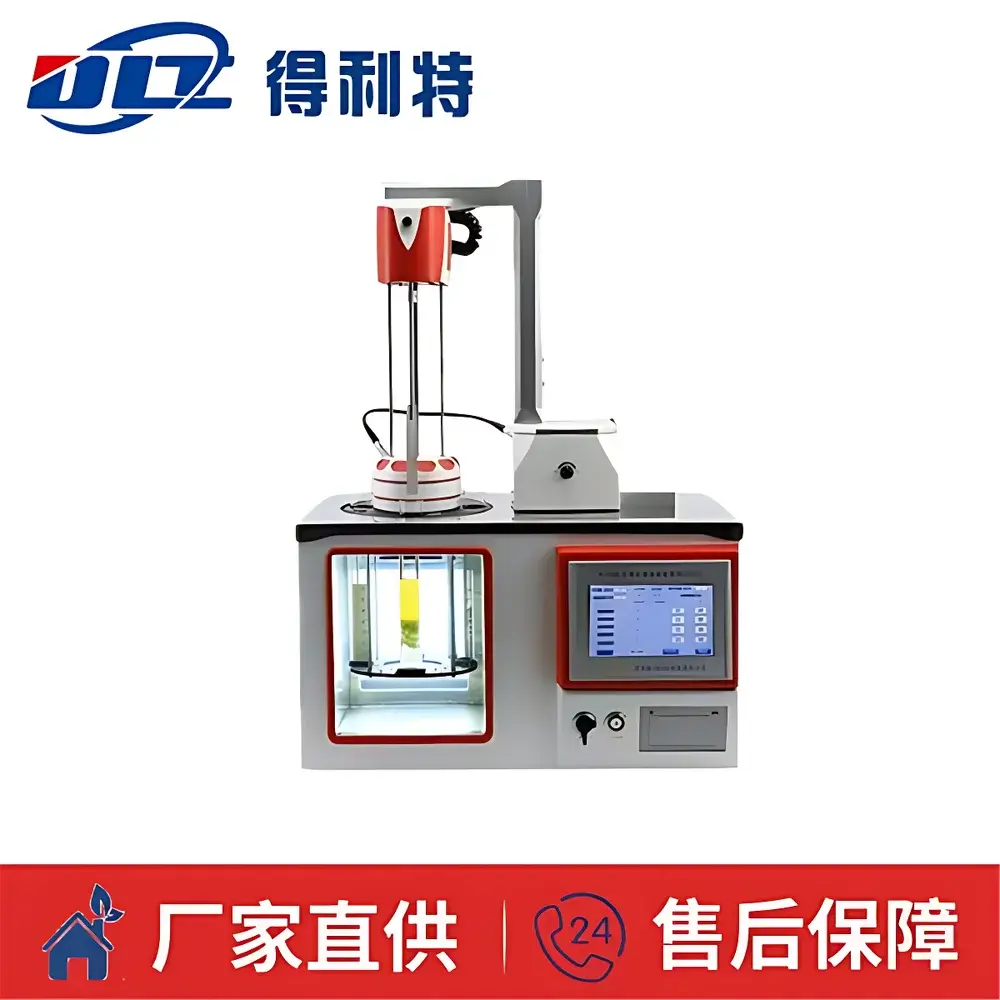
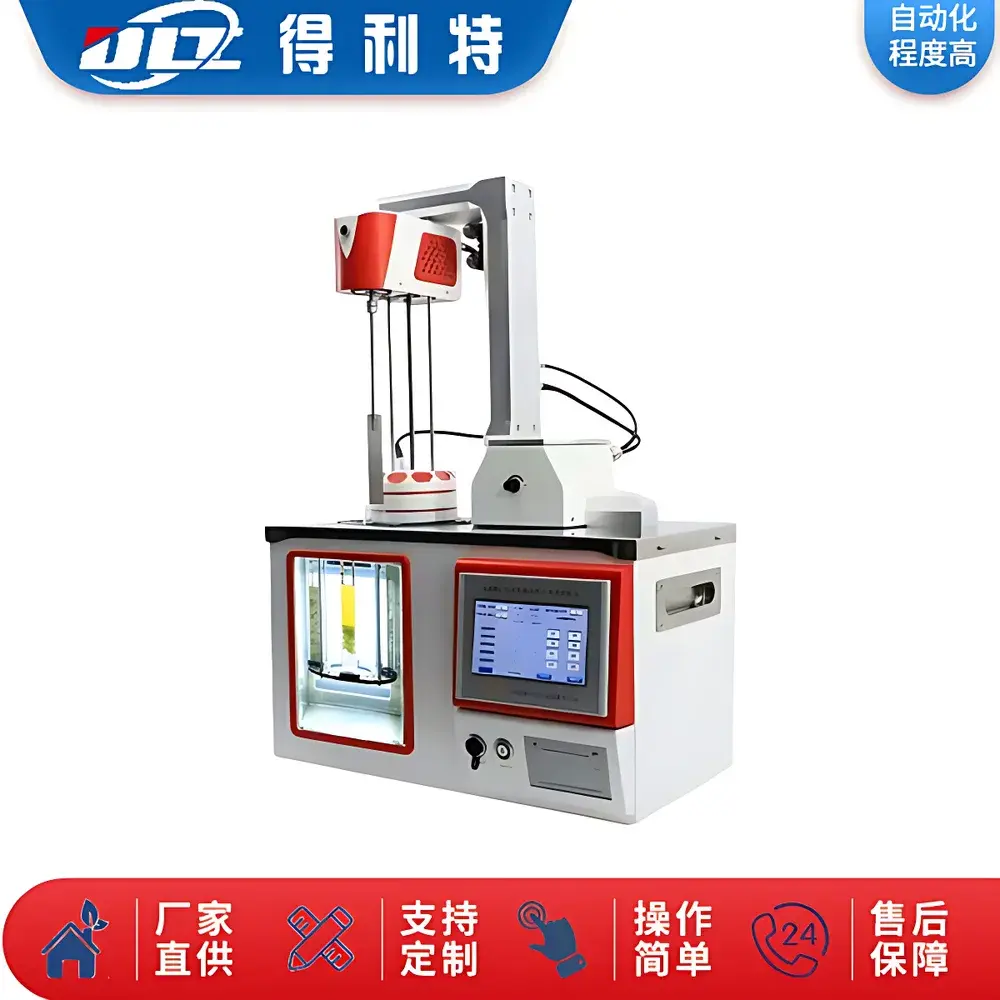
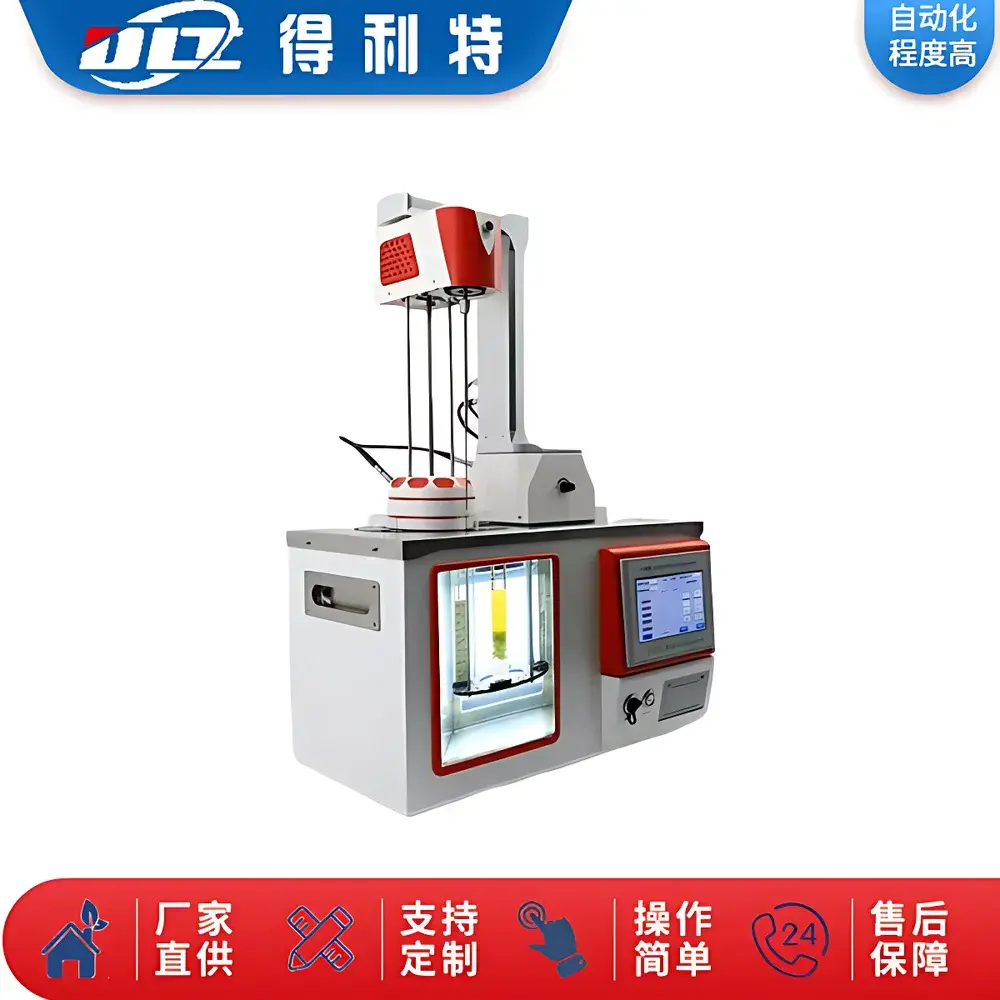
Delite A1065 Petroleum Demulsibility Tester
| Brand | Delite |
|---|---|
| Origin | Beijing, China |
| Manufacturer Type | Direct Manufacturer |
| Model | A1065 |
| Temperature Control Range | Ambient to 100 °C |
| Temperature Accuracy | ±1 °C |
| Stirring Speed | 1500 rpm |
| Sample Capacity | 8 test tubes |
| Stirring Timer Range | 1–59 min |
| Sample Equilibration Timer | 1–59 min |
| Stirrer Shaft Pre-heat Timer | 1–59 min |
| Arm Dwell Time | 1–59 min |
| Power Supply | AC 220 V ±10%, 50 Hz |
| Max. Power Consumption | ≤2000 W |
| Dimensions (W×D×H) | 572 mm × 335 mm × 791 mm |
| Net Weight | 38 kg |
| Compliance Standards | GB/T 7305, GB/T 7605 |
Overview
The Delite A1065 Petroleum Demulsibility Tester is an automated, microprocessor-controlled instrument engineered for precise evaluation of the demulsification behavior of petroleum-based lubricants, turbine oils, hydraulic fluids, and synthetic industrial oils when mixed with water. It operates on the principle of standardized thermal-mechanical separation assessment: oil-water emulsions are prepared under controlled temperature and agitation conditions, then allowed to settle; the volume of separated water, emulsion layer, and remaining oil is quantified at defined time intervals. This method directly reflects the fluid’s resistance to stable emulsion formation—a critical performance parameter for systems where water ingress compromises lubricity, accelerates oxidation, or promotes corrosion. Designed in strict accordance with GB/T 7305 (equivalent to ASTM D1401) and GB/T 7605 (equivalent to ASTM D2711), the A1065 delivers repeatable, auditable results essential for quality control laboratories in power generation, petrochemical refining, aviation maintenance, and OEM fluid certification.
Key Features
- Eight-position simultaneous testing capability—enables high-throughput batch analysis without manual intervention between samples.
- PT100 platinum resistance temperature sensor integrated into the thermostatic bath ensures linear, traceable thermal feedback with <±1 °C stability across the full 20–100 °C operational range.
- Programmable multi-stage timing logic: independent control over sample equilibration, stirring duration (1–59 min), stirrer shaft pre-heating, and post-agitation dwell period—fully replicating standardized test protocols.
- Automated mechanical actuation system: motor-driven vertical lift mechanism raises and lowers the stirring arm with repeatable positioning; gear-reduced DC motor delivers consistent 1500 rpm stirring velocity with minimal vibration and zero audible noise.
- Industrial-grade PLC controller provides deterministic real-time sequencing, hardware-level interlock protection, and immunity to electromagnetic interference—meeting long-term reliability requirements in continuous QC environments.
- Integrated thermal printer outputs timestamped test reports including date/time stamp, set parameters, observed phase volumes (oil/water/emulsion), and operator ID—supporting GLP documentation and internal audit trails.
- Ergonomic stainless-steel bath chamber with drain valve and fill port simplifies routine maintenance, coolant replacement, and cross-contamination prevention between test series.
Sample Compatibility & Compliance
The A1065 accommodates standard 100 mL graduated glass test tubes (ASTM D1401-compliant dimensions) and accepts a broad range of hydrocarbon-based and synthetically formulated oils—including mineral turbine oils, phosphate ester fluids, polyalkylene glycols (PAGs), and diester-based lubricants. Its design adheres to national and international regulatory frameworks: test methodology conforms to GB/T 7305 (identical to ASTM D1401 “Standard Test Method for Determining the Separability of Oil and Water by Heating”) and GB/T 7605 (aligned with ASTM D2711 “Standard Test Method for Demulsibility Characteristics of Turbine Oils”). The instrument’s deterministic control architecture, non-volatile parameter storage, and printed output support compliance with ISO/IEC 17025 accreditation requirements and internal GMP/GLP validation protocols.
Software & Data Management
While the A1065 operates via embedded PLC firmware without external PC dependency, all user-defined parameters—including temperature setpoint, stirring duration, equilibration delay, and dwell time—are stored in non-volatile memory with checksum verification. Each test cycle logs local timestamps and final phase-volume readings directly to the built-in thermal printer. For laboratories requiring digital archiving, optional RS232 serial interface (standard) enables connection to LIMS or custom SCADA systems. Audit-ready printouts include instrument ID, calibration due date (manually entered), operator initials, ambient lab temperature/humidity (if externally fed), and pass/fail indication per GB/T 7305 acceptance criteria (e.g., ≤3 mL emulsion after 30 min at 54 °C). No proprietary software installation is required—ensuring compatibility with air-gapped networks common in utility and defense-sector labs.
Applications
- Turbine oil condition monitoring in thermal and nuclear power plants—detecting early-stage additive depletion or oxidative degradation affecting demulsibility.
- Quality release testing of new lubricant batches prior to shipment to OEMs or refinery customers.
- Research into emulsifier efficacy, demulsifier screening, and formulation optimization for specialty hydraulic fluids.
- Failure analysis of in-service oils exhibiting sludge formation, varnish deposition, or bearing corrosion linked to poor water separation.
- Third-party certification testing for ISO 8573-compliant compressed air system lubricants and marine engine oils subject to seawater exposure.
FAQ
What standards does the A1065 comply with?
It fully implements GB/T 7305 and GB/T 7605, which are technically equivalent to ASTM D1401 and ASTM D2711, respectively.
Can the instrument be validated for ISO/IEC 17025 accreditation?
Yes—the deterministic PLC control, PT100 traceable temperature sensing, calibrated timer circuitry, and permanent printed records satisfy clause 6.4.10 (equipment verification) and 7.7 (result reporting) of ISO/IEC 17025:2017.
Is calibration documentation provided with the unit?
A factory calibration certificate is supplied, listing as-found/as-left data for temperature (at 40 °C, 54 °C, and 82 °C) and timer accuracy (±0.5 s over 60 min), traceable to CNAS-accredited reference standards.
Does the system support remote monitoring or data export?
RS232 serial output allows integration with external data loggers or LIMS; no Ethernet or Wi-Fi connectivity is included to maintain electromagnetic compatibility in high-noise industrial settings.
What maintenance is required for long-term operation?
Monthly cleaning of the bath chamber and drain valve, biannual inspection of stirrer shaft seals, and annual verification of PT100 sensor drift using a certified dry-block calibrator are recommended per the maintenance schedule in the technical manual.






