
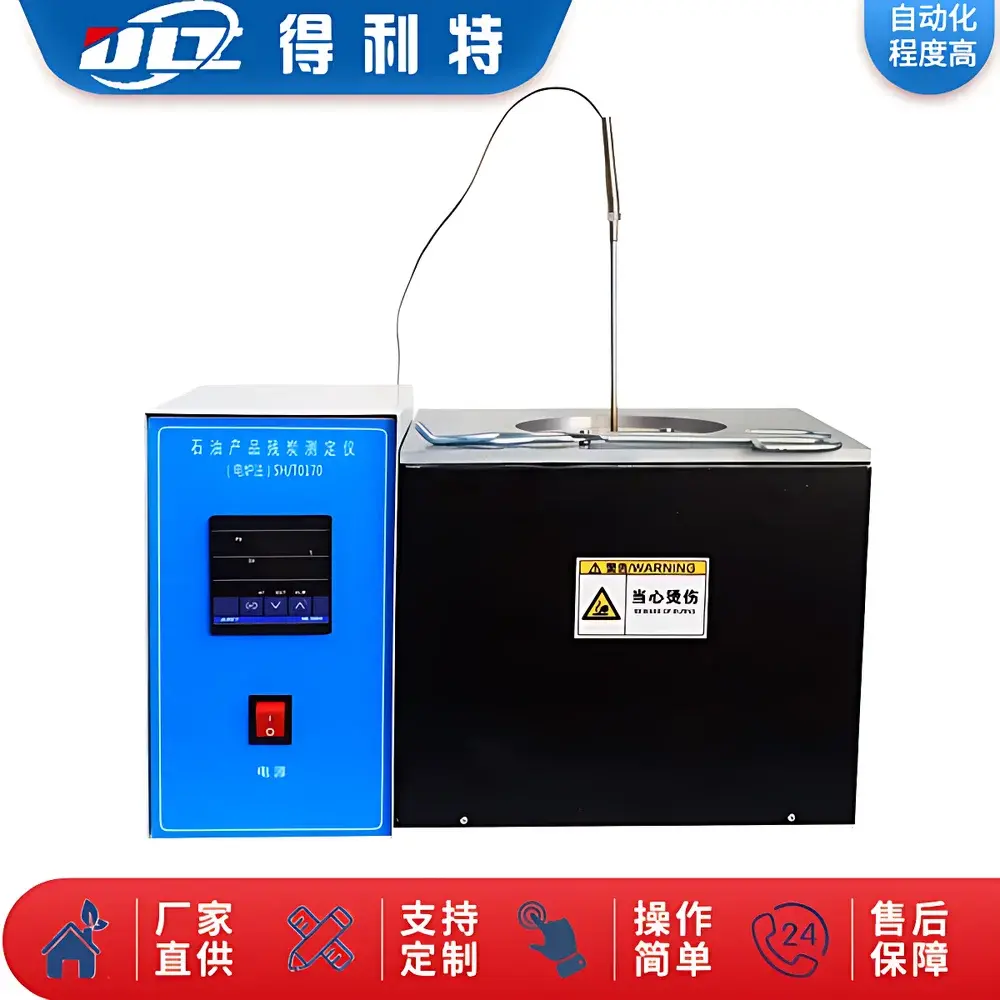
Delite A1261 Conradson Carbon Residue Tester
| Brand | Delite |
|---|---|
| Origin | Beijing, China |
| Manufacturer Type | Manufacturer |
| Country of Origin | Domestic (China) |
| Model | A1261 |
| Heating Method | Electric Furnace |
| Heating Power | 300 W + 600 W + 1000 W (Triple-Zone) |
| Temperature Control Range | 0–520 °C |
| Temperature Control Accuracy | ±5 °C |
| Total Power Consumption | ≤2000 W |
| Ambient Operating Temperature | 5–40 °C |
| Relative Humidity | ≤85 % RH |
| Power Supply | AC 220 V ±10 %, 50 Hz |
| Dimensions (W×D×H) | 345 × 345 × 381 mm |
| Net Weight | 22 kg |
| Compliance Standard | SH/T 0170 |
Overview
The Delite A1261 Conradson Carbon Residue Tester is a precision-engineered laboratory instrument designed for the quantitative determination of carbon residue in petroleum products—specifically lubricating oils, heavy fuel oils, and other distillate or residual hydrocarbon streams. It implements the standardized Conradson carbon residue (CCR) test method as specified in SH/T 0170, the Chinese national standard equivalent to ASTM D189 and ISO 10370, which defines the gravimetric measurement of coke-forming tendency under controlled thermal decomposition in an inert atmosphere. The instrument operates via a three-zone electric furnace system that enables precise ramp-and-hold thermal profiles, simulating the coking behavior of samples during high-temperature processing in refinery units or engine environments. Its robust architecture supports routine QC/QA workflows in petroleum testing laboratories where reproducibility, traceability, and compliance with regulatory reporting requirements are essential.
Key Features
- Fuzzy logic-based temperature control integrated with PID auto-tuning algorithm ensures stable thermal equilibrium across the full 0–520 °C operating range, minimizing overshoot and drift during extended heating cycles.
- Modular, maintenance-free furnace design with three independently rated heating elements (300 W, 600 W, and 1000 W) allows optimized power distribution for rapid ramp-up and uniform heat distribution within the steel bath chamber.
- Intuitive digital temperature controller enables direct setpoint input; the system autonomously executes pre-programmed heating stages per SH/T 0170—including initial heating to 500 °C, followed by controlled cooling and final weighing of the carbonaceous residue.
- Thermal insulation and sealed steel bath construction minimize ambient interference and ensure consistent thermal mass behavior across repeated runs, contributing to inter-laboratory repeatability.
- Compliance-ready hardware architecture includes calibrated Type K thermocouples with cold-junction compensation (1 m lead length), ensuring NIST-traceable temperature monitoring throughout the test sequence.
Sample Compatibility & Compliance
The A1261 accommodates standard 18 mL porcelain crucibles (supplied, 12 pcs) and compatible steel bath covers (4 pcs), supporting sample masses up to 10 g as required by SH/T 0170. It is validated for use with mineral-based lubricants, marine fuels, vacuum residues, and cracked stocks—materials exhibiting varying volatility and thermal stability. The instrument conforms to SH/T 0170, and its operational parameters align with the procedural constraints defined in ASTM D189 (Conradson Carbon Residue of Petroleum Products) and ISO 10370 (Petroleum products — Determination of carbon residue — Conradson method). While not intrinsically certified for GLP or 21 CFR Part 11 compliance, its stable thermal performance, documented calibration traceability, and audit-ready manual data recording support integration into GMP-aligned petroleum quality systems when paired with laboratory SOPs and electronic lab notebook (ELN) documentation practices.
Software & Data Management
The A1261 operates as a standalone benchtop instrument without embedded software or digital connectivity. All temperature programming and status monitoring occur via front-panel digital display and tactile controls. Users record time-temperature profiles, crucible tare/mass values, and final residue weights manually in accordance with internal QA protocols. For laboratories requiring digital data capture, the instrument’s thermal stability and repeatable endpoint behavior enable seamless integration with external balance interfaces and LIMS platforms via manual entry or CSV import. Optional third-party data logging modules (e.g., USB-connected thermocouple readers with PC software) may be deployed to generate time-stamped temperature logs for internal validation or regulatory review.
Applications
- Quality assurance of base oils and finished lubricants in manufacturing plants and independent testing labs.
- Refinery process monitoring of coker feedstocks and vacuum tower bottoms to predict coke drum fouling potential.
- Specification verification of marine residual fuels (RMG/RMK grades) against ISO 8217 requirements for carbon residue limits.
- R&D evaluation of additive packages affecting thermal stability and deposit formation tendencies.
- Contract testing services for customs inspection, commodity certification (CIQ), and third-party conformity assessment bodies.
FAQ
What standard methods does the A1261 support?
It is fully compliant with SH/T 0170 and technically aligned with ASTM D189 and ISO 10370 for Conradson carbon residue determination.
Is the instrument suitable for automated data export?
No—it is a manually operated, non-networked device. Data must be recorded externally using balances and lab notebooks or imported into LIMS via manual entry.
Can the A1261 be used for Ramsbottom carbon residue (RCR) testing?
No. The A1261 implements only the Conradson method (open crucible, steel bath heating); RCR requires a different furnace geometry and pressure-controlled environment per ASTM D524.
What maintenance is required for long-term reliability?
The modular furnace design is maintenance-free under normal operation; periodic verification of thermocouple calibration and visual inspection of crucibles and bath seals are recommended every 200 test cycles.
Does the unit include safety interlocks or overtemperature protection?
Yes—it features dual-stage thermal cutoffs and a redundant 20 A fuse set (2 pcs supplied) to prevent uncontrolled heating beyond 550 °C.





