
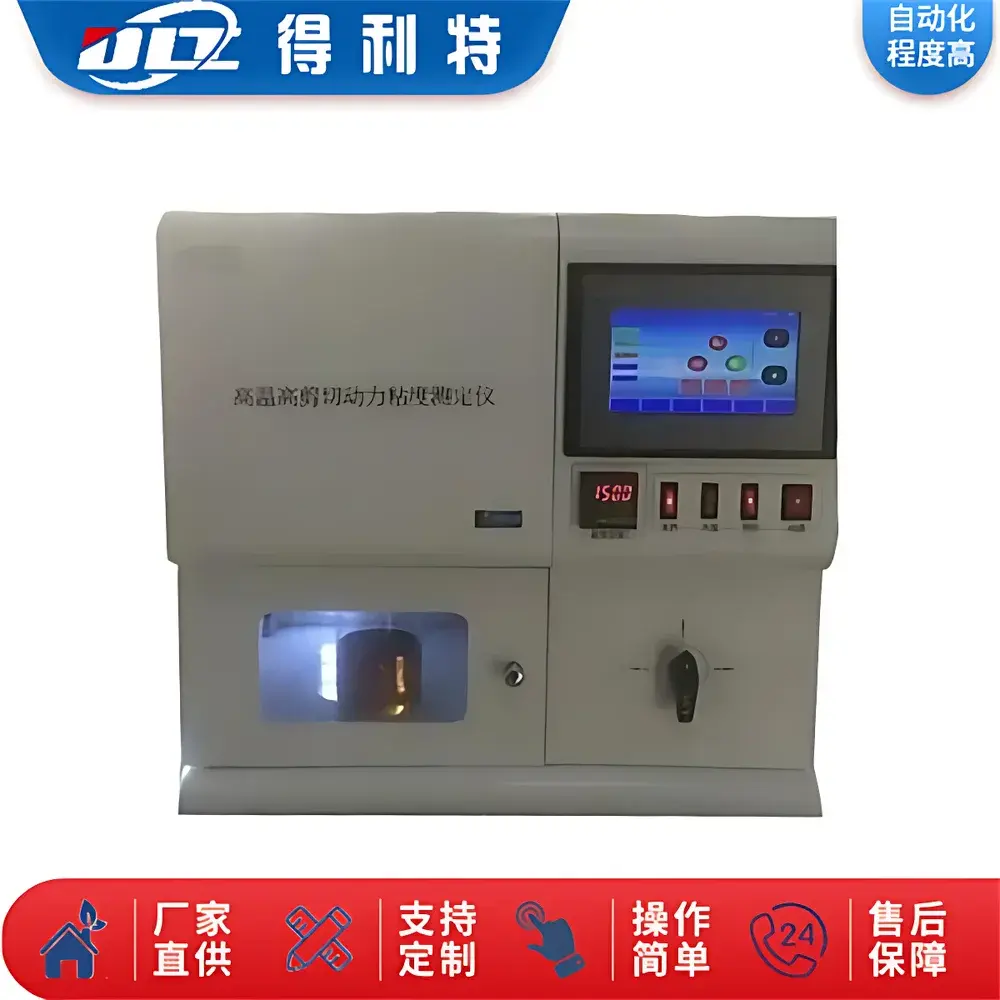
Delite A1460 High-Temperature High-Shear (HTHS) Viscosity Tester
| Brand | Delite |
|---|---|
| Origin | Beijing, China |
| Manufacturer Type | Direct Manufacturer |
| Regional Classification | Domestic (China) |
| Model | A1460 |
| Product Category | Laboratory Instrument |
| Test Parameter | High-Temperature High-Shear Viscosity (HTHS) |
| Applicable Standards | SH/T 0703, ASTM D5481 |
| Power Supply | 220 V, 50 Hz |
| Temperature Control Method | Aluminum Block Bath |
| Test Temperature | 150 ± 0.1 °C |
| Capillary Inner Diameter | 0.15 mm |
| Capillary Effective Length | 16–18 mm |
| Gas Pressure Range | 0.5–3.5 MPa |
| Number of Capillary Cells | 1 |
| Detection Principle | Pressure-Driven Capillary Flow under Controlled Thermal and Shear Conditions |
| Automation | Fully Automated Timing, Pressure Stabilization Monitoring, HTHS Viscosity Calculation & Reporting |
Overview
The Delite A1460 High-Temperature High-Shear (HTHS) Viscosity Tester is a precision laboratory instrument engineered for the quantitative determination of kinematic resistance to flow under thermally accelerated and mechanically stressed conditions—specifically designed to replicate the extreme operating environments experienced by engine oils in modern internal combustion engines. It operates on the principle of pressure-driven laminar flow through a standardized capillary tube at precisely controlled elevated temperature (150 °C), where viscosity is derived from Poiseuille’s law using measured pressure drop, flow time, and geometric constants. This method directly correlates with shear rates exceeding 1 × 10⁶ s⁻¹—conditions representative of journal bearing and piston ring/cylinder liner interfaces. Compliance with SH/T 0703 (Chinese national standard) and ASTM D5481 (Standard Test Method for Measuring Viscosity of Engine Oils at High Temperature and High Shear Rate Using a Tapered Bearing Simulator) ensures data traceability and interlaboratory comparability required for OEM specifications, API licensing, and SAE J300 classification.
Key Features
- Single-capillary architecture with no rotating or sliding mechanical components—eliminates bearing wear, torque calibration drift, and rotor misalignment issues common in rotational rheometers.
- Aluminum block heating bath delivering exceptional thermal stability (±0.1 °C at 150 °C), minimizing axial temperature gradients along the capillary and ensuring reproducible shear history.
- Standardized fused-silica capillary (ID = 0.15 mm, effective length = 16–18 mm) manufactured to ASTM D5481 dimensional tolerances; certified geometry enables direct application of reference calibration equations.
- Programmable inert gas (N₂ or Ar) pressurization system with digital pressure regulation (0.5–3.5 MPa range), enabling precise control over applied shear stress and accommodation of varying base oil viscosities and additive package responses.
- Dedicated firmware with embedded calculation engine: automatically records stabilized pressure, efflux time, ambient barometric correction, and outputs HTHS viscosity in mPa·s (cP) per ASTM D5481 Annex A1 algorithms.
- Integrated thermal safety interlocks, pressure relief valves, and real-time fault logging—designed for unattended operation in GLP-compliant laboratories.
Sample Compatibility & Compliance
The A1460 accepts neat engine oils, gear oils, hydraulic fluids, and formulated lubricant blends meeting ISO 3104 sample preparation guidelines. Sample volume requirement is ≤1.5 mL per test. The instrument satisfies critical regulatory and industry validation requirements: full alignment with ASTM D5481 procedural clauses (including preheating duration, pressure stabilization criteria, and repeatability thresholds); documented compliance with SH/T 0703 for domestic Chinese certification workflows; and compatibility with ISO/IEC 17025 quality management systems when operated within validated SOPs. While not inherently 21 CFR Part 11 compliant, audit trails (test logs, pressure/time stamps, operator ID fields) can be exported in CSV format for integration into validated LIMS or ELN platforms supporting electronic record retention.
Software & Data Management
The A1460 operates via an embedded microcontroller interface with local LCD display and tactile keypad navigation—no external PC dependency required for routine testing. All measurement metadata (date/time stamp, bath temperature, inlet pressure, efflux duration, calculated HTHS value, capillary ID, user code) are stored internally with non-volatile memory retention (>10,000 test records). Optional USB-C port enables direct export of raw and processed data to spreadsheet-compatible .csv files. For enterprise deployment, optional RS-232 or Ethernet modules support SCADA-level integration and remote status monitoring. Calibration certificates, maintenance logs, and firmware revision history are accessible via service menu—facilitating internal QA audits and external accreditation reviews.
Applications
- Formulation development of low-viscosity, high-HVI engine oils (e.g., SAE 0W-16, 0W-20) where HTHS viscosity directly impacts fuel economy and high-speed film strength.
- Quality control release testing of finished lubricants against OEM engineering specifications (e.g., GM dexos1™ Gen 3, Ford WSS-M2C946-A, MB 229.71).
- Stability assessment of shear-thinning polymer additives (e.g., OCPs, PIBs) under prolonged thermal-mechanical stress.
- Research into nano-additive dispersion effects on high-shear rheology and boundary lubrication performance.
- Third-party verification testing for API Licensing and ILSAC GF-7 certification submissions.
FAQ
What standards does the A1460 validate against?
ASTM D5481 and SH/T 0703 are fully implemented—including specified capillary geometry, temperature control accuracy, pressure measurement uncertainty, and calculation methodology.
Can the instrument operate at temperatures other than 150 °C?
No—the aluminum bath and firmware are optimized exclusively for 150 °C ± 0.1 °C as mandated by ASTM D5481; deviation would invalidate compliance.
Is multi-capillary throughput possible?
The A1460 is a single-cell configuration. Parallel analysis requires multiple units or sequential runs; no multiplexing hardware is integrated.
How is calibration verified?
Users perform periodic verification using NIST-traceable reference oils (e.g., Standard Reference Material 1851) with certified HTHS values; instrument-specific calibration factors are not adjustable.
Does the system support automated reporting for regulatory submission?
Raw data export (.csv) enables formatting per FDA/EMA templates; however, signature capture, electronic approval workflows, and audit trail encryption require integration with external validated software platforms.






