
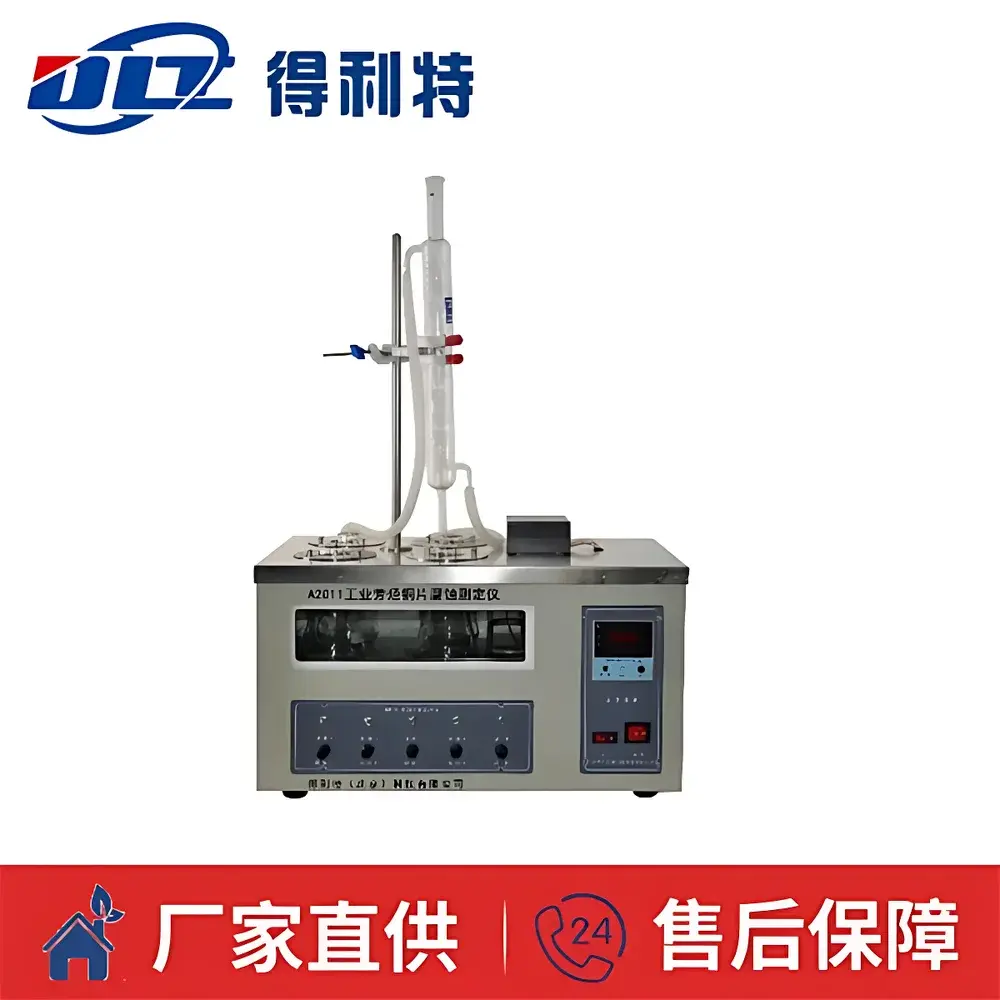
Delite A2011 Industrial Aromatic Hydrocarbon Copper Strip Corrosion Tester
| Brand | Delite |
|---|---|
| Origin | Beijing, China |
| Manufacturer Type | Direct Manufacturer |
| Country of Origin | China |
| Model | A2011 |
| Price | Upon Request |
| Power Supply | AC 220 V ±10%, 50 Hz |
| Temperature Sensor | PT100 |
| Temperature Control Range | Ambient to 100 °C (adjustable) |
| Temperature Accuracy | ±1 °C |
| Heating Power (Main) | 600 W |
| Auxiliary Heating Power | 1000 W |
| Timer Range | 1 min to 24 h (programmable) |
| Temperature Display | LED digital |
| Time Display | LED digital |
| Test Positions | 4 independent reaction wells |
| Overall Dimensions | 480 mm × 360 mm × 520 mm (W × D × H) |
| Net Weight | 18 kg |
| Operating Humidity | ≤85% RH |
| Max. Power Consumption | ≤1800 W |
Overview
The Delite A2011 Industrial Aromatic Hydrocarbon Copper Strip Corrosion Tester is a precision-engineered benchtop instrument designed for qualitative evaluation of copper strip corrosion caused by industrial aromatic hydrocarbons under controlled reflux conditions. It operates in strict accordance with internationally recognized test standards—including GB/T 11138 (Chinese National Standard) and ASTM D849 (Standard Test Method for Corrosivity of Industrial Aromatic Hydrocarbons to Copper)—ensuring methodological consistency across global petroleum quality control laboratories. The instrument employs a dual-heating architecture: primary PID-regulated heating for precise thermal stabilization, and auxiliary high-power heating to rapidly achieve and maintain reflux conditions across all four test positions simultaneously. Its core function is to subject standardized copper strips to defined temperatures and exposure durations in sealed glass reflux apparatuses, enabling visual assessment of surface discoloration, tarnish, or pitting per standardized rating scales (e.g., ASTM D130 color chart equivalents).
Key Features
- PID-based digital temperature control system ensures stable, repeatable thermal profiles within ±1 °C accuracy across the full 0–100 °C operating range;
- Independent programmable timer (1 minute to 24 hours) with LED digital display enables precise synchronization of exposure duration across all four test wells;
- Four parallel test positions accommodate simultaneous evaluation of multiple samples or replicates—enhancing throughput and statistical robustness;
- Dual-zone heating design: 600 W main heater for fine-grained temperature regulation; 1000 W auxiliary heater for rapid thermal ramp-up and sustained reflux performance;
- PT100 platinum resistance thermometer provides high-stability, NIST-traceable temperature feedback for closed-loop control;
- Compact footprint (480 × 360 × 520 mm) and lightweight construction (18 kg net) facilitate integration into QC labs with limited bench space;
- LED digital displays for both temperature and elapsed time ensure unambiguous real-time monitoring without parallax error or analog interpretation.
Sample Compatibility & Compliance
The A2011 is specifically validated for use with industrial-grade aromatic hydrocarbon streams—including benzene, toluene, xylene (BTX), ethylbenzene, and mixed alkylbenzenes—as specified in ASTM D849. It accommodates standard ASTM D130-compliant copper strips (75 mm × 12.5 mm × 1.5 mm) housed in borosilicate glass reflux tubes. All thermal and timing parameters are fully configurable to meet method-specific requirements for pre-conditioning, heating rate, soak time, and cooling protocols. The instrument supports GLP-compliant operation through deterministic, non-volatile parameter storage and operator-logged test initiation—enabling audit-ready documentation when paired with laboratory notebook practices. While not inherently 21 CFR Part 11 compliant (as it lacks electronic signature or audit trail firmware), its operational repeatability and traceable calibration path align with ISO/IEC 17025 requirements for testing laboratories performing petroleum product corrosion assessments.
Software & Data Management
The A2011 operates as a standalone hardware platform with no embedded software or network connectivity. All control logic resides in dedicated microcontroller firmware, minimizing failure modes associated with OS-dependent systems. Temperature setpoints, timer values, and operational status are retained in non-volatile memory across power cycles. Users record test parameters and visual corrosion ratings manually in laboratory notebooks or LIMS-integrated spreadsheets. For laboratories requiring automated data capture, optional external USB thermocouple loggers or time-lapse imaging systems may be deployed adjacent to the unit—though such integrations fall outside the scope of factory validation. Calibration certificates for the PT100 sensor and verification reports for timer accuracy can be supplied upon request to support internal QA documentation.
Applications
- Quality assurance of aromatic feedstocks prior to catalytic reforming or alkylation units;
- Corrosion screening of commercial solvents used in paint, adhesive, and polymer manufacturing;
- Batch release testing of BTX products against refinery specifications and contractual sulfur/corrosivity limits;
- Research and development of corrosion inhibitors for aromatic-rich fuel blends;
- Third-party verification of supplier compliance with API RP 500, ISO 8217, or regional fuel specifications;
- Training and method validation in petroleum technology education programs.
FAQ
Does the A2011 include copper strips or reflux glassware?
No. The instrument is supplied as a heating and timing platform only. ASTM D130-compliant copper strips and borosilicate reflux tubes must be procured separately per user laboratory protocols.
Can the A2011 be used for non-aromatic petroleum products like diesel or jet fuel?
No. It is explicitly designed and validated for industrial aromatic hydrocarbons per ASTM D849. Testing non-aromatics requires instruments conforming to ASTM D130 or D2670, which employ different thermal profiles and exposure geometries.
Is calibration service available from Delite?
Yes. Traceable calibration of the PT100 sensor and timer function can be performed at Delite’s Beijing facility or via authorized regional service partners, with documentation issued per ISO/IEC 17025 guidelines.
What safety certifications does the unit carry?
The A2011 complies with GB 4793.1 (equivalent to IEC 61010-1) for electrical safety in laboratory equipment. CE marking is not applicable, as the device is manufactured for domestic and export markets under China’s CCC exemption policy for analytical instrumentation.
How is temperature uniformity verified across the four test wells?
Uniformity is validated during factory acceptance testing using calibrated PT100 probes placed at identical radial/axial positions in each well. Measured deviation remains ≤±0.8 °C at 50 °C and ≤±1.2 °C at 100 °C under steady-state conditions.




