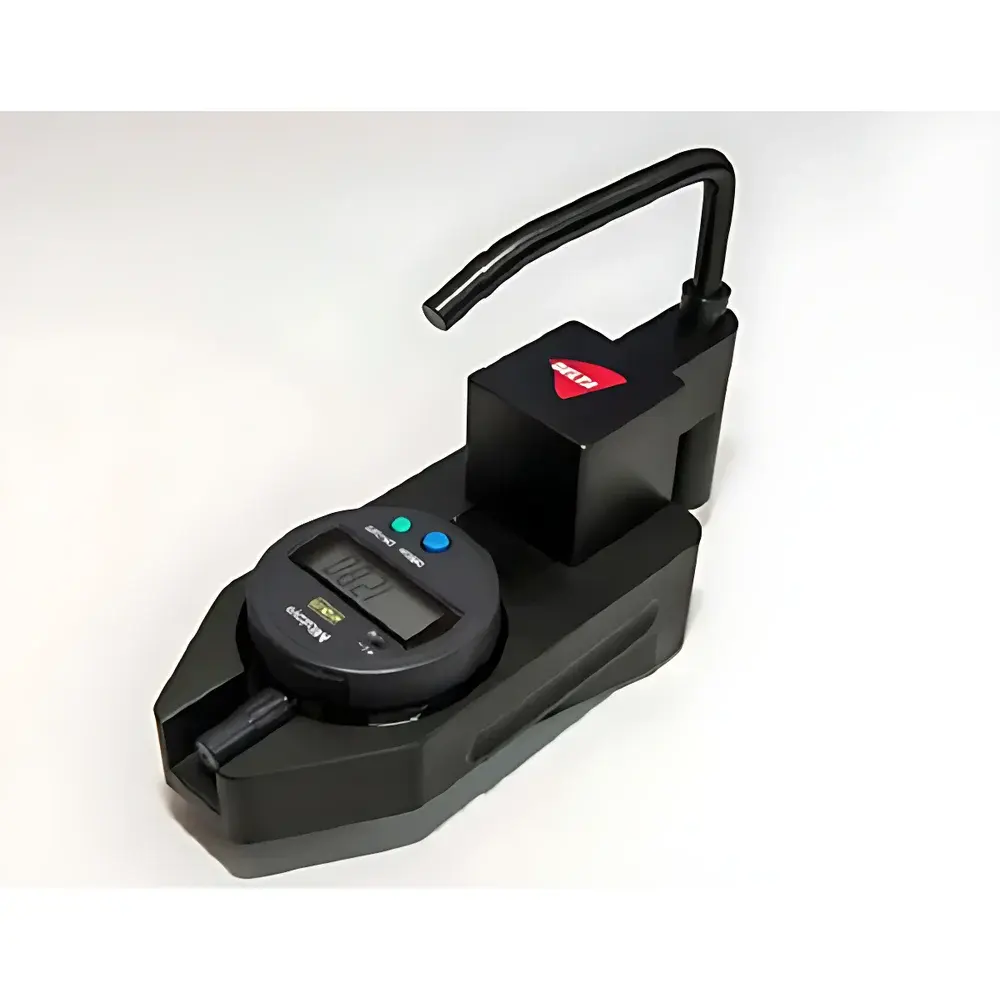
Delta MTG Road Marking Thickness Gauge
| Brand | Delta |
|---|---|
| Origin | Denmark |
| Model | MTG |
| Measurement Range | ±12.7 mm (±0.5 in) |
| Resolution | 0.02 mm |
| Accuracy | ±0.02 mm |
| Dimensions | 80 × 70 × 130 mm |
| Weight | 950 g |
| Construction | Stainless Steel Housing with Mitutoyo Absolute Digimatic Linear Scale |
| Display | LED Digital Readout |
| Power Source | SR44 Silver-Oxide Battery (Battery Life: ~20,000 hours under normal use) |
| Ingress Protection | IP42 |
| Compliance | ISO 2233, GB 16311–2009 |
Overview
The Delta MTG Road Marking Thickness Gauge is a precision-engineered handheld instrument designed for non-destructive, direct-contact measurement of dry thermoplastic, paint, and cold-plastic road marking thickness on asphalt and concrete pavements. Operating on the principle of high-resolution linear displacement sensing via a calibrated Mitutoyo Absolute Digimatic scale, the MTG delivers traceable, repeatable thickness readings without surface preparation or calibration drift. Its mechanical architecture eliminates reliance on external power during measurement—ensuring consistent performance across field environments where ambient temperature, dust, or transient moisture may compromise electronic alternatives. The gauge conforms to the geometric and metrological requirements defined in ISO 2233 (“Road traffic markings — Measurement of thickness”) and supports full compliance with GB 16311–2009 (“Technical requirements and test methods for quality of road traffic markings”), enabling regulatory-grade data acquisition for highway authorities, pavement maintenance contractors, and third-party inspection agencies.
Key Features
- Stainless steel construction with ergonomic grip and low-profile probe geometry—optimized for stable placement perpendicular to curved or sloped marking edges.
- Mitutoyo Absolute Digimatic linear scale integrated into the measuring head—provides absolute position encoding without zero-reset dependency, eliminating cumulative error during sequential measurements.
- LED digital display with automatic hold function—locks reading within 1.5 seconds of stable contact, minimizing operator-induced parallax or vibration artifacts.
- IP42-rated enclosure—resists ingress of solid objects ≥1 mm and vertically falling water droplets, supporting extended outdoor deployment in variable climatic conditions.
- SR44 silver-oxide battery powering >20,000 hours of typical operation—translating to multi-year service life without scheduled battery replacement under standard QA/QC inspection cycles.
- Calibration traceability supported through optional NIST-traceable certificate (available upon request), aligning with ISO/IEC 17025 laboratory accreditation requirements.
Sample Compatibility & Compliance
The MTG is validated for use on cured road marking materials including solvent-based paints, waterborne acrylics, thermoplastic compounds (with or without glass bead embedment), and two-component cold plastics. It accommodates surface roughness up to Rz 150 µm and substrate curvature radii ≥2 m without loss of measurement fidelity. All units undergo factory verification against certified step gauges traceable to DKD (Danish Accreditation Fund) standards. The device satisfies mandatory testing provisions in ISO 2233 Annex A (mechanical gauge methodology) and fulfills Clause 5.2.1 of GB 16311–2009 for “thickness determination of traffic markings.” It is routinely deployed in audits requiring adherence to national highway asset management frameworks and supports documentation for ISO 9001:2015 clause 7.1.5 (monitoring and measuring resources).
Software & Data Management
While the MTG operates as a standalone analog-digital hybrid instrument with no embedded firmware or wireless interface, its output is fully compatible with downstream data governance workflows. Measured values are manually recorded into digital QA logs or imported into pavement management systems (PMS) such as Pontis or PAVER via CSV templates. For laboratories operating under GLP or GMP regimes, the MTG’s mechanical simplicity ensures full auditability: no software validation is required per FDA 21 CFR Part 11, and all readings are directly attributable to physical scale displacement—not algorithmic interpolation. Optional calibration certificates include uncertainty budgets calculated per GUM (Guide to the Expression of Uncertainty in Measurement), supporting metrological rigor in accredited testing environments.
Applications
- Verification of contractual coating thickness compliance during new road construction and resurfacing projects.
- Periodic condition assessment of aging markings to determine remaining service life and optimal re-stripping intervals.
- Quality control sampling at material batch release—correlating applied thickness with theoretical coverage rates to detect over-application or material wastage.
- Forensic analysis following wet-night visibility complaints—cross-referencing thickness profiles with retroreflectivity data to isolate material degradation mechanisms.
- Supporting lifecycle cost modeling by linking measured thickness variance to predicted wear rates derived from EN 1436 field correlation studies.
FAQ
Does the MTG require periodic recalibration?
Yes—while the Absolute Digimatic scale maintains long-term stability, annual verification against certified reference standards is recommended per ISO/IEC 17025 and internal QA protocols.
Can the MTG measure thickness on freshly applied wet paint?
No—it is intended exclusively for cured, dry markings; attempting measurement on uncured material risks probe indentation and invalid readings.
Is the probe interchangeable or field-replaceable?
The probe assembly is integral to the scale housing and not user-serviceable; replacement requires return to an authorized Delta service center.
What environmental conditions limit operational use?
Operation is rated for –10 °C to +50 °C ambient; condensation on the scale face or sustained exposure to salt-laden fog may affect long-term corrosion resistance despite stainless steel construction.
How does the MTG compare to ultrasonic or eddy-current thickness gauges?
Unlike non-contact methods, the MTG provides direct mechanical measurement independent of substrate acoustic impedance or electromagnetic permeability—making it universally applicable across diverse pavement types without material-specific calibration.
Related Products