
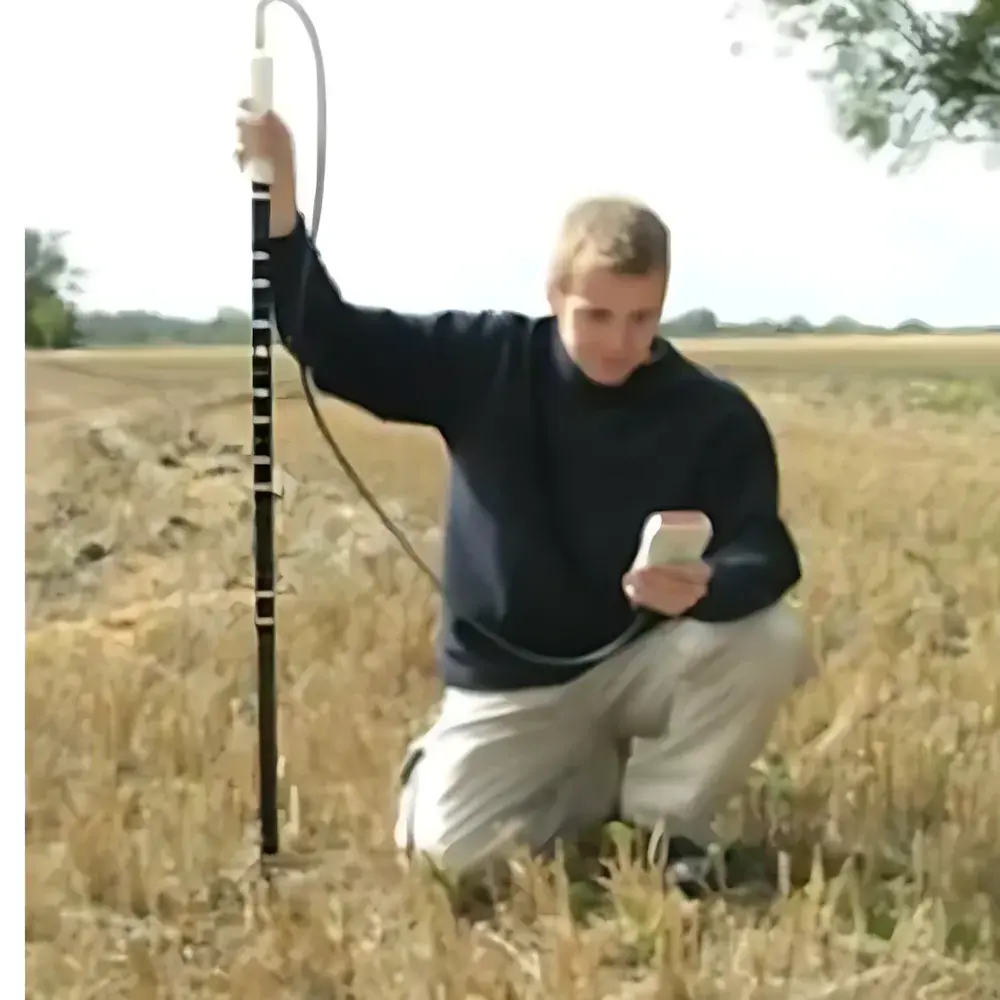
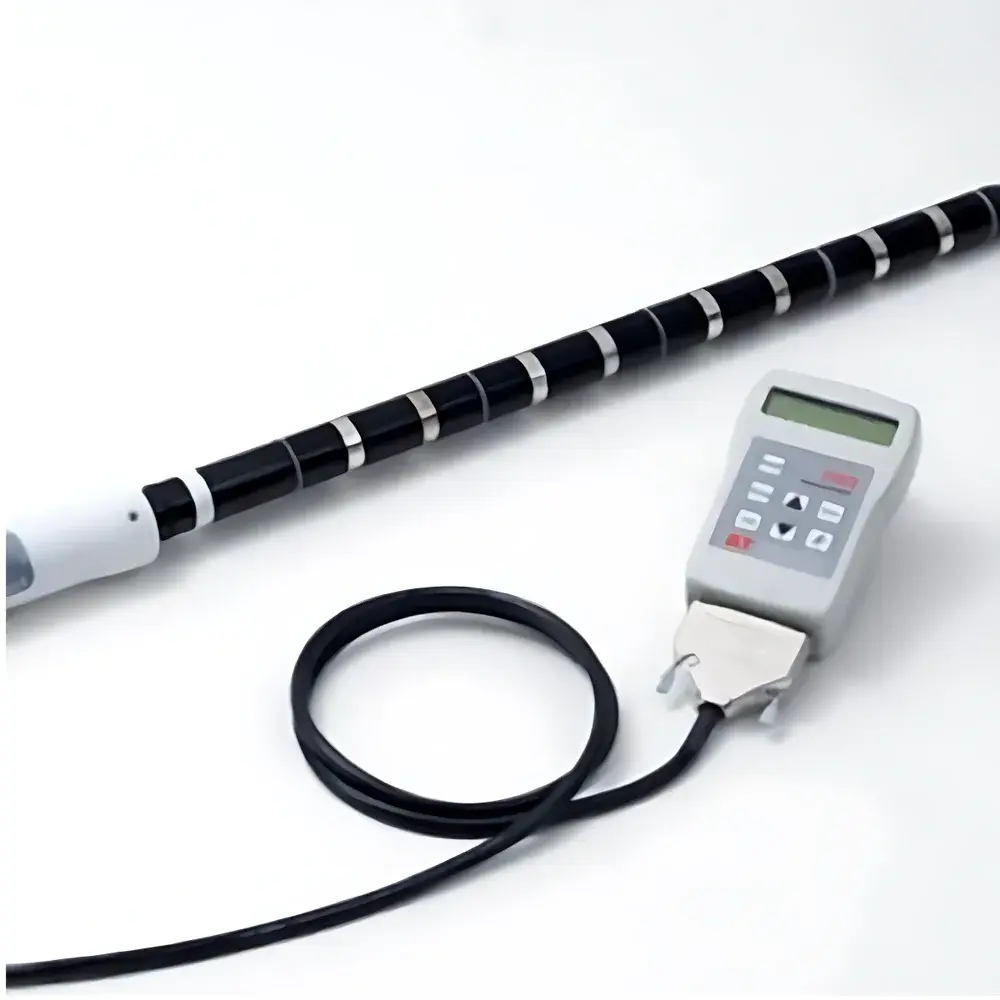
Delta-T Devices PR2-4 Profile Soil Moisture Probe
| Brand | Delta-T Devices |
|---|---|
| Origin | United Kingdom |
| Model | PR2-4 |
| Measurement Principle | Frequency Domain Reflectometry (FDR) |
| Probe Depths | 10, 20, 30, and 40 cm |
| Output | Four analog voltage signals (0–1 V corresponding to 0–60 % vol) |
| Volumetric Water Content Range | 0–100 % vol (optimal accuracy: 0–40 % vol) |
| Accuracy | ±4 % vol (0–+40 °C, soil-specific calibration) or ±6 % vol (0–+40 °C, generic calibration) |
| Salinity Tolerance | 50–400 mS/m (pore water electrical conductivity) |
| Sensor Sensitivity Volume | Cylindrical zone of 10 cm diameter × 5 cm height (95 % contribution to reading) |
| Operating Temperature | –20 to +70 °C (optimal accuracy: 0–+40 °C) |
| IP Rating | IP67 (probe), IP52 (HH2 meter) |
| Power Supply | 5.5–15 V DC |
| Current Draw | <80 mA |
| Response Time | 1 s |
| Cable | Shielded 9-conductor, standard 1.5 m with M12 IP68 connector |
| Probe Material | Polycarbonate housing with stainless steel tip |
| Probe Dimensions | 750 mm length × 25.4 mm diameter |
| Probe Weight | 0.6 kg |
| HH2 Meter Display | 16×2 character LCD |
| HH2 Memory Capacity | 166–782 readings |
| HH2 Battery Life | ~4500 measurements on one 9 V alkaline cell |
| EMC Compliance | Meets EU EMC Directive 2014/30/EU |
Overview
The Delta-T Devices PR2-4 Profile Soil Moisture Probe is a rigorously engineered field instrument designed for high-reproducibility volumetric water content (θv) profiling in mineral and organic soils. Based on Frequency Domain Reflectometry (FDR), the PR2-4 integrates four independent dielectric sensors along a single rigid probe rod—each calibrated at fixed depths of 10, 20, 30, and 40 cm below surface. Unlike time-domain transmission (TDT) or capacitance-based systems requiring complex waveform analysis, FDR measures the resonant frequency shift of an oscillating circuit embedded within each sensor, directly correlating to the real part of soil complex permittivity—a physical property dominantly governed by water content. This principle enables rapid (<1 s per profile), non-destructive, and temperature-compensated measurements without the need for in-situ calibration across most agricultural, ecological, and hydrological contexts. The probe’s robust polycarbonate-and-stainless-steel construction ensures long-term stability under repeated insertion in cultivated, compacted, or rocky soils—while its IP67 rating guarantees reliable operation in rain, dust, and temporary submersion.
Key Features
- Four-depth simultaneous measurement (10/20/30/40 cm) on a single 750 mm probe—minimizing spatial variability and installation time
- Dual deployment modes: fully portable (hand-held with HH2 meter) or permanently installed (with optional data logger interface)
- Soil-specific calibration protocols validated against gravimetric standards per ASTM D5539 and ISO 11274, enabling ±4 % vol accuracy in common loam, clay, and sandy textures
- Engineered salinity resilience: stable performance across pore water EC from 50 to 400 mS/m—critical for irrigation monitoring in arid or reclaimed lands
- Thermal drift compensation across –20 to +70 °C ambient range, with optimal precision maintained between 0 and +40 °C
- Modular cabling architecture: shielded 9-conductor cable with M12 IP68 connector supports extension to 100 m without signal degradation
Sample Compatibility & Compliance
The PR2-4 is validated for use in structured and unstructured mineral soils, peat, and amended horticultural substrates. Its cylindrical sensing volume (10 cm diameter × 5 cm height) defines the spatial representativeness of each depth reading; users must ensure this zone is free of metallic debris, large stones (>2 cm), or dense root masses (>3 mm diameter), as these introduce dielectric heterogeneity that violates the effective medium assumption underlying FDR theory. The probe complies with IEC 60529 (IP67 ingress protection), EN 61326-1:2013 (EMC for laboratory and industrial use), and meets essential requirements of the EU Low Voltage Directive 2014/35/EU. When deployed with the HH2 meter and Delta-T’s HH2Read software, full audit trails—including timestamp, battery voltage, and sensor ID—are retained for GLP-compliant field studies.
Software & Data Management
Data acquisition is managed via the HH2 handheld meter, which stores up to 782 profiles (dependent on enabled sensors) with automatic timestamping and battery-voltage logging. Raw analog outputs (0–1 V per depth) are digitized at 12-bit resolution and mapped to volumetric water content using user-selectable calibration curves—either factory-default (generic mineral soil) or site-specific (imported from CSV). The included HH2Read desktop application (Windows-compatible) enables batch download, unit conversion (e.g., % vol ↔ m³·m⁻³), outlier flagging, and export to CSV, Excel, or ASCII formats compatible with R, Python (pandas), or MATLAB workflows. All data files retain embedded metadata (probe serial number, measurement date/time, operator ID), satisfying traceability requirements under ISO/IEC 17025 and FDA 21 CFR Part 11 when used with controlled access and electronic signature protocols.
Applications
- Root-zone water dynamics monitoring in precision agriculture (e.g., irrigation scheduling for maize, wheat, or vineyards)
- Long-term vadose zone flux modeling in catchment-scale hydrological studies (paired with tensiometers or neutron probes)
- Validation of satellite-derived soil moisture products (e.g., SMAP, Sentinel-1) at field scale
- Green infrastructure performance assessment (bioswales, permeable pavements, green roofs)
- Ecological research on plant–soil–water relations in grasslands, forests, and restoration sites
- Regulatory compliance reporting for landfill cover systems and contaminated land remediation projects
FAQ
Can the PR2-4 be used in saline or sodic soils?
Yes—the probe maintains functional accuracy across pore water EC values of 50–400 mS/m. For soils exceeding 400 mS/m, Delta-T recommends empirical recalibration using saturated paste extracts.
Is it necessary to recalibrate the probe for different soil types?
Factory calibration suffices for most mineral soils. However, for organic-rich (e.g., >20 % OM) or highly variable substrates, Delta-T provides a documented two-point gravimetric protocol aligned with ISO 11274 Annex B.
What is the minimum recommended distance between adjacent PR2-4 probes?
To avoid electromagnetic cross-talk, install probes at least 50 cm apart horizontally when using identical cable lengths and power supplies.
Does the HH2 meter support real-time data streaming to a PC?
No—the HH2 operates in discrete measurement mode only. For continuous logging, integrate the PR2-4’s analog outputs with a Campbell Scientific CR1000X or similar datalogger using appropriate excitation and signal conditioning.
How often should the probe be cleaned or serviced?
Wipe the stainless steel tip and polycarbonate body with distilled water after each use in high-salinity or clay-rich soils. No routine internal servicing is required; the sealed electronics carry a 3-year limited warranty.







