
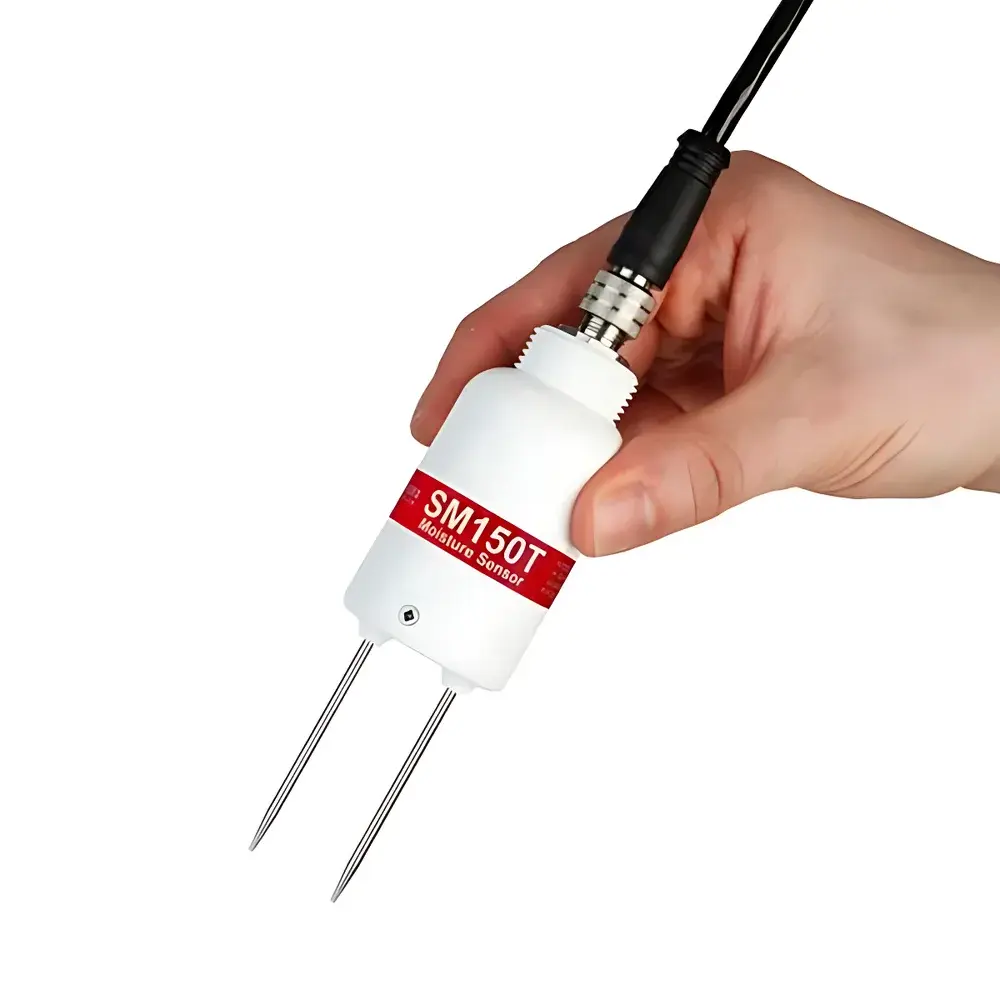
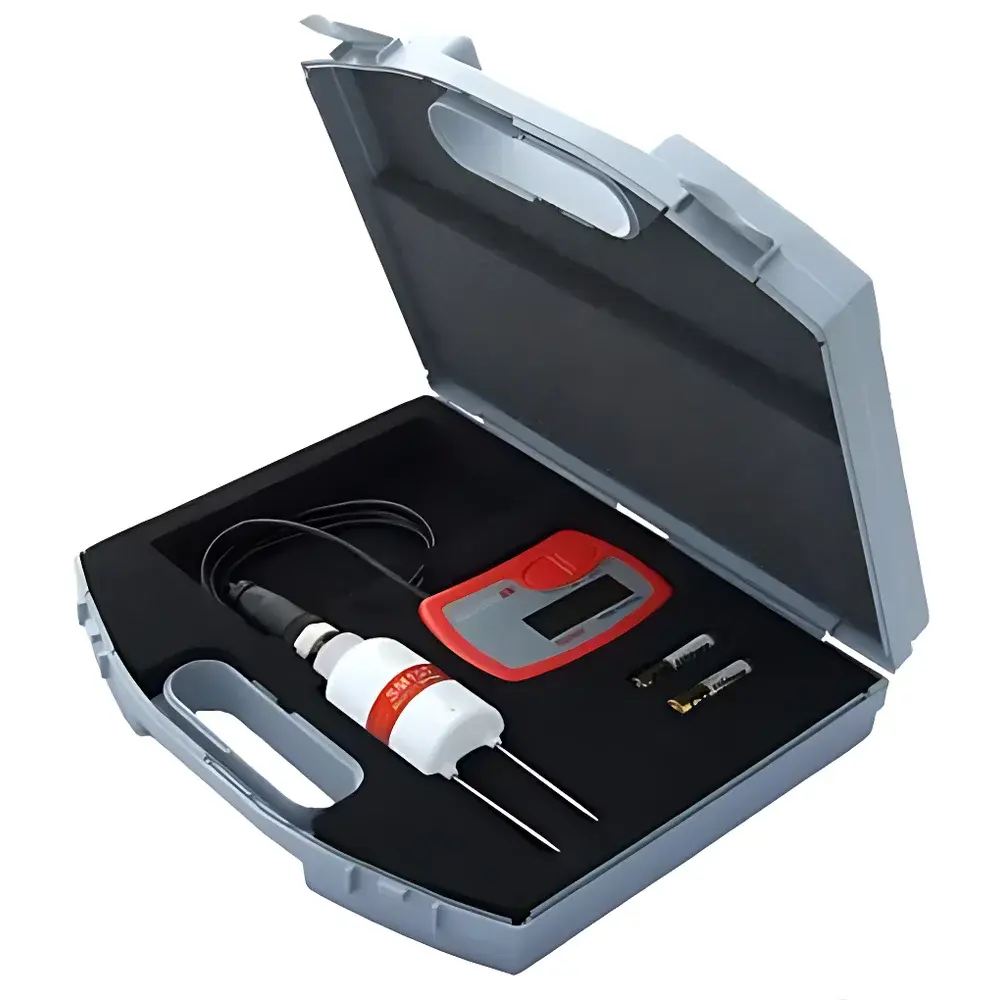
Delta-T SM150T Soil Moisture and Temperature Sensor
| Brand | Delta-T |
|---|---|
| Origin | United Kingdom |
| Model | SM150T |
| Measurement Principle | Frequency Domain Reflectometry (FDR) |
| Soil Moisture Range | 0–0.7 m³·m⁻³ (standard), extendable to 0–1.0 m³·m⁻³ |
| Soil Moisture Accuracy | ±0.03 m³·m⁻³ (±3% vol.) |
| Soil Temperature Range | −20 to +60 °C |
| Temp. Accuracy | ±0.5 °C (0–40 °C), ±0.75 °C (−20 to +60 °C) |
| Electrical Conductivity Tolerance | 50–500 mS·m⁻¹ |
| EC-Induced Error | < ±0.035 m³·m⁻³ (for θ = 0.05–0.4 m³·m⁻³) |
| Output Signal | 0–1.0 V analog |
| Power Supply | 5–14 VDC, 18 mA @ 1 s sampling interval |
| IP Rating | IP68 |
| Operating Temperature | −40 to +70 °C |
| Sensing Volume | Ø70 mm × 55 mm cylinder |
| Probe Dimensions | 51 mm × Ø2.5 mm |
| Mass | 0.1 kg |
| Compatible Loggers | Delta-T GP1, GP2, DL2e, DL6 |
Overview
The Delta-T SM150T is a high-reliability, field-deployable soil moisture and temperature sensor engineered for long-term in situ monitoring and rapid spot measurements in diverse edaphic conditions. It operates on the principle of Frequency Domain Reflectometry (FDR), emitting a stable high-frequency electromagnetic signal (typically 20–100 MHz) along its dual parallel-rod probe. The propagation velocity and attenuation of this signal are modulated by the dielectric permittivity of the surrounding medium—primarily governed by volumetric water content (θv) in mineral soils. By calibrating the output voltage (0–1.0 V) against known dielectric responses, the SM150T delivers traceable, physics-based estimates of θv across a wide dynamic range (0–0.7 m³·m⁻³, extendable to 0–1.0 m³·m⁻³). Integrated Pt1000-class thermistor circuitry enables simultaneous, co-located temperature measurement—critical for compensating dielectric drift and enabling thermal correction in low-temperature or saline environments.
Key Features
- IP68-rated stainless-steel probe and connector assembly, validated for continuous burial in saturated, freeze-thaw, and high-salinity soils
- Minimal-intrusion 51 mm × Ø2.5 mm cylindrical probe design preserves native soil structure and minimizes air-gap artifacts during insertion
- Robust FDR electronics with built-in temperature compensation and factory calibration traceable to NIST-traceable standards
- Low-power operation (18 mA peak, 1 s sampling interval) compatible with solar-powered remote stations and battery-limited deployments
- Universal 0–1.0 V analog output ensures seamless integration with Delta-T loggers (GP1, GP2, DL2e, DL6) and third-party systems supporting unipolar voltage input
- No internal memory or onboard processing—designed for deterministic, low-latency data acquisition in GLP/GMP-aligned environmental monitoring workflows
Sample Compatibility & Compliance
The SM150T is validated for use in mineral soils ranging from sandy loam to heavy clay, with documented performance across electrical conductivity levels from 50 to 500 mS·m⁻¹—enabling reliable deployment in irrigated agriculture, coastal dune systems, and reclaimed mine soils. Its measurement uncertainty remains within ±0.03 m³·m⁻³ (±3% vol.) under standard calibration conditions (θv = 0.1–0.5 m³·m⁻³, T = 20 °C, EC < 100 mS·m⁻¹), meeting the accuracy requirements of ISO 11274:2021 (soil physical properties) and ASTM D5960/D5961 (field moisture sensing). While not intrinsically certified for FDA 21 CFR Part 11, its analog output architecture supports audit-trail-capable data logging when paired with compliant recorders (e.g., Delta-T DL6 with timestamped binary logging and SD card write verification).
Software & Data Management
The SM150T functions as a passive transducer and does not require proprietary firmware or driver installation. Raw voltage outputs are acquired and scaled via external data loggers using user-defined linear or polynomial conversion equations—commonly implemented in Delta-T’s PC-based Loggernet software or open platforms such as Campbell Scientific LoggerNet, LabVIEW DAQmx, or Python-based PyCampbellCR1000. When used with HH150 handheld readers, data remain non-storable and display-only; for archival, time-series analysis, or regulatory reporting, integration with a timestamped logger is mandatory. All calibration coefficients and sensor-specific metadata (serial number, probe geometry, date of last verification) must be maintained externally per ISO/IEC 17025 documentation practices.
Applications
- Long-term soil water balance studies in flux towers and eddy covariance sites
- Irrigation scheduling and deficit irrigation optimization in viticulture, horticulture, and precision agriculture
- Root-zone monitoring in controlled-environment growth chambers and rhizotron facilities
- Hydrological modeling input for SWAT, HYDRUS, and MODFLOW-2000 parameterization
- Ecophysiological research linking soil water potential dynamics to stomatal conductance and leaf water status
- Environmental impact assessments of land-use change, reclamation, and wetland restoration
FAQ
Can the SM150T be used in frozen soil?
Yes—the probe is rated for operation down to −40 °C, and its FDR response remains functional in partially frozen soils; however, interpretation requires empirical calibration under freezing conditions due to dielectric hysteresis of ice.
Does the SM150T require recalibration after field installation?
Factory calibration is stable over time; however, site-specific validation against gravimetric samples is recommended at installation and annually thereafter per ISO 5725 guidelines.
Is the SM150T compatible with Campbell Scientific CR1000X loggers?
Yes—when configured for single-ended 0–1 V analog input with appropriate excitation and cold-junction compensation for the integrated temperature channel.
What is the minimum recommended installation depth?
For representative root-zone measurement, ≥5 cm depth is advised; shallow placement (<2 cm) increases sensitivity to surface evaporation and diurnal thermal noise.
How does salinity affect accuracy, and how is it mitigated?
High EC (>200 mS·m⁻¹) introduces minor dielectric dispersion; the stated error bound (<±0.035 m³·m⁻³) reflects worst-case bias in the 0.05–0.4 m³·m⁻³ range—no real-time EC compensation is embedded, so post-processing correction models may be applied where needed.




