
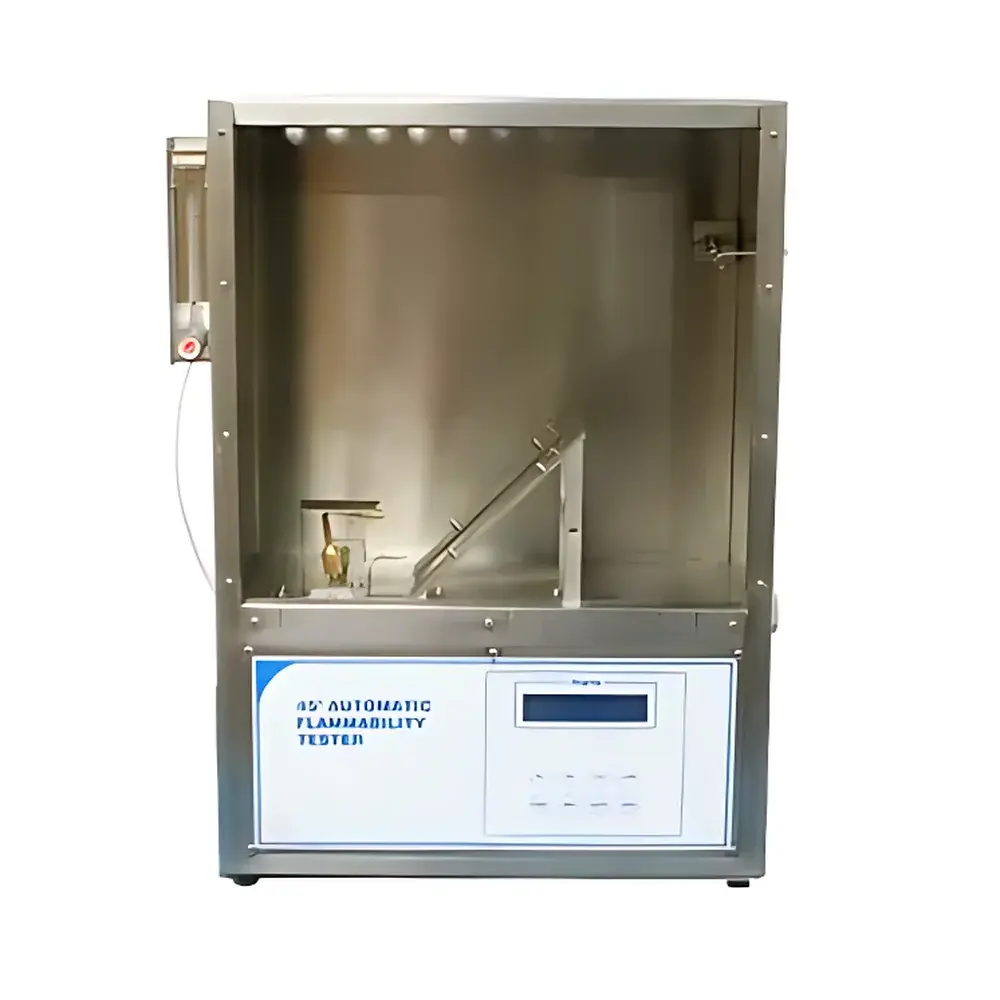
DELTA1111 Flame Retardancy Tester for Artificial Turf Fibers
| Origin | Guangdong, China |
|---|---|
| Manufacturer Type | Authorized Distributor |
| Origin Category | Domestic (China) |
| Model | DELTA1111 |
| Quotation | Available upon Request |
| Test Standards | ISO 6925, CFR 1630/1631, BS 6307, BS 4790, GB/T 20394–2013, GB/T 11049–2008, GB/T 14768–2015 |
| Sample Size | 230 mm × 230 mm (8 specimens per test) |
| Heating Source | Hot Metal Nut Method & Hexamethylenetetramine (Urotropine) Pellet Method |
| Ignition | Automatic Pulse Ignition |
| Timing Range | Flame Application Time: 0–99 s/min |
| Flame Application & Withdrawal Interval | 1.0–999.9 s (digital preset) |
| Afterflame Time | 1.0–999.9 s (digital readout) |
| Repetition Cycles | 1–9999 (digital preset) |
| Test Chamber Dimensions | 300 mm × 300 mm × 300 mm (W×D×H) |
| Ventilation Hood Volume | 2 m³ with Auto-Exhaust & Explosion-Proof Lighting |
| Exhaust Duct Diameter | Ø110 mm |
| Control System | PLC + 7-inch HMI Touchscreen |
| Power Supply | AC 220 V ±10%, 50 Hz |
| Stainless Steel Hot Plate | 230 mm × 230 mm × 6.5 ±0.5 mm, central aperture Ø205 mm |
| Desiccant | Color-Indicating Silica Gel GPE0038 |
| Safety Features | Interlocked Protective Door, Black Interior Finish, Observation Window with Integrated LED Illumination |
Overview
The DELTA1111 Flame Retardancy Tester for Artificial Turf Fibers is a precision-engineered benchtop combustion testing system designed to evaluate the ignitability, flame propagation resistance, and afterflame behavior of synthetic turf fibers and carpet materials under controlled small-flame exposure conditions. It operates on two standardized ignition protocols—hot metal nut (per ISO 6925 and GB/T 20394–2013) and hexamethylenetetramine (urotropine) pellet (per GB/T 14768–2015)—enabling comparative assessment of flame retardancy performance across diverse fiber chemistries, including polyethylene (PE), polypropylene (PP), and nylon-based monofilaments. The instrument implements a defined thermal challenge via calibrated metallic heating elements or chemically activated pellets, followed by quantitative measurement of afterflame duration, char length, and dimensional stability (e.g., heat-induced shrinkage). Its design adheres strictly to the physical geometry, timing resolution, and environmental control requirements specified in ASTM E622 (referenced in CFR 1630/1631), BS 4790, and GB/T 11049–2008, ensuring metrological traceability for regulatory submissions and quality assurance documentation.
Key Features
- PLC-controlled automation with 7-inch high-resolution touchscreen HMI for intuitive parameter configuration, real-time status monitoring, and audit-ready operation logging.
- Interlocked safety door with mechanical and electronic dual-locking mechanism, automatically disabling ignition and heating functions when opened.
- Black-finished internal chamber with integrated explosion-proof LED illumination and tempered glass observation window for unobstructed visual assessment of flame dynamics and specimen degradation.
- Stainless steel hot plate (230 mm × 230 mm × 6.5 ±0.5 mm) with precisely machined Ø205 mm central aperture—optimized for uniform thermal distribution and compliance with GB/T 20394–2013 dimensional tolerances.
- Dual-mode ignition: programmable hot metal nut (temperature-stabilized) and urotropine pellet delivery systems, each independently selectable and time-synchronized via digital preset timers.
- High-resolution digital timing circuitry with 0.1-second resolution for flame application, withdrawal, and afterflame duration—fully compliant with ISO/IEC 17025 timing validation requirements.
- Integrated ventilation hood (2 m³ volume) featuring automatic exhaust modulation, airflow velocity monitoring, and fail-safe shutoff in case of overpressure or temperature excursion.
Sample Compatibility & Compliance
The DELTA1111 accommodates flat, non-woven or tufted specimens measuring exactly 230 mm × 230 mm, supporting up to eight replicate samples per test sequence—satisfying statistical requirements outlined in ISO/IEC 17025 and GLP-compliant laboratories. It is validated for use with synthetic turf infill-free fiber bundles, cut-pile carpets, and modular turf tiles meeting minimum backing thickness specifications (≥1.5 mm). Regulatory alignment includes full conformance with U.S. CPSC standards CFR 1630 (residential carpet) and CFR 1631 (institutional carpet), UK BS 6307 (ignition resistance), BS 4790 (char length measurement), and Chinese national standards GB/T 20394–2013 (artificial turf safety), GB/T 11049–2008 (fire performance classification), and GB/T 14768–2015 (45° angle test method). All test reports generated support FDA 21 CFR Part 11-compliant electronic signatures when paired with optional LIMS integration.
Software & Data Management
The embedded control firmware supports configurable test templates, user-defined pass/fail thresholds, and automatic generation of ISO/IEC 17025-compliant test records—including operator ID, ambient temperature/humidity (via optional external sensor input), specimen lot number, flame duration, char length, and photographic evidence (when connected to USB camera module). Audit trails record all parameter changes, emergency stops, and calibration events with timestamp and user attribution. Export formats include CSV for statistical analysis (Minitab, JMP), PDF for regulatory submission, and XML for enterprise LIMS ingestion. Optional software upgrade enables remote diagnostics, firmware OTA updates, and synchronized calibration certificate management aligned with ISO/IEC 17025 Clause 6.4.10.
Applications
- Quality control screening of virgin and recycled PE/PP turf fibers prior to extrusion and tufting.
- Formulation development of halogen-free flame retardant additives (e.g., aluminum trihydrate, melamine polyphosphate) for synthetic turf backings.
- Third-party certification testing for FIFA Quality Programme for Football Turf and World Rugby Regulation 22 compliance.
- Comparative evaluation of fire performance between monofilament, fibrillated, and slit-film yarn architectures.
- Root cause analysis of field-reported ignition incidents through controlled replication of thermal stress scenarios.
- Supporting CE marking documentation under EU Construction Products Regulation (CPR) Annex ZA for sports surface applications.
FAQ
Does the DELTA1111 comply with FDA 21 CFR Part 11 for electronic records?
Yes—when operated with the optional audit trail module and configured user authentication, it meets electronic signature and record retention requirements for regulated environments.
Can the instrument be used for testing coated or laminated turf substrates?
Yes, provided the total specimen thickness does not exceed 8 mm and the coating remains intact during pre-conditioning at 23 °C ±2 °C and 50% ±5% RH for 48 hours.
Is calibration verification traceable to NIST or CNAS-accredited standards?
All timing circuits are verified using NIST-traceable quartz chronometers; temperature calibration of the hot plate follows ISO 17025 procedures with DAkkS-certified reference thermocouples.
What maintenance intervals are recommended for the exhaust system?
The silica gel desiccant (GPE0038) must be regenerated or replaced every 50 test cycles; the exhaust duct interior requires visual inspection and cleaning every 200 cycles to prevent soot accumulation.
How is flame height measured during testing?
Flame height is determined visually through the observation window using the built-in calibrated scale (0–100 mm, ±1 mm accuracy) mounted on the chamber rear wall, per GB/T 14768–2015 Section 7.3.



