
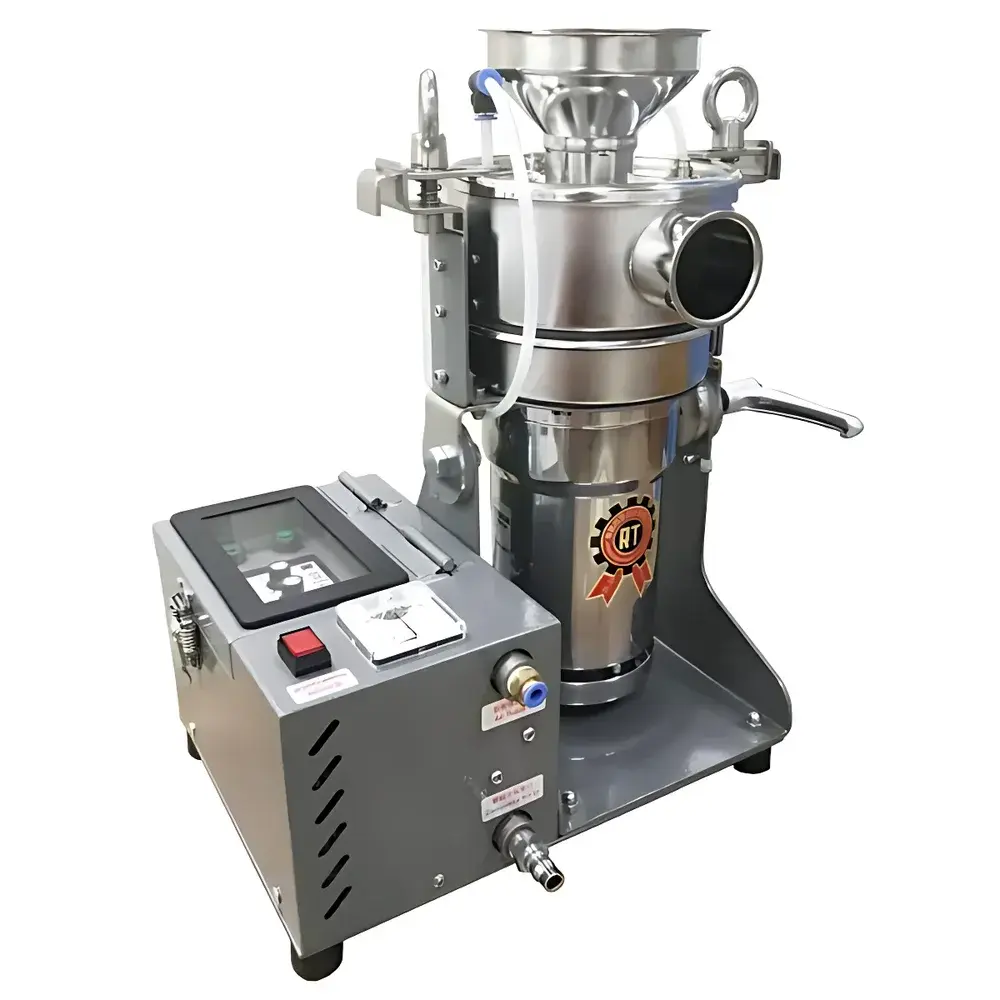
Desktop Pulse-Jet Cyclonic Ultrafine Grinder RT-UF26AP
| Brand | Rong Tsong (Taiwan) |
|---|---|
| Origin | Taiwan |
| Model | RT-UF26AP |
| Motor Power | 2.6 HP (1.9 kW) |
| Voltage | 220 V AC, single-phase (custom voltage available) |
| Particle Size | ≤74 µm (≥200 mesh) |
| Throughput | 1–5 kg/hr (material-dependent) |
| Rotational Speed | 4,000–24,000 rpm |
| Pulse Jet System | Adjustable interval & duration |
| Dimensions | 420 × 330 × 460 mm |
| Weight | 18.3 kg |
| Construction | Food-grade SUS304 stainless steel contact parts |
| Milling Blade | Heat-treated SUS420 stainless steel (HRC 50) |
| Safety | Interlocked powder chamber door switch |
| Compliance | Meets general food-contact material requirements per FDA 21 CFR §178.3570 and ISO 22000 hygiene principles |
Overview
The Rong Tsong RT-UF26AP Desktop Pulse-Jet Cyclonic Ultrafine Grinder is a compact, laboratory-scale comminution system engineered for controlled, continuous dry grinding of heat- and shear-sensitive materials into sub-74 µm particles. It operates on a dual-mechanism principle: high-speed rotor impact (up to 24,000 rpm) combined with cyclonic air classification and pulse-jet assisted discharge. Unlike screen-based mills, the RT-UF26AP employs a screenless design—relying on centrifugal force within an integrated cyclone separator to classify and eject fine particles while retaining coarse fractions for recirculation. The pulse-jet system—activated via programmable solenoid valves—introduces short bursts of compressed air (user-supplied, 0.5–0.7 MPa) directly into the grinding chamber at defined intervals. This prevents agglomeration and wall adhesion of dense, oily, or hygroscopic feedstocks (e.g., dried herbs, roasted seeds, or mineral oxides), thereby sustaining consistent throughput and particle size distribution over extended operation.
Key Features
- Compact desktop footprint (420 × 330 × 460 mm) optimized for teaching labs, QC rooms, and pilot-scale R&D environments.
- Variable-speed motor (4,000–24,000 rpm) with thermal overload protection and low-noise brushless DC architecture for stable torque delivery across speed ranges.
- SUS304 stainless steel grinding chamber, cyclone body, and collection vessel—certified for food, pharmaceutical, and cosmetic applications under ISO 22000-aligned hygiene protocols.
- Hardened SUS420 milling blades (HRC 50) mounted on dynamically balanced rotors to minimize vibration and extend service life under abrasive loading.
- Interlocked safety switch on the micro-powder chamber door—automatically de-energizes the motor when opened during operation.
- Ergonomic tilt-and-lock chassis with reinforced motor mounting frame for secure repositioning and easy access to internal components.
- Tool-free quick-release fasteners for rapid removal and cleaning of the powder collection tray—reducing cross-contamination risk between batches.
- Adjustable pulse-jet timing interface (manual potentiometer) enabling optimization of air burst frequency (1–30 s intervals) and duration (0.1–2.0 s) per cycle.
Sample Compatibility & Compliance
The RT-UF26AP accommodates dry, free-flowing, non-fibrous solids with moisture content <8% w/w and oil content <12% w/w. Verified compatible materials include botanicals (e.g., turmeric rhizomes, ginseng slices, rose petals), cereals (oats, barley, rice bran), minerals (alumina, vermiculite, hydroxyapatite), marine biopolymers (crab shell chitin), and low-viscosity excipients (lactose, microcrystalline cellulose). It is explicitly unsuitable for fibrous biomass (e.g., bamboo, flax), thermoplastic polymers, or wet/slurry feeds. All wetted surfaces comply with FDA 21 CFR §178.3570 for indirect food additives and meet EU Regulation (EC) No. 1935/2004 requirements for food-contact metals. The unit supports GLP-aligned documentation practices through traceable batch logs (when paired with external lab notebooks) and satisfies basic GMP readiness criteria for pre-formulation studies in academic and contract research settings.
Software & Data Management
The RT-UF26AP is a manually operated, analog-control instrument with no embedded firmware or digital connectivity. Operational parameters—including rotational speed, pulse interval, and pulse duration—are set via front-panel dials and retained mechanically. For integration into regulated workflows, users are advised to record settings and output metrics (e.g., input mass, processing time, final particle size via laser diffraction or sieve analysis) in paper-based or LIMS-linked electronic lab notebooks. While the device lacks native 21 CFR Part 11 compliance features (e.g., electronic signatures, audit trails), its mechanical simplicity ensures full transparency and reproducibility—facilitating third-party validation per ASTM E2922–22 (Standard Guide for Powder Processing Equipment Qualification).
Applications
This grinder serves pedagogical and applied research functions across chemical engineering curricula, including unit operations labs (size reduction energy balance calculations), material science modules (particle morphology vs. milling intensity correlation), and formulation development projects (API micronization feasibility screening). In industry, it supports small-batch preparation of functional food powders (e.g., fortified grain blends), herbal extract carriers, catalyst precursors, and ceramic green-body feedstocks. Its pulse-jet functionality enables comparative studies on anti-caking mechanisms and airflow-assisted classification efficiency—making it suitable for senior design projects and capstone thesis work requiring empirical process parameter mapping.
FAQ
Is an air compressor included with the RT-UF26AP?
No. A clean, oil-free compressed air source delivering 0.5–0.7 MPa at ≥10 L/min is required and must be procured separately.
Can the RT-UF26AP grind wet or pasty materials?
No. It is strictly limited to dry, free-flowing solids. Moisture or stickiness will cause chamber clogging and impede pulse-jet effectiveness.
What maintenance intervals are recommended for the milling blade?
Blade replacement is advised after 200–300 operational hours when processing abrasive materials (e.g., minerals); for botanicals, inspection every 500 hours is sufficient.
Does the unit support IQ/OQ protocol execution?
Yes—its mechanical design allows full installation qualification (IQ) and operational qualification (OQ) using vendor-provided test protocols and user-defined acceptance criteria per ISO/IEC 17025.
Is the RT-UF26AP compliant with CE or UL safety standards?
It carries Taiwan CNS 14115 certification for electrical safety and EMC; CE/UL listing requires end-user responsibility for regional conformity assessment and local authority approval.




