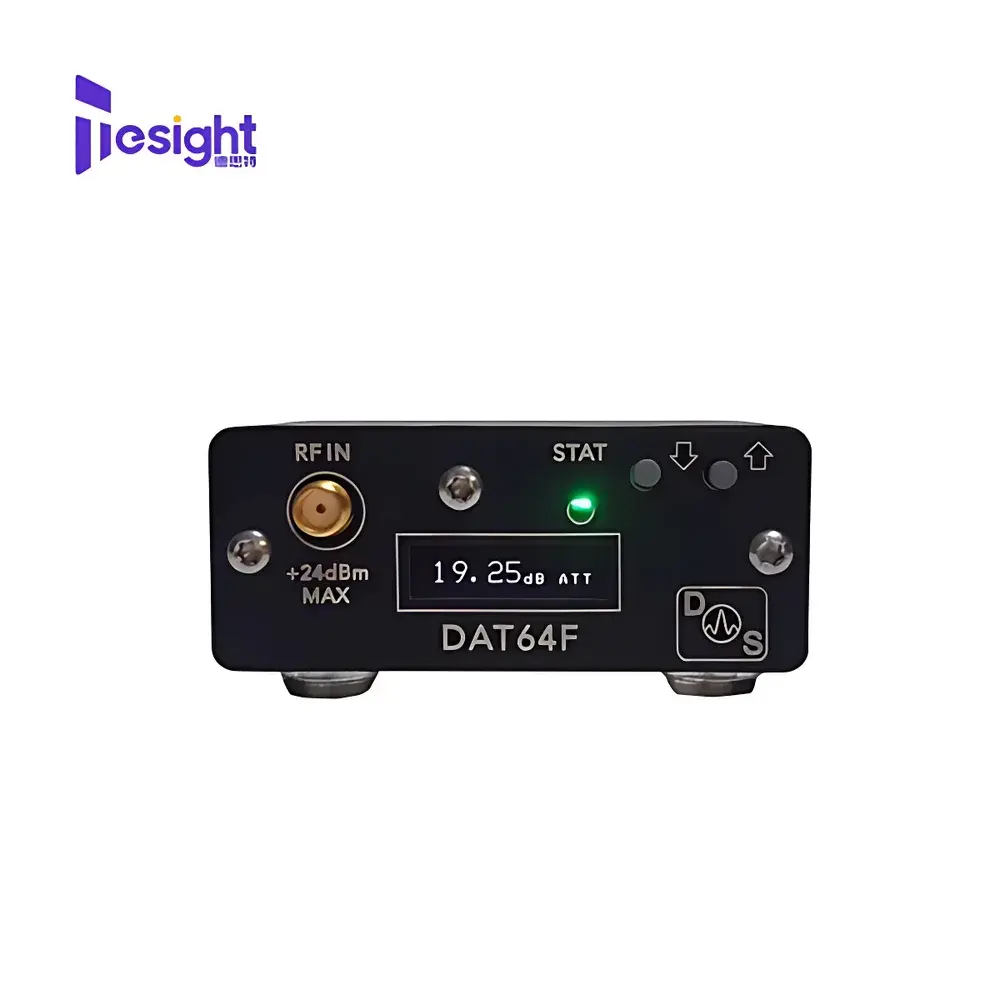
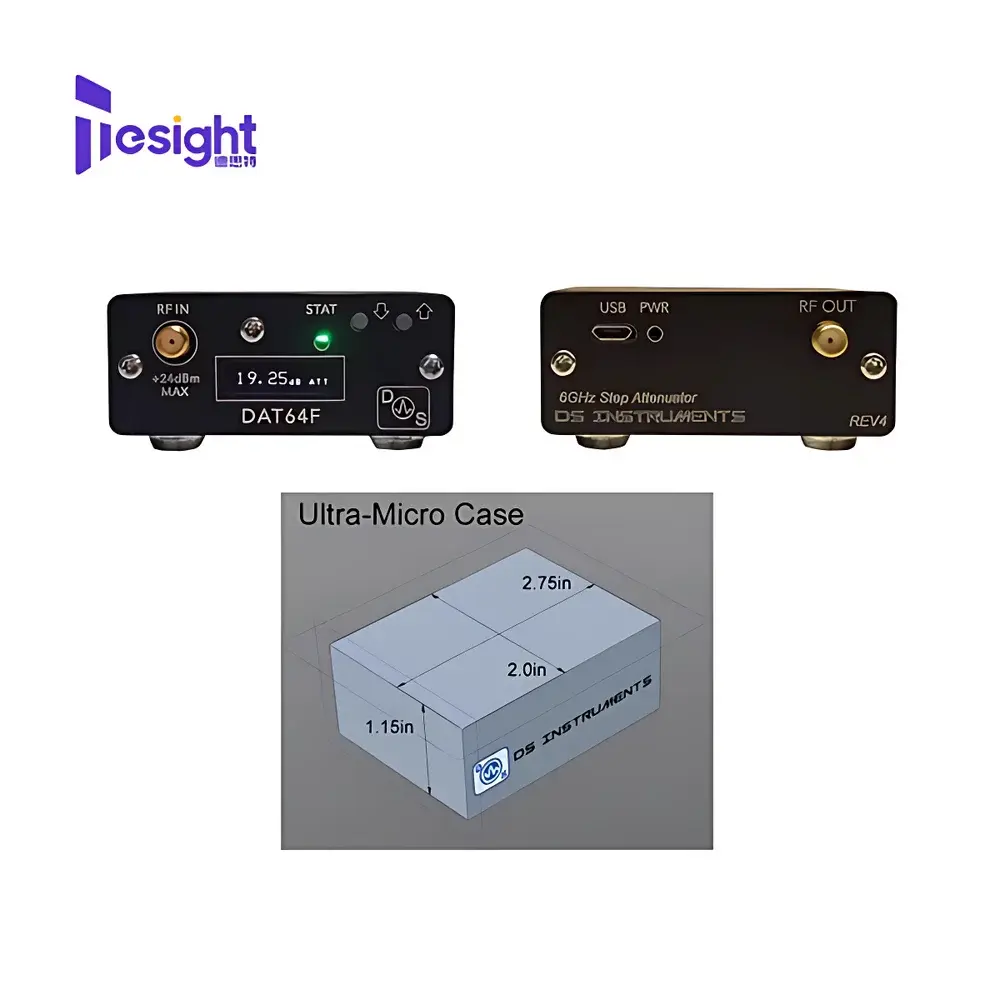
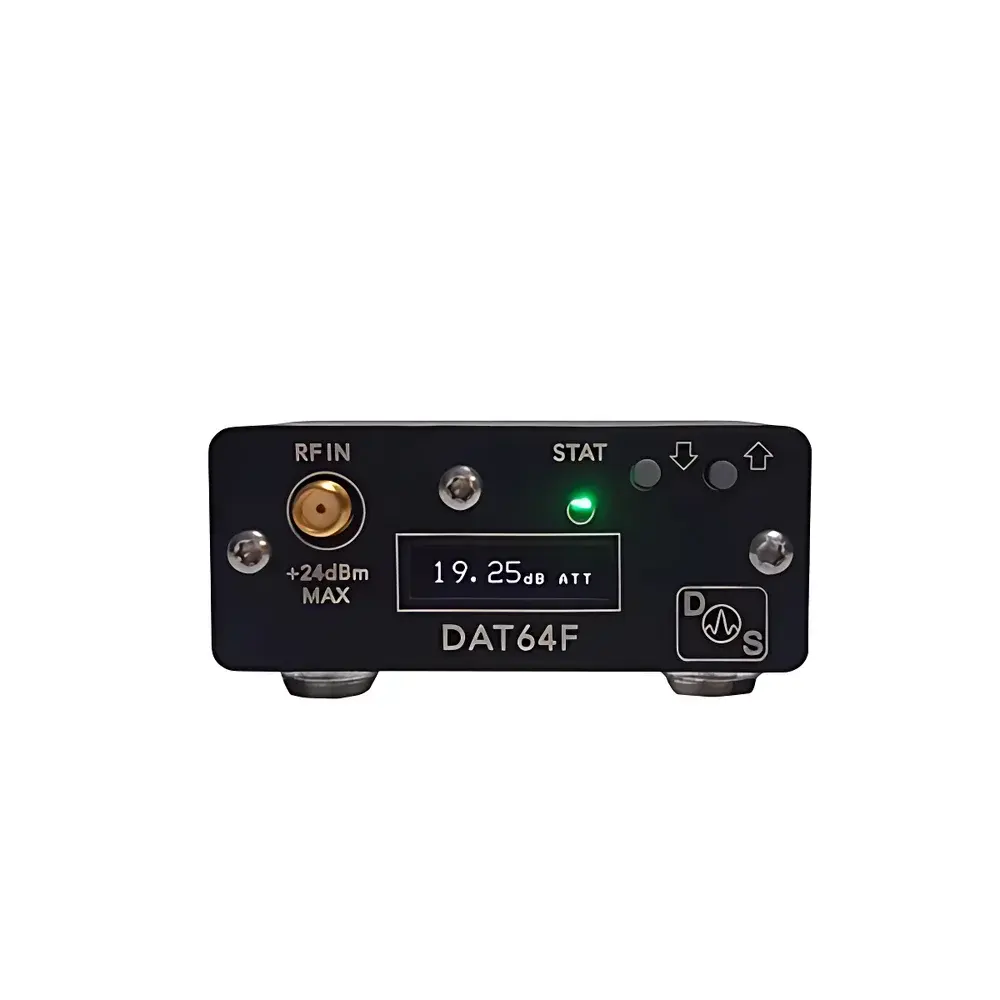
DesTest TS-DAT64F 6 GHz Digital Step Attenuator
| Brand | DesTest Instruments |
|---|---|
| Origin | USA |
| Model | TS-DAT64F |
| Frequency Range | 100 MHz – 6 GHz |
| Attenuation Range | 0–63 dB |
| Step Size | 0.25 dB |
| Max Input Power | +25.0 dBm |
| Insertion Loss (at 6 GHz) | < 7 dB |
| Return Loss | > 12 dB |
| Interface | USB (SCPI-compliant), Optional Ethernet |
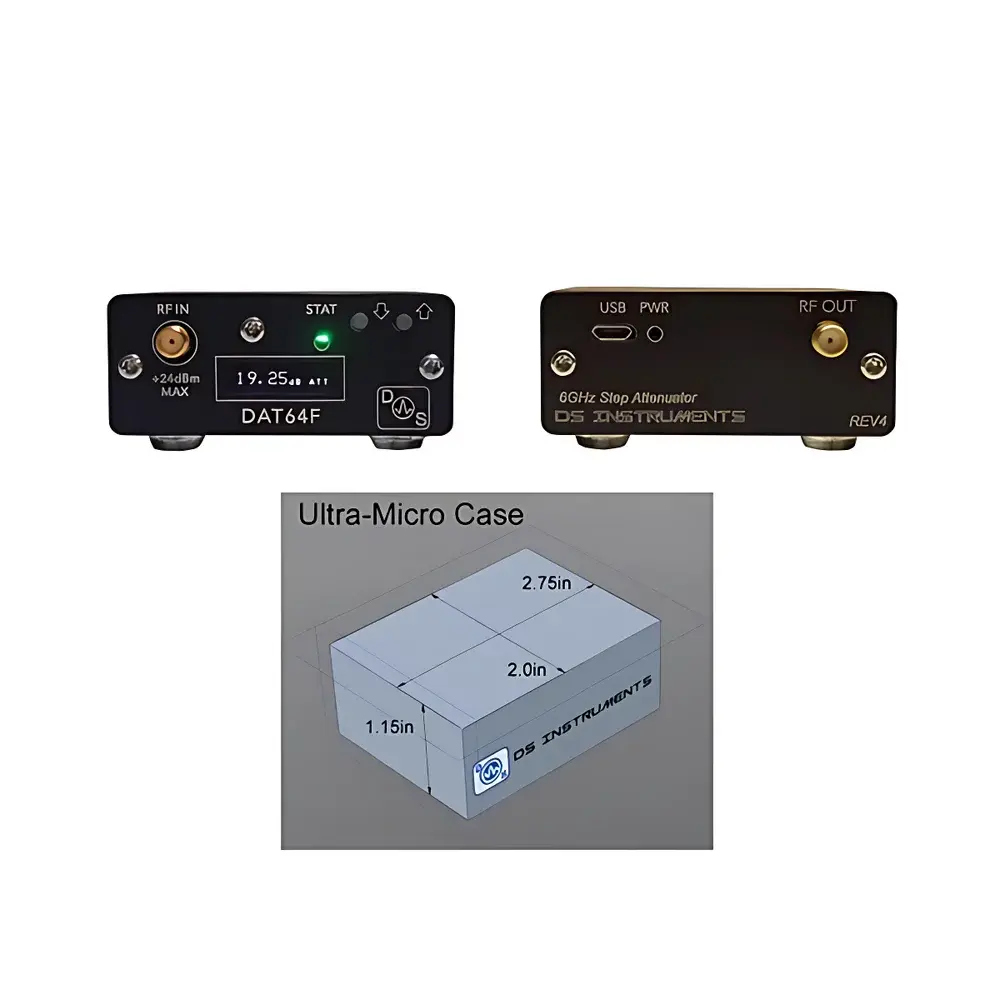
| Dimensions | 2.75" × 1.25" × 2.15" |
| RF Connectors | Gold-plated SMA |
| Power Supply | Micro-USB (5 V DC) |
Overview
The DesTest TS-DAT64F is a high-precision, USB-controlled digital step attenuator engineered for demanding RF and microwave test environments. Operating on the principle of solid-state switched attenuation networks, it delivers repeatable, low-drift attenuation across a broad frequency spectrum—from 100 MHz to 6 GHz—with fine 0.25 dB resolution steps and a total range of 0–63 dB. Its architecture employs precision thin-film resistive elements and low-loss RF switching paths to ensure minimal signal distortion, amplitude flatness, and phase stability over temperature and time. Designed for integration into automated test systems (ATE), R&D labs, and production validation workflows, the TS-DAT64F meets the stringent requirements of modern RF characterization—where traceability, repeatability, and deterministic control are essential. Unlike analog or voltage-variable attenuators, this digitally addressed device guarantees discrete, non-varying attenuation states with no hysteresis or settling delay, making it ideal for calibration-critical applications such as receiver sensitivity testing, gain compression analysis, and signal level staging in multi-stage RF chains.
Key Features
- Precision 0.25 dB step resolution across full 0–63 dB range, enabling granular signal level control for sensitive measurements
- Ultra-low insertion loss (< 7 dB at 6 GHz) and high return loss (> 12 dB), preserving signal integrity and minimizing measurement uncertainty
- Gold-plated SMA connectors ensure robust RF performance, corrosion resistance, and long-term mating repeatability (≥500 cycles)
- Self-contained, benchtop-ready design powered via standard micro-USB (5 V DC); no external power supply required
- Front-panel LCD display and tactile push-button interface support standalone operation without host software
- Fully SCPI-compliant USB virtual COM port enables seamless integration with LabVIEW, Python (PyVISA), MATLAB, and other ATE frameworks
- Optional Ethernet interface (RJ-45) supports remote configuration and monitoring in rack-mounted or distributed test systems
- Compact mechanical footprint (2.75″ × 1.25″ × 2.15″) facilitates dense instrument stacking and portable lab deployment
Sample Compatibility & Compliance
The TS-DAT64F is compatible with all standard 50 Ω RF signal sources, analyzers, and DUTs operating within its specified bandwidth. It maintains impedance match and VSWR stability across its entire attenuation range, eliminating the need for external matching networks in most configurations. The device complies with FCC Part 15 Subpart B (Class A) for unintentional radiators and meets CE marking requirements for EMC (EN 61326-1) and safety (EN 61010-1). While not certified to MIL-STD-810 or DO-160, its rugged aluminum housing and thermal design support operation in controlled laboratory and light industrial environments (0–45 °C, non-condensing). For regulated industries—including aerospace, defense, and medical RF subsystem validation—the unit supports audit-ready usage when integrated into GLP/GMP-aligned test procedures, particularly where SCPI command logging and firmware version tracking are maintained.
Software & Data Management
Control is implemented via industry-standard SCPI commands over USB CDC ACM (Virtual COM Port), with no proprietary drivers required on Windows, Linux, or macOS. DesTest provides a free, open-source Python reference library (desattlib) on GitHub, including example scripts for sweep sequencing, attenuation calibration verification, and error-log generation. All command executions—including set attenuation, query status, and read firmware revision—are timestamped and can be captured in CSV or JSON format for traceability. Optional Ethernet-enabled units support TCP/IP socket communication and include HTTP-based status pages for real-time health monitoring. Firmware updates are performed via signed binary upload over USB, with CRC-32 validation and rollback capability. No data storage resides on the device; all configuration state is volatile and resets to default (0 dB) on power cycle unless explicitly saved to non-volatile memory via dedicated SCPI command.
Applications
- Automated receiver sensitivity and dynamic range testing in 4G/5G NR base station and UE validation
- Calibration of RF power meters and spectrum analyzers using known attenuation references
- Signal level conditioning in vector network analyzer (VNA) receiver protection circuits
- Education and research labs requiring reproducible, digitally addressable attenuation for microwave theory instruction
- Production line go/no-go testing of LNA, PA, and mixer modules under varying input power conditions
- EMI/EMC pre-compliance testing where precise stimulus attenuation is required to emulate path loss scenarios
- Space-constrained embedded test fixtures where low-profile, self-powered attenuation is critical
FAQ
Does the TS-DAT64F support IEEE-488 (GPIB) interface?
No. The device natively supports USB CDC ACM and optional Ethernet only. GPIB functionality is not available and cannot be added via adapter due to protocol-level incompatibility with SCPI command timing constraints.
What is the maximum continuous RF input power rating?
+25.0 dBm (316 mW) average power across the full 100 MHz–6 GHz band. Exceeding this may cause permanent degradation of internal attenuator elements or connector interfaces.
Is attenuation accuracy specified over temperature and time?
Yes. Accuracy is specified as ±(0.10 dB + 4% of attenuation setting) over 0–45 °C and 24-hour stability, per DesTest Calibration Certificate Rev. 3.2.
Can multiple TS-DAT64F units be synchronized for parallel attenuation control?
Not natively. Each unit operates independently with its own USB/Ethernet endpoint. Synchronization must be implemented at the host application layer using timestamp-aligned command issuance.
Does the device require recalibration after firmware updates?
No. Firmware updates do not alter hardware calibration coefficients. Recalibration is recommended annually or after mechanical shock exceeding 25 g, per ISO/IEC 17025 guidance.