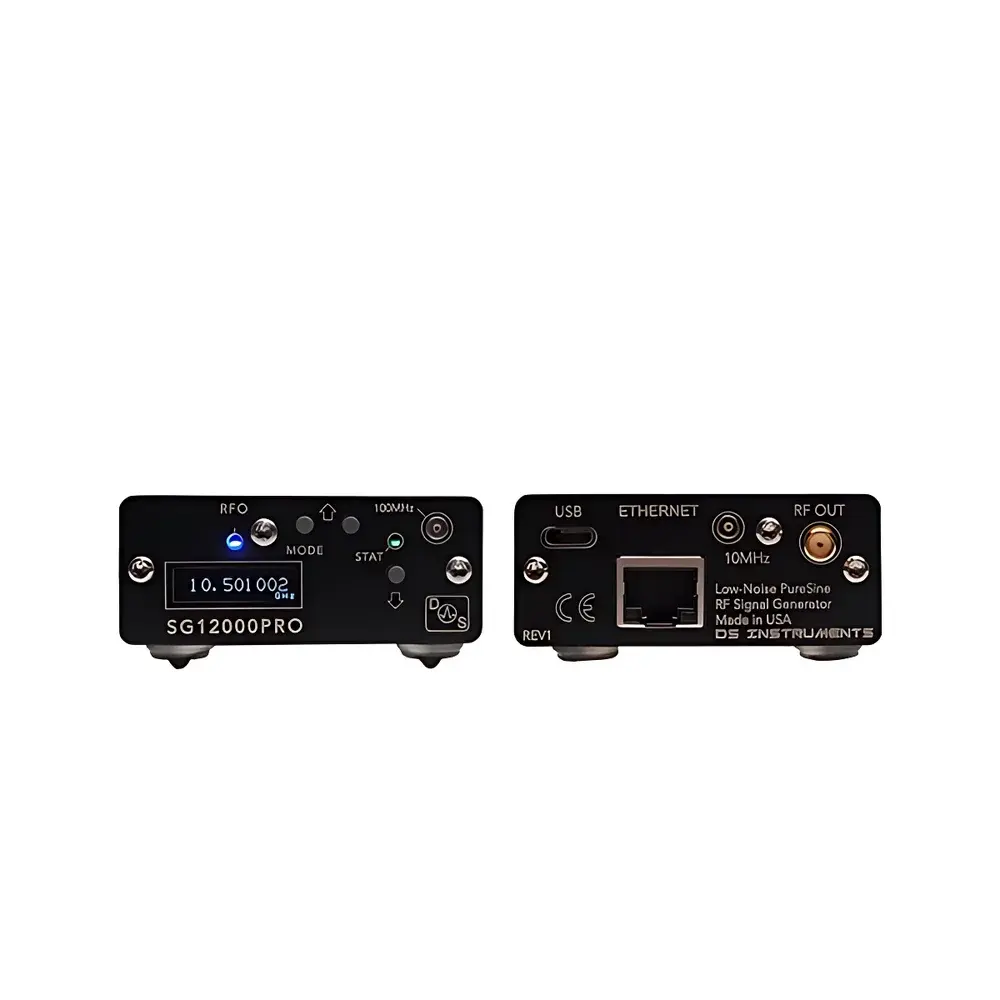
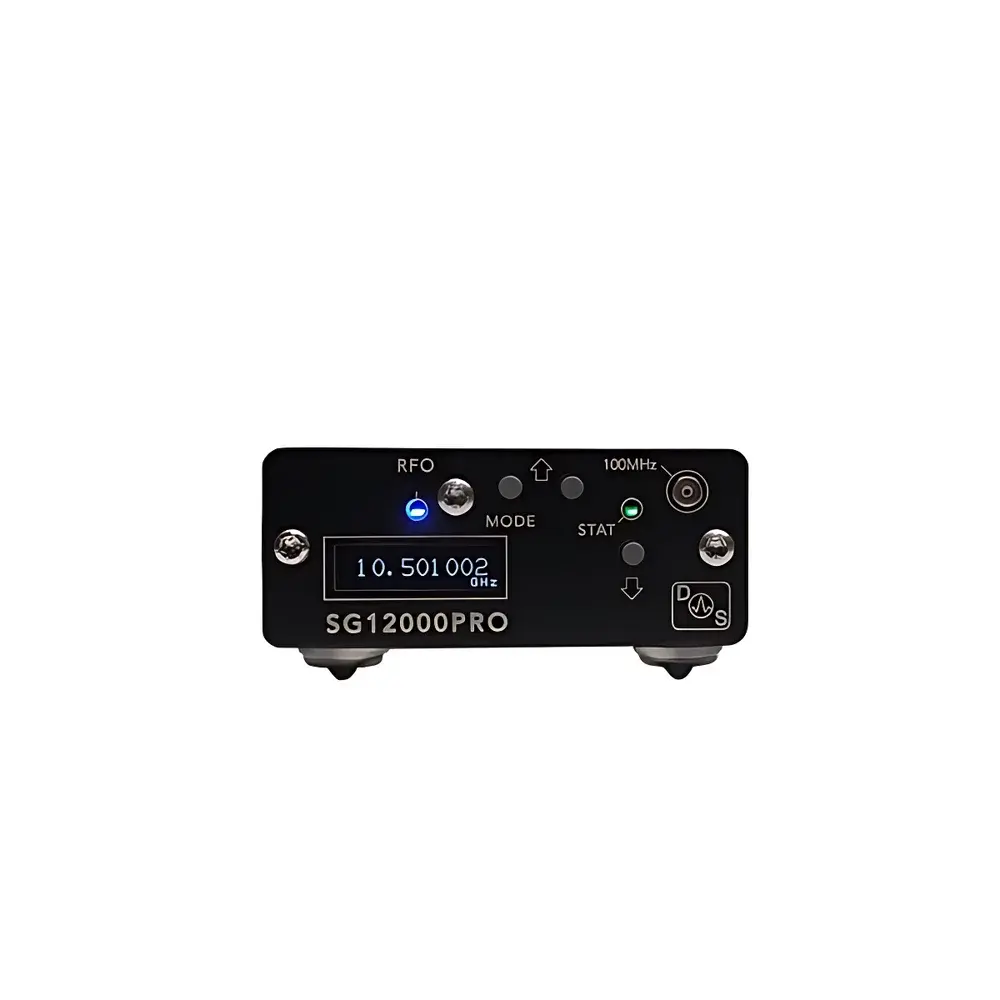
DesTest TS-SG12000PRO 13 GHz Synthesized RF Signal Generator
| Brand | DS Instruments |
|---|---|
| Origin | USA |
| Model | TS-SG12000PRO |
| Frequency Range | 50–13,000 MHz (10–15,000 MHz uncalibrated) |
| Output Power Range | –30 to +15 dBm (calibrated), –21.5 to +10 dBm (calibrated at 12 GHz) |
| Phase Noise | –94 dBc/Hz @ 10 kHz offset (at 12 GHz) |
| Harmonic Level | < –30 dBc (1–13 GHz, typical) |
| Frequency Resolution | 10 Hz |
| Internal Attenuator | 64 dB (0.25 dB steps, 6–15 GHz), 32 dB (0.5 dB steps, 0–6 GHz), ~15 dB variable (10-bit DAC, 0–15 GHz) |
| Reference Input | 10 MHz & 100 MHz, internal ultra-low-noise 100 MHz OCXO |
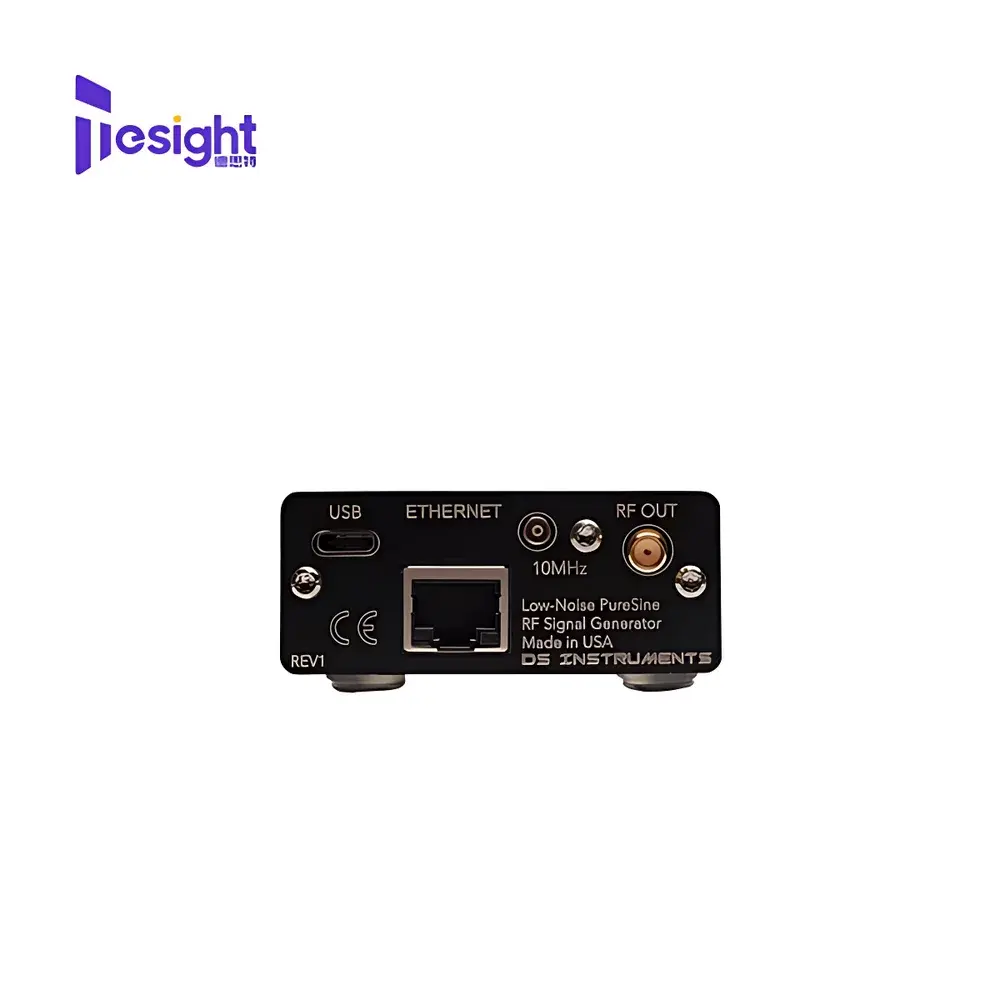
| Connectivity | USB-C (5 V, 1.3 A), Ethernet (RJ-45), SCPI-compliant |
| Dimensions | 6.985 × 3.175 × 10.541 cm |
| RF Connector | Gold-plated 18 GHz SMA |
| Impedance | 50 Ω |
Overview
The DesTest TS-SG12000PRO is a fully synthesized, fractional-N RF signal generator engineered for precision, stability, and compact integration in demanding laboratory, production, and field-deployable test environments. Operating on the principle of direct digital synthesis (DDS) combined with advanced fractional-N phase-locked loop (PLL) architecture, it delivers spectrally pure output across a calibrated frequency range of 50 MHz to 13 GHz—with extended uncalibrated operation from 10 MHz to 15 GHz. Unlike conventional compact synthesizers relying on integer-N PLLs or harmonic multiplication, the TS-SG12000PRO employs an integrated harmonic suppression filter (< –30 dBc typical, 1–13 GHz) and optimized loop filter design to minimize spurious content and ensure low-phase-noise performance critical for modern wireless standards including 5G NR FR1, Wi-Fi 6E/7, UWB, and radar waveform validation.
Key Features
- Ultra-low phase noise: –94 dBc/Hz @ 10 kHz offset at 12 GHz—achieved via high-stability internal 100 MHz oven-controlled crystal oscillator (OCXO) and optimized PLL bandwidth control
- High-resolution frequency tuning: 10 Hz minimum step size, enabling precise channel spacing alignment for LTE, NR, and IEEE 802.11ax/ay applications
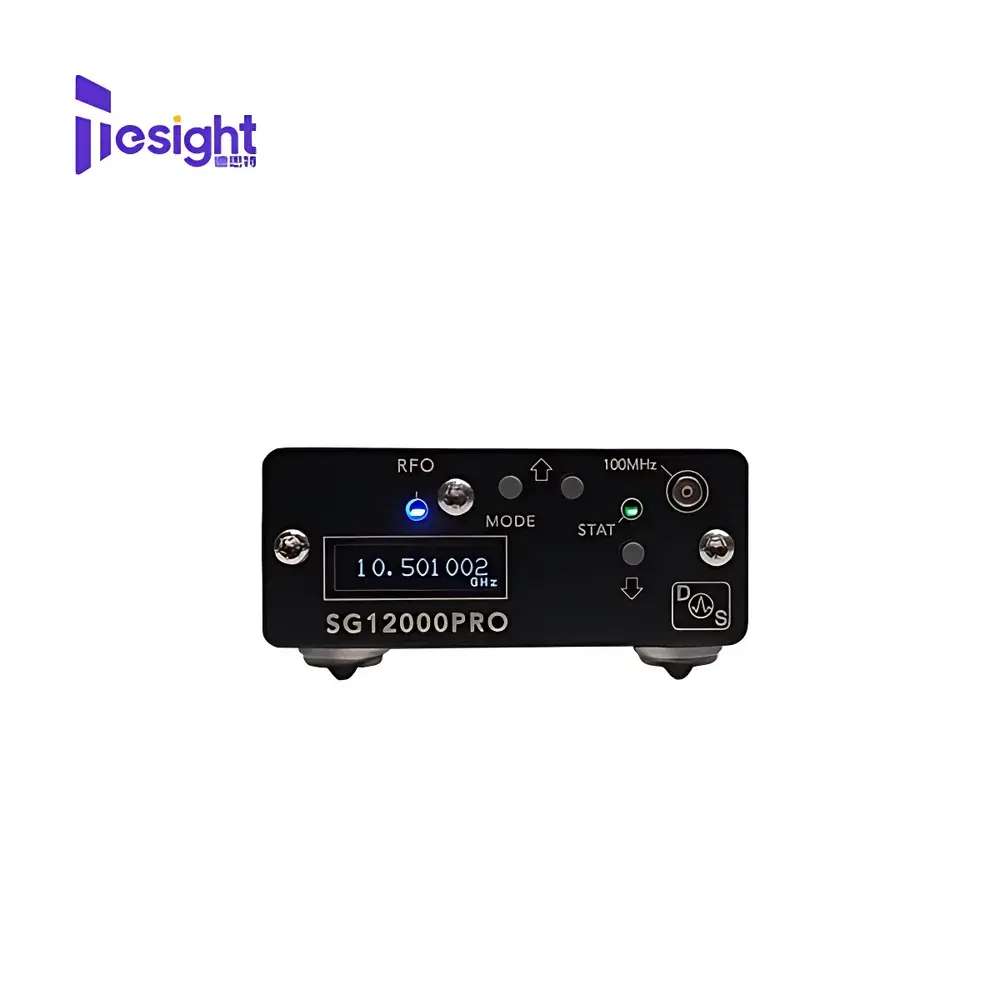
- Dual-mode output control: Independent front-panel operation with tactile push-button interface and real-time OLED feedback, plus remote control via USB-C or standard Ethernet (10/100BASE-T)
- Flexible attenuation architecture: Digitally controlled 64 dB attenuator (0.25 dB steps, 6–15 GHz), 32 dB (0.5 dB steps, 0–6 GHz), and analog-variable ~15 dB range (10-bit DAC) for fine-grained power leveling
- SCPI 1999-compliant command set supporting seamless integration into automated test systems using Python, MATLAB, LabVIEW, .NET, or custom C/C++ frameworks
- Compact form factor (6.985 × 3.175 × 10.541 cm) with gold-plated 18 GHz SMA RF output connector and 50 Ω impedance matching for minimal VSWR across full band
Sample Compatibility & Compliance
The TS-SG12000PRO is designed for use with standard 50 Ω RF components and instrumentation—including spectrum analyzers (e.g., Keysight PXA, R&S FSW), vector network analyzers (VNA), and RF power sensors. Its harmonics-suppressed output meets spectral purity requirements defined in IEEE Std 1114™ (Standard for Calibration of RF Signal Generators) and supports verification per IEC 61000-4-3 (EMC radiated immunity testing) when used as a stimulus source. While not certified to MIL-STD-461 or DO-160, its stable reference architecture and low EMI emissions make it suitable for GLP-aligned R&D labs and ISO/IEC 17025-accredited calibration workflows where traceable RF stimulus is required. The device complies with FCC Part 15 Subpart B (Class B) and CE RED Directive 2014/53/EU for unintentional radiator emissions.
Software & Data Management
Firmware is upgradable via USB or Ethernet using DesTest’s cross-platform Command Console—a lightweight Windows GUI supporting parameter scripting, sweep sequencing, and real-time power monitoring. All communication layers adhere to IEEE 488.2 and SCPI 1999 standards, ensuring interoperability with commercial test executive platforms such as NI TestStand and Keysight PathWave. For audit-ready environments, the instrument supports time-stamped logging of all remote commands and configuration changes; while native 21 CFR Part 11 compliance is not embedded, external software wrappers (e.g., Python-based audit trail recorders) can be deployed to satisfy GxP data integrity requirements. Ethernet connectivity enables integration into enterprise-wide test asset management systems via SNMP v2c/v3 or RESTful API extensions.
Applications
- Local oscillator (LO) substitution in receiver sensitivity and adjacent channel selectivity testing
- Modulated signal generation (AM/FM/ΦM) for demodulator characterization in SDR and mmWave transceiver development
- Automated production line testing of Wi-Fi 6E access points, Bluetooth LE Audio modules, and UWB ranging devices
- EMI pre-compliance screening using swept-frequency continuous-wave (CW) stimuli per CISPR 16-1-1
- Antenna pattern measurement and near-field probe calibration requiring phase-coherent multi-tone excitation
- Academic RF curriculum delivery—including PLL theory demonstration, phase noise measurement techniques, and spectrum masking analysis
FAQ
What is the calibrated frequency and power accuracy specification?
Calibrated operation spans 50 MHz to 13 GHz at output levels from –21.5 dBm to +10 dBm (±0.8 dB typical uncertainty, traceable to NIST standards). Uncalibrated mode extends to 15 GHz but does not guarantee amplitude or frequency accuracy.
Does the TS-SG12000PRO support external 10 MHz reference locking?
Yes—both 10 MHz and 100 MHz reference inputs are provided on the rear panel with automatic switching and holdover capability during reference loss.
Can this unit generate modulated waveforms (e.g., QPSK, OFDM)?
The base model provides CW and basic analog modulation (AM/FM/ΦM); digital modulation requires optional firmware upgrade and external IQ baseband injection via the auxiliary input port.
Is the Ethernet interface compatible with IPv6 and DHCP?
Yes—the embedded TCP/IP stack supports IPv4/IPv6 dual-stack operation, DHCP client mode, static IP assignment, and mDNS service discovery for zero-configuration network deployment.
How is firmware updated, and is rollback supported?
Updates are performed via signed binary upload through USB or Ethernet using DesTest’s secure bootloader; full version history and one-generation rollback are retained in non-volatile memory.