
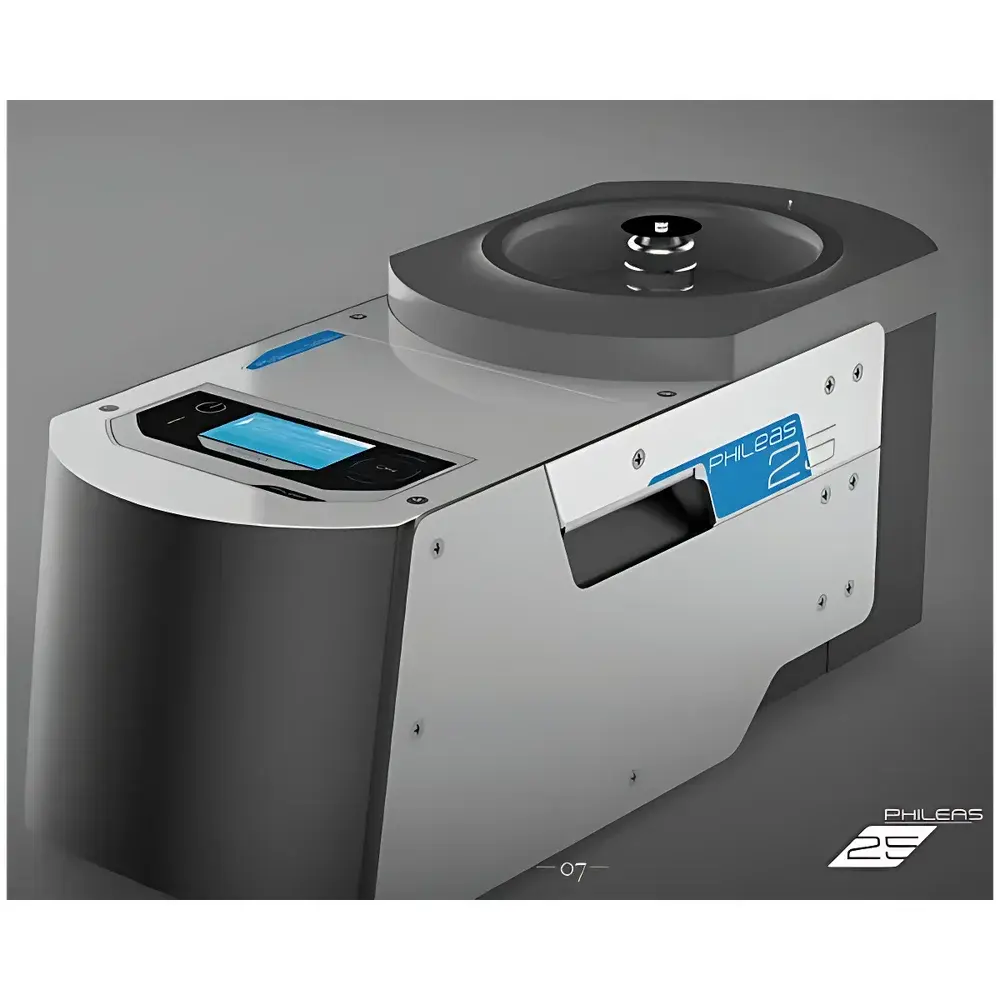
Devea Phileas®25 Hydrogen Peroxide Vapor (HPV) Sterilization System
| Brand | Devea |
|---|---|
| Origin | France |
| Model | Phileas®25 |
| Sterilization Volume | 1–40 m³ |
| Hydrogen Peroxide Dose | 500 mL |
| Air Flow Rate | 700 mL/h |
| Droplet Size | 5–10 µm |
| Cycle Duration (for 20 m³) | 20 min @ 12 mL/m³ |
| Power Consumption | 30 W |
| Dimensions (L×W×H) | 475 × 193 × 222 mm |
| Weight | 5 kg |
| Compliance | EN 17272, MA FR-2019-0071 |
| Power Input | 100–240 VAC, 50/60 Hz, 1.8 A |
| Material Compatibility | O₂SAFE 7.4 & Phileasafe® compatible |
Overview
The Devea Phileas®25 is a compact, mobile hydrogen peroxide vapor (HPV) sterilization system engineered for terminal disinfection of enclosed environments ranging from 1 to 40 m³—ideal for laboratories, cleanrooms, biosafety cabinets, isolators, and small-scale pharmaceutical or diagnostic workspaces. It operates on the principle of low-temperature vapor-phase hydrogen peroxide delivery, generating a homogeneous, non-condensing aerosol with a controlled droplet size distribution (5–10 µm) to ensure deep penetration into complex geometries while minimizing surface residue. Unlike liquid spray or fogging systems, the Phileas®25 utilizes a precisely metered, thermally stabilized evaporation process that maintains consistent vapor concentration throughout the cycle, enabling reproducible biocidal efficacy validated under EN 17272 for sporicidal activity against Bacillus atrophaeus and Geobacillus stearothermophilus. Its 500 mL integrated reservoir delivers up to 12 mL/m³ H₂O₂ dose across defined volumes, supporting rapid 20-minute cycles for 20 m³ spaces—a critical advantage in high-throughput QC or containment settings where downtime must be minimized.
Key Features
- Mobile, ergonomic design with integrated handle and compact footprint (475 × 193 × 222 mm) for seamless repositioning between rooms or equipment enclosures
- Dual-power capability: Operates from standard AC mains (100–240 VAC, 50/60 Hz) or optional rechargeable battery pack—enabling uninterrupted use during power fluctuations or in off-grid facilities
- Automated safety interlocks including real-time “liquid inlet fault” detection to prevent dry-run operation when the 500 mL H₂O₂ reservoir is depleted
- Low-energy architecture (30 W nominal consumption) optimized for extended duty cycles without thermal load accumulation
- Material compatibility certified for use with O₂SAFE 7.4 and Phileasafe® formulations—ensuring compatibility with sensitive electronics, polymers, and stainless-steel surfaces common in GMP environments
- No external compressor or humidification unit required: Integrated air flow control delivers stable 700 mL/h carrier gas stream for consistent vapor dispersion
Sample Compatibility & Compliance
The Phileas®25 is validated for use in regulated life science and healthcare settings where documented sterility assurance is mandatory. Its HPV delivery protocol conforms to EN 17272:2020 for chemical disinfectants and antiseptics — specifically addressing efficacy testing of vaporized hydrogen peroxide systems against bacterial spores under defined environmental conditions. The system’s performance has received formal validation under French regulatory authorization MA FR-2019-0071, confirming compliance with national requirements for medical device reprocessing and environmental decontamination. While not a sterilizer per ISO 14937 (which applies to product-level sterilization), it meets the functional definition of a “terminal disinfection system” aligned with EU Annex 1 (2022) recommendations for cleanroom environmental control. All operational parameters—including dose delivery accuracy, vapor homogeneity, and cycle repeatability—are traceable and support GLP/GMP documentation workflows.
Software & Data Management
The Phileas®25 operates via an embedded microcontroller with pre-programmed cycle logic; no external PC or proprietary software is required for routine operation. However, all cycles log timestamped metadata—including start time, volume setting, H₂O₂ volume dispensed, air flow rate, and fault alerts—to internal non-volatile memory. These logs can be exported via USB interface for integration into facility-wide environmental monitoring systems (EMS) or electronic batch records. For users requiring audit-trail compliance under FDA 21 CFR Part 11, optional firmware upgrades support user authentication, electronic signatures, and immutable cycle reports—facilitating alignment with quality management systems in pharmaceutical manufacturing and clinical diagnostics labs.
Applications
- Terminal disinfection of Class A/B/C/D cleanrooms between production batches
- Routine decontamination of biosafety cabinets (BSCs), laminar flow hoods, and gloveboxes prior to maintenance or filter replacement
- Emergency response decontamination following biological spill incidents involving risk group 2 or 3 agents
- Pre-use conditioning of isolators and restricted access barrier systems (RABS) in aseptic processing suites
- Validation support for room qualification studies (IQ/OQ/PQ) where spatial H₂O₂ concentration mapping is required
- Field-deployable disinfection in mobile labs, field hospitals, or temporary containment units
FAQ
What is the maximum recommended volume for a single Phileas®25 cycle?
The system is validated for volumes from 1 m³ up to 40 m³; however, optimal sporicidal efficacy is achieved within the 10–25 m³ range using standard 12 mL/m³ dosing. For volumes exceeding 30 m³, extended diffusion time or supplemental air mixing may be advised.
Is the Phileas®25 suitable for use in ISO Class 5 environments?
Yes—when operated according to EN 17272 protocols and verified via biological indicators (e.g., G. stearothermophilus strips), it achieves ≥6-log reduction in viable spores, satisfying ISO 14644-1 cleanliness requirements for post-cycle recovery.
Does the system require annual calibration or third-party certification?
No scheduled calibration is mandated; however, users must perform periodic verification using chemical indicators and biological challenge tests as part of their internal quality program per ISO 13688 and EU GMP Annex 1.
Can the Phileas®25 be integrated with building management systems (BMS)?
Via optional digital I/O module, the unit supports dry-contact signals for cycle start/stop and fault status—enabling synchronization with HVAC interlocks and room access controls.
What safety precautions are required during operation?
Operators must wear nitrile gloves and safety goggles; ambient H₂O₂ levels must remain below 1 ppm during exposure (per OSHA PEL and EU Directive 2004/37/EC), verified by real-time monitor integration or post-cycle aeration verification.



