
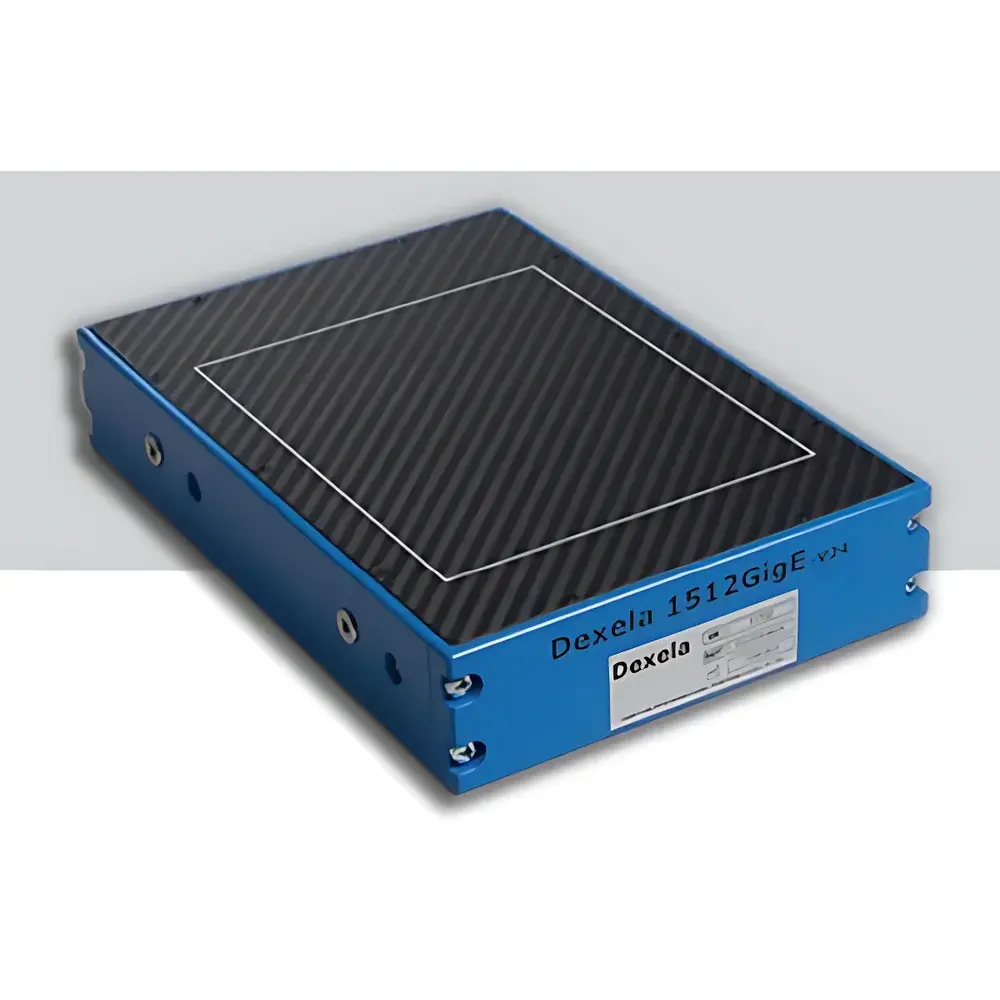
Dexela CMOS X-ray Camera
| Brand | Dexela |
|---|---|
| Origin | USA |
| Manufacturer Type | Authorized Distributor |
| Product Origin | Imported |
| Model | CMOS X-ray Camera |
| Pricing | Upon Request |
| Effective Area | 114.9 × 64.6 mm |
| Resolution | 1536 × 864 pixels |
| Pixel Size | 74.8 µm (1×1), 149.6 µm (2×2), 299.2 µm (4×4) |
| Frame Rate | Up to 65 fps at full resolution (Camera Link) |
| MTF @ 6 lp/mm | >20% (with 150 µm high-resolution CsI scintillator, no binning) |
| DQE | ~0.7 at 0.5 lp/mm (28 kV, W/Al filtration) |
| Binning Modes | 1×1, 1×2, 2×2, 1×4, 2×4, 4×4 |
| Dynamic Range | 6400:1 (low-noise mode), 2400:1 (high-dynamic-range mode) |
| ADC Resolution | 14-bit |
| Interface | Camera Link or Gigabit Ethernet |
| Max. X-ray Energy | Standard ≤220 kV |
| Scintillator Options | Gd₂O₂S (Gadox) or columnar CsI, thickness customizable per application |
| Dimensions | 241 × 150 × 42 mm |
| Weight | 1.9 kg |
Overview
The Dexela CMOS X-ray Camera is a high-performance, direct-conversion digital X-ray imaging detector engineered for precision radiography and fluoroscopy applications across medical, industrial non-destructive testing (NDT), and synchrotron-based scientific research. Built on a monolithic silicon CMOS sensor architecture, it delivers superior spatial resolution, low electronic noise, and high quantum detection efficiency (DQE) without the lag or afterglow associated with traditional amorphous silicon (a-Si) flat-panel detectors. Unlike indirect conversion systems relying on photodiode arrays, this camera integrates photon-to-electron conversion and readout within a single semiconductor substrate—enabling true pixel-level charge integration and minimal signal crosstalk. Its design supports both direct detection of soft X-rays (e.g., in vacuum-compatible beamline environments) and indirect detection via coupling to structured scintillators such as thallium-doped cesium iodide (CsI:Tl) or gadolinium oxysulfide (Gd₂O₂S), optimized for energy ranges from diagnostic 28 kV up to high-energy industrial 400 kV exposures.
Key Features
- Monolithic CMOS sensor architecture with on-chip correlated double sampling (CDS) for ultra-low read noise (<5 e⁻ RMS) and high linearity across full dynamic range.
- Configurable pixel binning (1×1 to 4×4) enabling real-time trade-offs between spatial resolution, frame rate, and signal-to-noise ratio—critical for time-resolved tomography or high-throughput inspection.
- High modulation transfer function (>20% at 6 lp/mm with HR CsI, un-binned) ensuring faithful reproduction of fine structural detail in dense or low-contrast samples.
- Dual operating modes: Low-noise mode (6400:1 dynamic range) for high-fidelity static imaging; High-dynamic-range mode (2400:1) for rapid sequence acquisition under varying exposure conditions.
- Flexible scintillator integration: Compatible with Gadox (for general-purpose radiography) and needle-structured CsI (for enhanced light guiding and reduced lateral spread), with thickness selection tailored to X-ray energy and application-specific resolution requirements.
- Industrial-grade interface options: Camera Link (base configuration, up to 65 fps at full resolution) and Gigabit Ethernet (for simplified cabling and longer cable runs in distributed lab or factory-floor deployments).
Sample Compatibility & Compliance
The Dexela CMOS X-ray Camera supports diverse sample geometries and densities—from human anatomical phantoms and small-animal specimens in preclinical imaging to castings, composites, and additive-manufactured components in NDT. Its radiation-hardened sensor design meets IEC 62220-1-2 for medical X-ray imaging performance and conforms to ASTM E2737 (Standard Practice for Digital Detector Array Evaluation) for industrial radiographic system validation. When deployed in regulated environments (e.g., ISO 13485-certified medical device manufacturing or FDA-regulated QA labs), the system supports audit-ready metadata logging—including exposure parameters, timestamped acquisition logs, and firmware version tracking—aligning with GLP/GMP documentation requirements and facilitating 21 CFR Part 11-compliant software integration where applicable.
Software & Data Management
The camera operates with Dexela’s native SDK (C/C++, Python, MATLAB APIs) and third-party compatibility through GenICam-compliant drivers. Raw 14-bit image data is streamed in real time with lossless compression options, supporting DICOM export for PACS integration and HDF5/NEXUS formats for synchrotron or neutron imaging workflows. Acquisition software includes configurable region-of-interest (ROI) readout, automatic gain/offset calibration, defect map correction, and real-time flat-field normalization—ensuring quantitative repeatability across multi-day experiments or multi-site installations. All image metadata (scintillator type, binning, exposure time, kV/mA settings) is embedded in TIFF and DICOM headers, enabling traceable post-processing and automated report generation in LIMS-integrated environments.
Applications
- Preclinical & Veterinary Imaging: High-resolution micro-radiography of bone morphology, lung ventilation studies, and contrast-enhanced angiography using iodinated agents.
- Industrial NDT: Real-time weld inspection, porosity analysis in aerospace castings, and dimensional metrology of internal features in turbine blades or battery cells.
- Materials Science: In situ tensile/compression testing under X-ray illumination, phase transformation monitoring in alloys, and grain boundary mapping via diffraction-enhanced imaging.
- Security & Cargo Screening: Dual-energy material discrimination in baggage scanning systems leveraging high DQE at low dose and rapid frame-rate capability.
- Synchrotron Beamlines: Time-resolved tomography at sub-second temporal resolution, enabled by precise trigger synchronization and low-latency Camera Link interface.
FAQ
What scintillator options are supported, and how do they affect resolution versus sensitivity?
The system accepts both Gd₂O₂S (Gadox) and columnar CsI:Tl scintillators. Gadox offers higher X-ray absorption efficiency below 100 kV but exhibits moderate light spread; CsI provides superior spatial resolution due to its needle-like crystal structure, especially when paired with thinner layers (e.g., 150 µm) for high-resolution applications.
Can the camera be integrated into existing X-ray systems with non-standard power or cooling requirements?
Yes. The detector operates at +12 V DC with active thermal stabilization (±0.1°C regulation), and mechanical mounting follows standard ISO 10360-compliant flange patterns. Custom cooling shrouds and voltage regulators are available upon request for OEM integration.
Is firmware upgradable in the field, and does it support remote diagnostics?
Firmware updates are performed via Ethernet or USB; all versions include built-in self-test routines and real-time sensor health monitoring (dark current drift, pixel defect evolution), with logs exportable for predictive maintenance planning.
Related Products





