
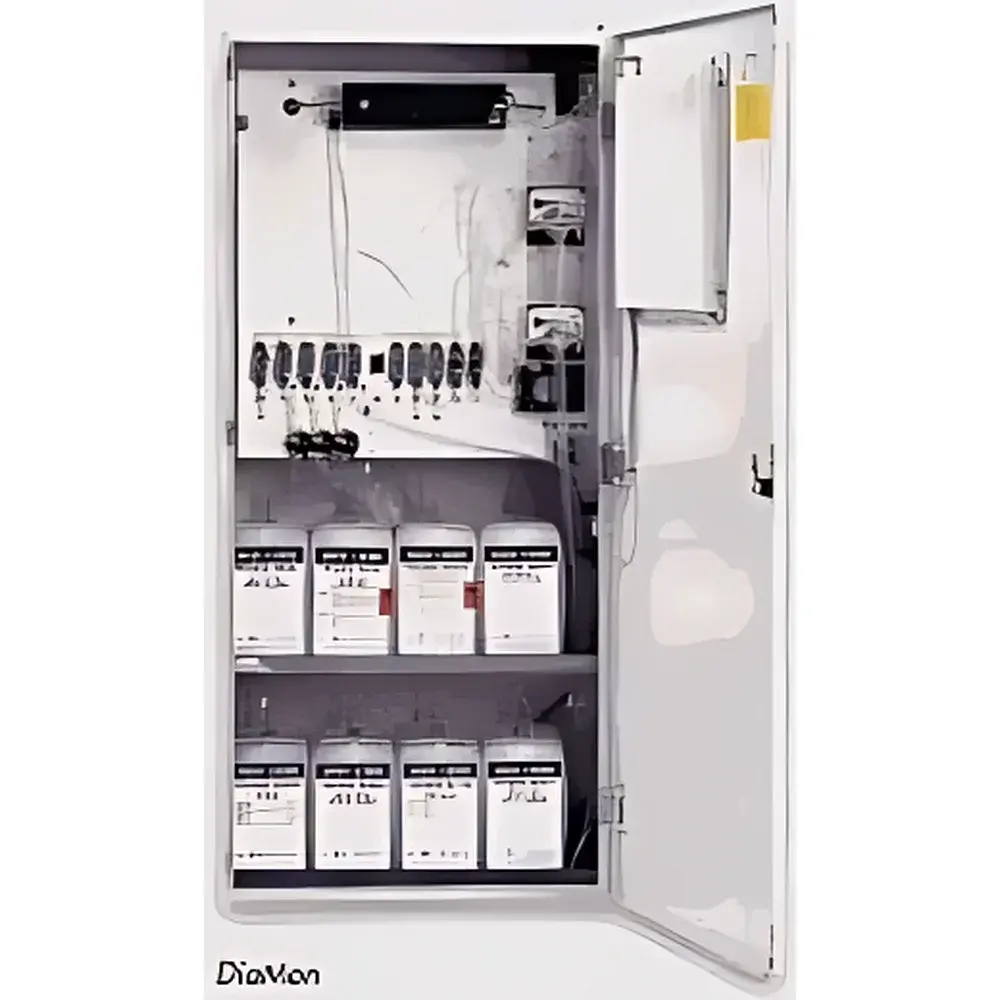
DiaMon Online Water Quality Analyzer
| Origin | Germany |
|---|---|
| Manufacturer Type | Distributor |
| Origin Category | Imported |
| Model | DiaMon |
| Instrument Type | Online Water Quality Analyzer |
| Spectral Range | 250–780 nm |
| Detection Principle | Diode Array Spectrophotometry (UV-Vis) |
| Processor | Intel 586DX @ 133 MHz |
| Memory | 4 MB RAM |
| Data Visualization | Configurable Graphical & Tabular Historical Trends |
| Programmability | User-Defined Scripting Support |
| Compliance Context | Designed for continuous monitoring in compliance with ISO 7027, ASTM D515, EPA Method 353.2, and EU Directive 2000/60/EC (Water Framework Directive) |
Overview
The DiaMon Online Water Quality Analyzer is an industrial-grade, fixed-mount spectrophotometric analyzer engineered for real-time, multi-parameter water quality assessment in municipal drinking water treatment plants, wastewater effluent streams, surface water monitoring stations, and industrial process water loops. It operates on the principle of diode array spectrophotometry (DAS), acquiring full UV-Vis absorption spectra across a calibrated wavelength range of 250–780 nm in a single scan—without mechanical grating movement or wavelength scanning delays. This solid-state optical architecture enables simultaneous quantification of multiple analytes through multivariate spectral deconvolution, eliminating the need for discrete reagent-based wet chemistry modules or sequential single-wavelength measurements. Unlike conventional colorimetric analyzers limited to one or two parameters per instrument, the DiaMon delivers concurrent, interference-compensated results for ammonium nitrogen (NH₄⁺-N), nitrate nitrogen (NO₃⁻-N), nitrite nitrogen (NO₂⁻-N), orthophosphate (PO₄³⁻), total phosphorus (TP), and total nitrogen (TN)—all traceable to NIST-traceable reference standards.
Key Features
- First commercially deployed online analyzer utilizing a fixed diode array detector for continuous UV-Vis spectral acquisition (250–780 nm)
- Embedded Intel 586DX processor (133 MHz) with 4 MB RAM, supporting deterministic real-time data processing and onboard calibration management
- Configurable local storage options: optional 3.5″ floppy drive and/or IDE hard disk for long-term trend archiving and firmware updates
- Intuitive, icon-driven human-machine interface (HMI) with customizable screen layouts and multilingual support (English, German, French, Spanish)
- Open architecture enabling user-defined algorithm scripting in ANSI C-compatible environment for custom calibration models or alarm logic
- Modular optical path design with quartz flow cell (10 mm path length), temperature-stabilized LED array light source, and thermally compensated detector array
Sample Compatibility & Compliance
The DiaMon is validated for use with clarified, low-turbidity aqueous matrices including potable water, tertiary-treated wastewater, river/lake influent, and cooling tower make-up water. It accommodates sample turbidity up to 10 NTU without filtration when equipped with optional integrated auto-cleaning module. All measurement protocols align with internationally recognized standard methods: ammonium nitrogen per ISO 7150-1, nitrate/nitrite per ISO 7890-3 and ASTM D3867, orthophosphate per ISO 6878, and total phosphorus via persulfate digestion per ISO 15681-2. The system supports audit-ready operation under GLP and GMP frameworks, with configurable event logging, user access levels, and electronic signature capability compatible with FDA 21 CFR Part 11 requirements when deployed with certified software extensions.
Software & Data Management
The embedded firmware provides dual-mode visualization: time-series graphical plots (with zoom, pan, and overlay functions) and tabular export in CSV/ASCII format via RS-232, RS-485, or optional Ethernet interface. Historical data retention is configurable from 30 days to 12 months depending on storage configuration. Remote diagnostics and parameter reconfiguration are supported through Modbus RTU/TCP and Profibus DP protocols. Optional PC-based desktop software (DiaMon Studio) enables advanced spectral library management, PLS regression model development, method validation reporting, and integration with SCADA/Historian systems (e.g., Siemens Desigo, Honeywell Experion, ABB Ability). All calibration records, maintenance logs, and spectral raw data files include ISO/IEC 17025-compliant metadata tagging.
Applications
- Real-time optimization of nitrification/denitrification basins in activated sludge plants
- Early detection of nutrient breakthrough in bank filtration or artificial recharge systems
- Compliance monitoring at wastewater discharge points per EU Urban Wastewater Treatment Directive limits
- Source water early warning for algal bloom precursors (e.g., phosphate surges, nitrate anomalies)
- Process control feedback for coagulant dosing in drinking water treatment based on dissolved organic carbon (DOC) surrogate signals
- Long-term trend analysis for watershed nutrient loading studies under national monitoring programs
FAQ
Does the DiaMon require chemical reagents for routine operation?
No—spectral quantification is reagent-free; only periodic optical cleaning and zero/span verification with certified standards are required.
Can the DiaMon be integrated into existing PLC-based control systems?
Yes—it supports native Modbus RTU/TCP and Profibus DP for seamless read/write access to all measured parameters and diagnostic statuses.
What is the recommended calibration frequency for regulatory reporting?
Initial factory calibration is NIST-traceable; field recalibration is advised every 30–90 days depending on matrix stability and regulatory jurisdiction (e.g., monthly for US EPA NPDES reporting).
Is spectral raw data accessible for third-party modeling?
Yes—full 250–780 nm absorbance spectra (1 nm resolution) are exportable in ASCII format for offline chemometric analysis.
How does the system handle variable flow rates or pressure fluctuations?
It requires a stable, laminar flow stream (0.5–2.0 L/min); integration with a precision flow controller or constant-head sampler is recommended for high-variability applications.
Related Products







