
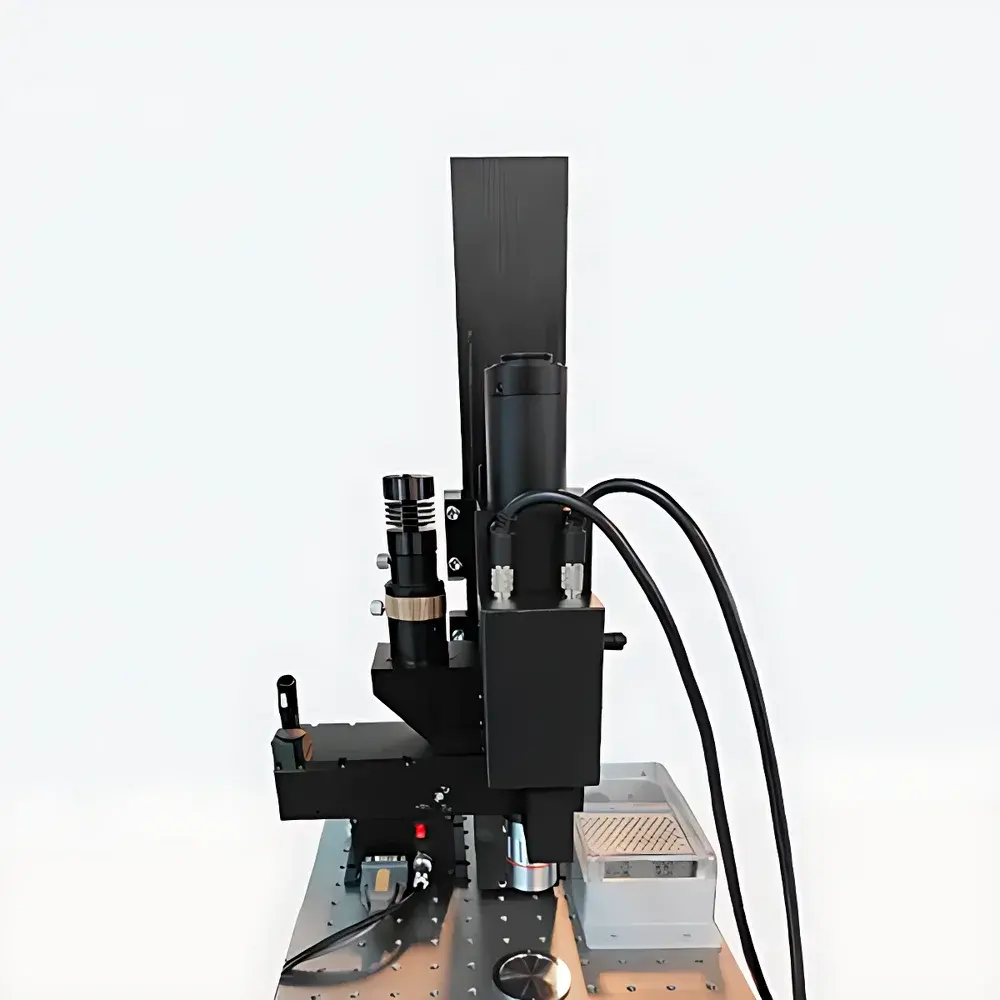
DIC Visual Micro-Strain Measurement System 200X
| Brand | Haytham |
|---|---|
| Origin | Guangdong, China |
| Manufacturer Type | Authorized Distributor |
| Country of Origin | China |
| Model | 200X |
| Pricing | Available Upon Request |
Overview
The DIC Visual Micro-Strain Measurement System 200X is a high-resolution digital image correlation (DIC) platform engineered for full-field, non-contact micro-scale deformation and strain analysis under dynamic mechanical and thermal loading. Leveraging stereo-vision optics with 200× optical magnification and sub-pixel displacement tracking algorithms, the system captures surface deformation patterns by correlating grayscale intensity variations between successive high-speed image frames. Unlike point-based extensometers or strain gauges, this system delivers spatially resolved strain maps (εxx, εyy, γxy) across entire regions of interest—enabling quantitative evaluation of localized yielding, crack initiation, interfacial delamination, and heterogeneous plastic flow. It is specifically designed for integration with universal testing machines (UTMs), environmental chambers, and custom thermal stages to support in situ characterization across extreme temperature ranges—from cryogenic (–190 °C) to elevated (420 °C) conditions.
Key Features
- 200× optical magnification capability with telecentric lens configuration to minimize perspective error and ensure measurement linearity across depth-of-field
- Stereo-DIC architecture with dual synchronized industrial CMOS cameras (≥5 MP resolution, ≥100 fps at full resolution) for robust 3D displacement and strain field reconstruction
- Sub-micron displacement resolution (<0.1 µm) and strain sensitivity down to 20 µε (microstrain) under optimal speckle contrast and illumination stability
- Real-time image acquisition and post-processing workflow compatible with ISO/IEC 17025-aligned validation protocols
- Modular hardware interface supporting TTL synchronization with load cells, thermocouples, and stage position encoders for time-synchronized multi-sensor data fusion
- Thermally stable aluminum-alloy optical bench with passive vibration isolation mounts, suitable for laboratory-grade metrology environments
Sample Compatibility & Compliance
The system accommodates specimens ranging from 0.5 mm to 50 mm in lateral dimension, including brittle ceramics, metallic foils, polymer films, biological fibers, and MEMS-scale components. Surface preparation follows ASTM E837-22 guidelines for speckle pattern application—requiring controlled particle size distribution (typically 2–10 µm diameter), sufficient contrast ratio (>30 dB), and adhesion stability under thermal cycling. All calibration procedures adhere to VDI/VDE 2634 Part 2 standards for optical 3D measuring systems. The platform supports GLP-compliant documentation generation, including audit trails for calibration history, user permissions, and raw image metadata—meeting foundational requirements for FDA 21 CFR Part 11 readiness when deployed in regulated R&D settings.
Software & Data Management
The proprietary analysis suite provides a validated, scriptable environment for DIC computation, strain tensor derivation, and comparative kinematic visualization. It supports batch processing of multi-condition test series (e.g., thermal ramp + tensile hold), automated ROI definition via edge-detection and template matching, and export of calibrated displacement/strain matrices in HDF5 and ASCII formats for third-party finite element model correlation (e.g., Abaqus, ANSYS). Software logs include timestamps synchronized to UTC, operator ID, environmental chamber setpoints, and instrument firmware revision—all retained for ≥10 years per internal data retention policy. Optional API integration enables direct data streaming into LIMS or PLM systems via RESTful endpoints.
Applications
- In situ tensile testing of plant-derived cellulose nanofibrils under ambient humidity control, quantifying anisotropic swelling and fibril reorientation prior to failure
- Cryogenic thermo-mechanical characterization of silicon interposers subjected to thermal shock from 20 °C to –190 °C, identifying brittle fracture onset at –160 °C via strain localization mapping
- High-temperature cyclic deformation analysis of nickel-titanium (NiTi) actuator wires in smartphone haptic modules, capturing reversible phase transformation strains between martensite and austenite phases up to 420 °C
- Mechanical behavior assessment of collagen-based suture threads during uniaxial extension, resolving necking onset and fibrillar sliding mechanisms at sub-100 µm scale
- Interfacial shear strain quantification at polymer–metal interfaces in flexible printed electronics under bending fatigue
FAQ
What is the minimum measurable strain resolution achievable with the 200X system?
Under optimal speckle quality, illumination uniformity, and thermal stability, the system achieves a strain resolution of ≤20 µε for fields of view ≤2 mm × 2 mm.
Can the system be integrated with third-party environmental chambers?
Yes—the system includes standardized mounting flanges and electrical interfaces compliant with ISO 10816-3 for vibration-isolated chamber integration; optical viewport specifications (e.g., CaF2 windows for UV–IR transmission) must be confirmed with chamber OEMs.
Is real-time strain calculation supported during acquisition?
The system performs near-real-time displacement tracking (≤500 ms latency at 50 Hz frame rate), though full strain tensor computation and smoothing are performed post-acquisition to ensure numerical stability and traceability.
Does the software support automated pass/fail criteria based on strain thresholds?
Yes—customizable limit checks can be defined per ROI and exported as CSV reports with timestamped decision flags, aligning with internal QA gate review workflows.
What documentation is provided for IQ/OQ validation?
A complete validation toolkit is supplied, including installation qualification checklists, operational qualification test protocols per VDI/VDE 2634, and uncertainty budget templates compliant with GUM (JCGM 100:2008).



